


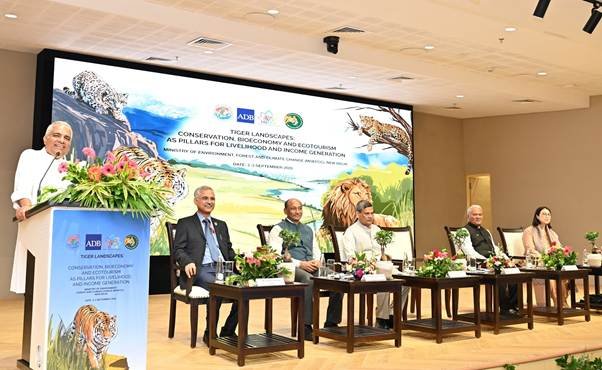
Tiger landscape conservation is emerging as an important approach to balancing ecological protection with sustainable livelihoods. Union Minister for Environment, Forest and Climate Change Bhupender Yadav highlighted this approach while inaugurating a two-day international workshop on tiger landscapes, bioeconomy and ecotourism in New Delhi.
The workshop is being jointly organised by the International Big Cat Alliance (IBCA), Asian Development Bank (ADB) and National Tiger Conservation Authority (NTCA) under the Ministry of Environment, Forest and Climate Change. It is being held on September 2 and 3, 2026.
Tiger Landscape Conservation Focuses on Coexistence
Addressing the inaugural session, Bhupender Yadav said human-nature coexistence should form the foundation of ecological conservation.
He highlighted India’s conservation journey under Project Tiger and stressed that tiger survival depends on healthy forests, grasslands, rivers, prey species, wildlife corridors and local communities.
Tiger landscapes also represent valuable natural capital. They provide ecosystem services such as water security, carbon sequestration, climate regulation, biodiversity conservation and livelihood support.
The Minister called for a shift from species-focused conservation towards integrated landscape management. Such an approach can combine ecological security with socio-economic development.
Conservation, Bioeconomy and Ecotourism
The workshop is examining how conservation, bioeconomy and ecotourism can support sustainable livelihoods and local income generation.
Shri Yadav highlighted the importance of nature-based solutions, innovative financing mechanisms and community-based ecotourism.
He also pointed to the challenges of desertification, declining soil moisture and soil degradation. He said protecting tiger landscapes can support sustainable development while preserving natural resources.
The Minister emphasised the need to recognise the role of local communities in conservation and use their traditional knowledge to support sustainable development.
Tiger Landscape Conservation to Include Traditional Knowledge
Shri Yadav called on participants to explore ways to document and incorporate traditional and indigenous knowledge into policymaking.
He said the workshop should encourage knowledge sharing, capacity building and greater participation of native communities.
The Minister also called for IBCA to help bring together traditional knowledge from countries of the Global South. This knowledge, he said, can contribute to the development of ecological conservation policies.
IBCA and ADB Sign MoU
A key development at the workshop was the signing of a Memorandum of Understanding between IBCA and ADB.
The partnership will strengthen cooperation in landscape conservation, sustainable development, capacity building, knowledge exchange and nature-positive financing initiatives.
Shri Yadav also highlighted the growing role of IBCA as a global platform for cooperation among countries and institutions working to conserve the world’s seven big cat species.
ADB to Support Sustainable Conservation Financing
Mia Oka, Country Director for India at ADB, welcomed the partnership with IBCA.
She noted that 2026 marks 40 years of ADB’s partnership with India. She highlighted India’s experience in ecological conservation and sustainable socio-economic development.
ADB will support greater cooperation among big cat range countries. It will also help explore opportunities for sustainable financing for ecological conservation.
Global Experts Join Tiger Landscape Workshop
The workshop has brought together government representatives and experts from Bangladesh, Bhutan, Cambodia, Malaysia, Nepal and Vietnam.
Participants also include senior officials from MoEFCC, State Forest Departments and tiger reserves, along with development partners, researchers and conservation practitioners.
The workshop provides a platform for sharing conservation experiences and strengthening regional cooperation.
It will also examine innovative approaches to tiger landscape conservation while supporting sustainable development, local livelihoods and long-term ecological security.
Source: PIB