


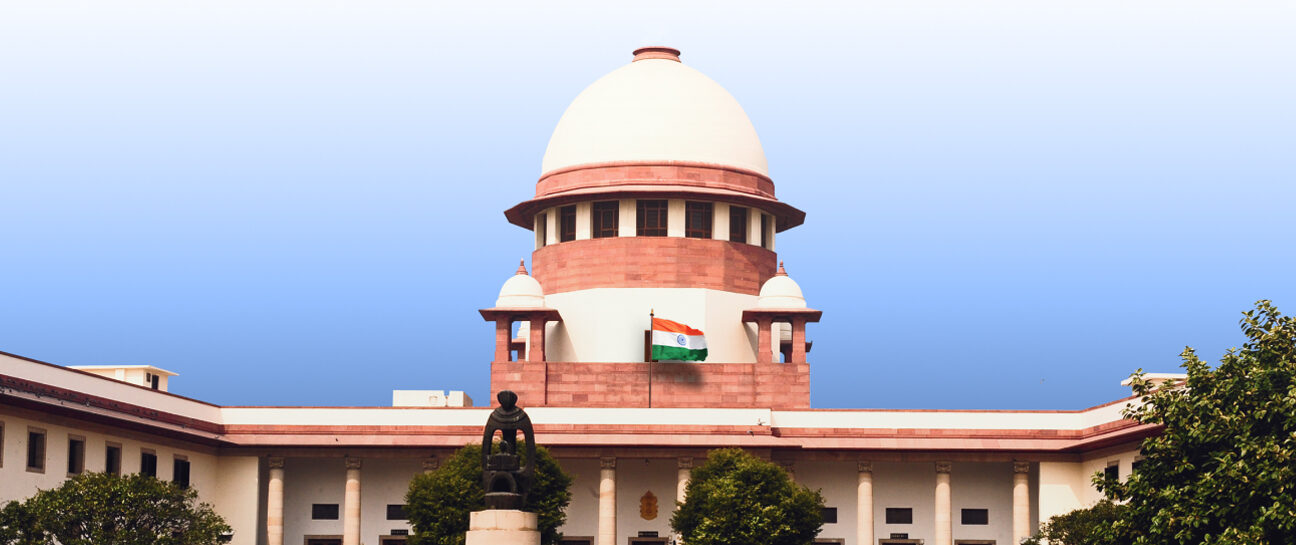
In a historic decision handed down on Wednesday, the Supreme Court established uniform criteria for calculating the income of victims who have passed away in cases involving compensation for motor vehicle accidents. The goal is to guarantee that relatives of victims receive fair and appropriate compensation under the Motor Vehicles Act.
Although Income Tax Returns (ITRs) are still among the most trustworthy statutory measures of income, a Bench of Justices Sanjay Karol and N.K. Singh emphasised that courts should not adhere to a strict or mechanical formula for determining compensation.
The decision was reached while reviewing an appeal lodged by the family of Manoranjan Pandey, who tragically passed away in a May 2018 road accident in Odisha. The disparity in the use of ITRs by different courts to determine compensation in car accident cases was also addressed in the ruling.
The highest court in the land made it clear that, in most cases, paid workers should look at their income tax return from the previous fiscal year. This is because, as the most recent return usually reflects compensation increases, promotions, and amended pay structures.
In cases when an individual’s income tax return (ITR) has not been filed as of yet, the Bench noted that courts have the authority to examine financial documents such as wage records, promotion letters, and others in order to ascertain the appropriate income.
The court, however, took a different tack with regard to sole proprietors and other self-employed people, acknowledging that their income can change as a result of things like market fluctuations, investments, and company cycles.
The ruling states that, for self-employed people, the most common starting point should be the average income shown in their Income Tax Returns for the most recent three years. Additionally, in order to reach a just decision, the court should consider the business’s type, location, development history, expansion plans, capital investments, and any other pertinent business aspects.
Because they may sometimes reveal exaggerated income, the Supreme Court warned judges against hastily approving Income Tax Returns submitted after a claimant’s death or injury. According to the Bench, these returns need to be double-checked with financial accounts and other supporting documentation before they may be trusted.
The Orissa High Court had made a mistake by simply averaging the deceased’s income tax returns without taking into account his expanding construction business, according to the Supreme Court’s application of these principles.
The compensation due to the family was increased from ₹1,87,75,150 by the High Court to ₹1,97,81,505 by the supreme court, which reevaluated the deceased’s yearly income at ₹14 lakh.
The Supreme Court reiterated in two other decisions handed down on the same day that income assessment should be based on the type of occupation or business, not a static mathematical formula, and extended the reformulated principles to other instances involving automobile accident compensation.
According to the Bench, the purpose of compensation under the Motor Vehicles Act is to help the victim’s dependents get back on their feet financially as much as feasible. The court reminded the parties that no amount of money can ever make up for the loss of a loved one, but that compensation should never be excessive or unfair, citing a previous ruling.
Disclaimer: All news articles are sourced through valid sources, and Business Unlimited (BU) doesn’t have any exclusive rights on these pieces. If BU features any exclusive story or article, it will be marked as Exclusive Story.