


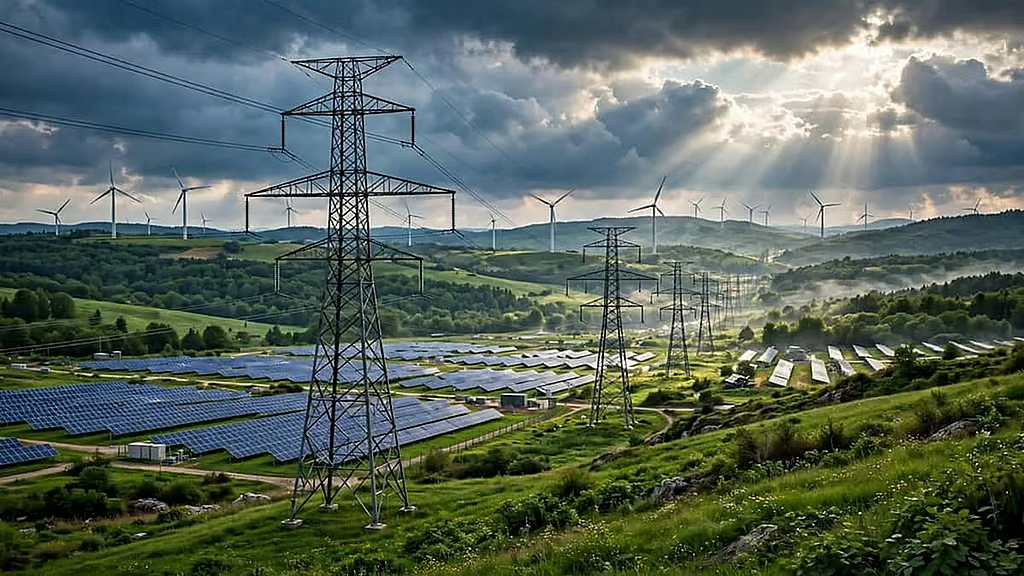
The Union Cabinet has approved the Rs 1.86 lakh crore Green Energy Corridor Phase-III scheme to strengthen state transmission networks and evacuate 135 GW of renewable energy.
The Union Cabinet has approved the Green Energy Corridor Phase-III scheme with an outlay of Rs 1,86,405 crore. The scheme will strengthen state transmission networks and enable the evacuation of up to 135 gigawatts (GW) of renewable energy.
Union Minister Ashwini Vaishnaw announced the decision after the Cabinet meeting. He said the initiative will strengthen the grid and improve renewable energy evacuation.
The scheme has two components. The first is the third phase of the Green Energy Corridor (GEC-III). The second is 50 gigawatt-hours (GWh) of battery energy storage systems (BESS).
The government has allocated Rs 1,36,378 crore for intra-state transmission systems under GEC-III. Another Rs 50,000 crore will support battery storage. The scheme will be implemented by 2032-33.
It will add 51,126 circuit kilometres of transmission lines. It will also create 2,28,903 megavolt-amperes (MVA) of transformation capacity.
“The primary objective of this project is to develop harmonised and accelerated renewable energy access, essentially creating grid connection points, while designing the grid to accommodate the inherent variability of renewable energy sources,” Vaishnaw said.
Green Energy Corridor to strengthen grid capacity
Vaishnaw set out the problem in terms of how a grid behaves. “Consider a grid with a steady current flow… one without significant fluctuations; that would be a very stable grid,” he said. Solar and wind do not supply power that way. “However, if fluctuations are high, for instance, with solar power (available during the day but not at night) or wind energy (which varies by season and even throughout the day), the grid must be designed to handle that variable load. Managing such fluctuations becomes a major challenge,” he said.
Geography adds to the difficulty, because the best renewable sites are often far from demand. “For instance, regions like Ladakh and the Rajasthan desert have the potential to meet a significant portion of the country’s renewable energy needs. To achieve this, it is crucial to properly design the power evacuation infrastructure,” Vaishnaw said.
The government presentation highlights the difference in project timelines. Transmission infrastructure takes about four years to build. A renewable energy project can take about two years.
The Ministry of New and Renewable Energy (MNRE) has set out a clear principle: “transmission must precede renewable energy generation.”
The scheme also aims to reduce renewable energy curtailment. It will help states meet their Renewable Consumption Obligation (RCO).
Another factor is the planned end of the waiver on Inter-State Transmission System (ISTS) charges after June 2028.
Vaishnaw also linked the scheme to India’s renewable energy capacity targets. On the 2030 target of 500 GW of non-fossil capacity, he said: “Given the current growth trajectory, we will definitely achieve the 500 GW target by 2030; furthermore, the plan is to reach 786 GW by 2035-36.”
Rs 54,082 crore Central support for Green Energy Corridor
The Centre will provide Rs 54,082 crore as Central Financial Assistance (CFA) under the scheme.
Of this amount, Rs 45,005 crore will support intra-state transmission. Another Rs 6,000 crore will be provided as viability gap funding (VGF) for battery storage.
The Centre has earmarked Rs 3,050 crore for committed liabilities from earlier phases of the Green Energy Corridor. Another Rs 27 crore will cover programme management and grid studies.
The government expects the Central support to reduce the impact of intra-state transmission costs on consumers.
“The Central Financial Assistance (CFA) will help in offsetting the Intra-State transmission charges and thus keep the power costs down,” its statement said.
MNRE expects the Central funds to leverage around Rs 1.32 lakh crore of investment in transmission infrastructure.
The scheme is also expected to support around Rs 4.6 lakh crore of investment in 135 GW of renewable energy capacity.
50 GWh battery storage to support renewable power
The scheme includes 50 GWh of battery energy storage. The storage capacity will help manage fluctuations in renewable generation.
The government’s statement says the batteries will be placed “at the Renewable Energy (RE) developer/generator end or any other location of importance for grid flexibility to address intermittency, congestion, peak-hour curtailment and meet non-solar hour demand.”
“With battery storage, fluctuations and variations are obviously smoothed out,” Vaishnaw said. He added that storage is only one part of the programme. “Apart from battery storage, the project also encompasses improvements to the grid, transmission systems, and load dispatch centers,” he said.
Green Energy Corridor projects to follow competitive bidding
The scheme has separate mechanisms for new and existing transmission infrastructure.
All new greenfield transmission lines will be awarded through tariff-based competitive bidding (TBCB). Transmission service providers will build, own, operate and maintain these assets under the BOOM model.
Upgrades and strengthening of existing brownfield networks will follow a cost-plus basis.
State transmission utilities (STUs) will serve as the overall implementing agencies.
“Greenfield projects will be taken up, as will brownfield ones,” Vaishnaw said. He described the delivery structure as a joint effort. “So, this is going to be a collaboration involving the Ministry of Power, Power Grid, the state transmission company, and the state government; all of them will have a role in this,” he said.
Funds will not be distributed equally among states. The scheme will use a challenge-mode approach to prioritise states that demonstrate readiness.
MNRE has outlined several readiness parameters. These include compliance with the RCO trajectory, a renewable energy policy and a land compensation mechanism.
States will also need to assess their renewable energy potential and sign memoranda of understanding. Advance action on right-of-way and forest clearances will also count.
Other parameters include rationalised registration fees for renewable energy developers and “efforts by the states for listing of State Transmission Utilities.”
Central funding linked to project milestones
The Centre will release financial assistance against defined project milestones.
A dedicated project monitoring unit will track physical and financial progress through an online dashboard. The Cabinet Secretary will conduct reviews every six months.
The Cabinet has also allowed projects to be shifted within and across states.
Projects in new states can be sanctioned from unallocated funds with the approval of the minister in charge. However, the total support must remain within the approved Central assistance.
MNRE said the Green Energy Corridor scheme will help expand renewable energy development into newer regions. These include the North-East and Himalayan states.
Source: PSU Watch