

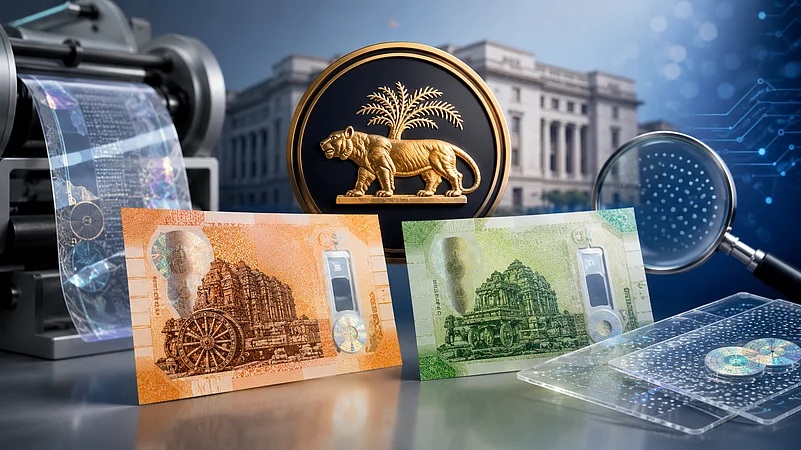
The Indian government has given its approval to the Reserve Bank of India’s (RBI) plan to test polymer notes with denominations of ₹10 and ₹20, according to Monday’s statement from the Finance Ministry to Parliament. Pankaj Chaudhary, India’s Minister of State for Finance, informed the Lok Sabha in a written response that the country’s central bank will test the polymer notes in India to see how well they work. The government has made it clear that this project is not meant to replace paper currency but rather to test the viability of polymer banknotes.
During the field trial phase, the RBI is proposed to issue one billion polymer notes for 10 and one billion polymer notes worth 20. Using a variety of climate and use scenarios in India, the pilot project will test features like circulation performance, public acceptance, handling qualities, and durability. If the experiment yields satisfactory results, a nationwide rollout will be seriously explored. There is no present plan to eliminate traditional currency, the Finance Ministry reaffirmed, and paper and polymer banknotes are anticipated to coexist.
Drawing on lessons learned abroad, the Reserve Bank of India has outlined the benefits of polymer banknotes. Polymer notes are ideal for lower denominations that are circulated and worn frequently since they typically have a longer lifespan than standard paper notes. Reducing the need to print and destroy worn-out notes due to their extended longevity can minimise replacement costs and save waste. Further strengthening the monetary system, polymer substrates allow for the integration of high-tech security features such as see-through windows, specialist security threads, and enhanced anti-counterfeiting technologies.
The Reserve Bank of India (RBI) has warned the government that gauging the effect of polymer notes on electronic payments is premature until the money is in widespread use. Digital payment technologies and physical cash, according to the central bank, are mutually beneficial and will likely remain coexisting in India’s payment ecosystem. With the planned field experiments, India can update its currency management and make its cash circulation system more efficient, secure, and long-lasting.
A major milestone in the evaluation of longer-lasting and safer banknotes has been reached with the approval of trials for ₹10 and ₹20 polymer currency notes. Any wider acceptance will be contingent on the success of the RBI’s field experiments, but the government has made it clear that paper currency will continue in circulation.
Image: Outlook Money