


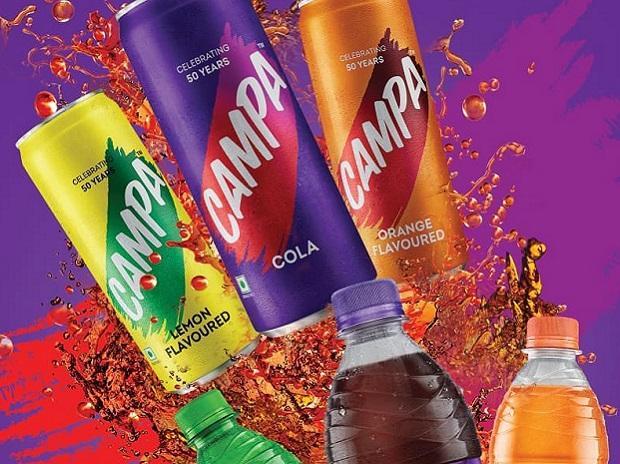
For nearly three decades, India’s carbonated beverage market has run like a settled duopoly. Coca-Cola and PepsiCo, backed by global scale and deep-pocketed local bottlers, controlled roughly 80-85% of a 2.4-billion-case market, leaving little room for challengers. Then Reliance Industries picked up a forgotten 1980s brand for a mere ₹22 crore and, within a few years, turned it into the most disruptive story in Indian FMCG. Here’s what B2B leaders can learn from how Campa Cola did it.
When Reliance Consumer Products (RCPL) acquired Campa Cola in 2022, it wasn’t just acquiring a trademark—it was acquiring decades of dormant brand equity. Campa had been a household name across Indian streets before liberalization in the early 1990s opened the market to Pepsi and Coca-Cola, who systematically out-marketed and out-distributed it into irrelevance. Reliance’s bet was that a generation of Indians who grew up with Campa, plus a younger generation curious about the “comeback,” would give the brand instant recall that a new label never could.
The real strategic signature, though, was pricing—and it borrowed directly from Reliance’s own telecom disruption. When Jio launched in 2016, it flooded the market with free calls and cheap data, a shock strategy that pushed weaker telecom operators out of business entirely and forced even market leader Airtel to restructure its pricing.
Campa applied the same logic to cola. RCPL launched its beverages at roughly half the prevailing price point—a 200ml bottle at ₹10 and a 500ml bottle at ₹20, against Coke and Pepsi’s comparable 600ml bottles priced around ₹40. This wasn’t a modest discount; it was a structural undercut designed to force competitors into an uncomfortable choice: match the price and sacrifice margin, or hold price and lose volume.
The pressure worked. Rivals were compelled to slash prices to stay competitive, even though ₹10 packs are widely acknowledged in the industry as barely profitable, or even loss-making, at scale. That’s a cost global giants can absorb only so long, while Reliance’s balance sheet—and its willingness to treat Campa as a long-horizon strategic investment rather than a quarterly profit center—gives it more room to sustain the squeeze.
Rather than attacking Coca-Cola and PepsiCo head-on in their strongest categories, Campa targeted segments the incumbents had underserved: smaller stock-keeping units, out-of-home consumption, and price-sensitive rural and semi-urban markets. Equity research from JM Financial has noted that Campa’s early traction concentrated in states like Tamil Nadu, Andhra Pradesh, Telangana, Uttar Pradesh, and West Bengal—markets where affordability, not brand loyalty, drives purchase decisions. In the larger home-consumption pack sizes (750ml and 2.25L), where Coca-Cola and PepsiCo still dominate, Campa’s inroads have been far more limited, suggesting the strategy is a wedge rather than a full-frontal assault.
Reliance also leaned on its existing retail and distribution muscle—built over years through Reliance Retail—to get Campa onto shelves fast, and it offered retailers higher margins to prioritize stocking the brand, a lever that matters enormously in a market where trade relationships often decide shelf space.
Distribution and pricing needed a visibility engine, and Reliance found it in cricket. Campa became a pouring partner for IPL franchises, using “strategic timeout” branding and jersey sponsorships to reach a mass audience quickly and cost-effectively, rather than building awareness gradually through conventional advertising.
The numbers suggest the strategy has real teeth. By FY26, Campa was reportedly generating close to ₹4,700 crore in gross sales and had secured double-digit market share in key regional markets, according to Reliance’s own earnings disclosures. RCPL has also committed further capital—reportedly up to ₹8,000 crore—to expand manufacturing and distribution, and is rolling out new formats such as aluminium cans to compete in premium retail and modern trade.
The disruption has also reshaped competitive behavior across the category. Tata has had to rethink its own beverage strategy, and ITC recently entered the cola segment with its own B Natural Coconut Cola, explicitly positioning itself against Coca-Cola, PepsiCo, and Reliance simultaneously—evidence that Campa’s entry has permanently altered the market’s competitive geometry, not just its pricing.
Campa Cola’s rise is a case study in three principles worth stealing: enter through underserved price points rather than direct feature competition, use existing infrastructure (retail, distribution, capital) as an unfair advantage rather than building from zero, and treat market share capture as a multi-year investment rather than a quarterly P&L line. Whether Campa can convert its beachhead into durable, profitable dominance is still an open question—but it has already proven that even the most entrenched global duopolies aren’t immune to a well-capitalized, patient challenger willing to disrupt on price.