


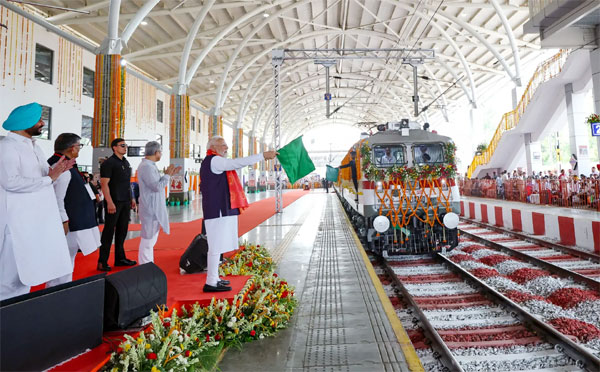
Under its mission-mode program, Indian Railways electrified 99.6 percent of its Broad Gauge network, positioning the country as a global leader in railway electrification. In a written reply to a question in the Lok Sabha on 22 July 2026, Union Minister for Railways, Information & Broadcasting and Electronics & Information Technology Shri Ashwini Vaishnaw revealed that, among countries in the world, India’s railway electrification stands second, behind only Switzerland.
The last ten years have seen a dramatic quickening of the rate of electrification. From 2014 to 26, a total of 48,072 route kilometres were electrified, compared to 21,801 route kilometres electrified nearly sixty years earlier. Additionally, electrification is now being approved for and built into all new railway lines and multi-tracking projects, which will aid in the long-term construction of a rail network that is energy efficient.
In June 2025, the International Union of Railways (UIC) released a report stating that Switzerland, India, China, Spain, Japan, and the UK had all reached 100% railway electrification. Other countries in the top ten were Japan (64%), France (60%) and the United Kingdom (39%). Now that one of the biggest infrastructure transformation programs in a decade has been completed, Indian Railways may be said to be among the most heavily electrified main railway lines in the world.
There have been major operational and environmental benefits to switching to electric traction. Transporting one tonne of freight over one kilometre by rail produces 11.5 grams of CO₂, as opposed to 101 grams by road, making rail travel around 89% cleaner, according to the NITI Aayog paper “Fast Tracking Freight in India” (June 2021). The electrification of railways has many benefits, including increased haulage capacity, faster trains, shorter travel times, and less reliance on foreign fossil fuels.
Because of the change, diesel is no longer used as much on the rail network. Traction diesel consumption fell 185 crore litres, from 293 crore litres in 2015-16 to 108 crore litres in 2024-25. According to the government, this has reduced carbon emissions and helped preserve foreign cash by decreasing gasoline imports.
Indian Railways is increasing its usage of renewable energy to bolster environmentally friendly operations. There were 103 MW of installed wind power capacity and approximately 1,161 MW of solar generating capacity (including ground-mounted and rooftop systems) as of June 2026. With the help of increased finance, improved project monitoring systems, and the Project Monitoring Group (PMG) portal, the remaining electrification work is moving forward under the Mission 100% Electrification plan. Full electrification has been accomplished in most railway zones and in a number of states, including Andhra Pradesh, Bihar, Madhya Pradesh, and Uttar Pradesh. Indian Railways is now in the forefront of sustainable rail infrastructure thanks to this accomplishment.
Image: daijiworld.ap
Disclaimer: All news articles are sourced through valid sources, and Business Unlimited (BU) doesn’t have any exclusive rights on these pieces. If BU features any exclusive story or article, it will be marked as Exclusive Story.