

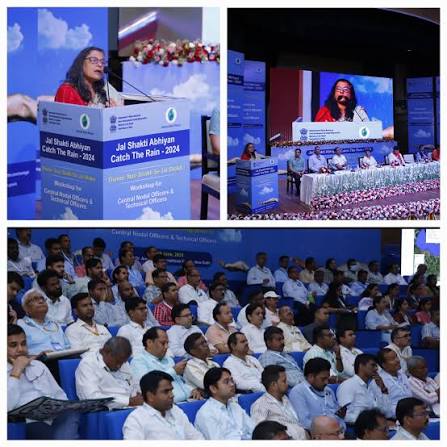
The All India Water Secretaries’ Conference was held in New Delhi by the Ministry of Jal Shakti. Nearly 200 top officials from various states and union territories as well as the Department of Water Resources, River Development & Ganga Rejuvenation were in attendance. The meeting was a great opportunity for the federal government and the individual states of India to discuss and examine their water governance priorities.
Water security is fundamental to India’s economic growth, food security, environmental sustainability, and public welfare, according to Union Minister for Jal Shakti C. R. Patil and Minister of State Raj Bhushan Choudhary, who chaired the conference. In the face of threats from climate change, declining groundwater levels, and fast urbanisation, the gathering discussed ways to better manage the country’s water resources in a scientific and sustainable manner.
The conference revolved around eight main agenda items that needed to be reviewed. These included the following: the Modernisation of Command Area Development and Water Management (M-CADWM) Scheme, the Catch the Rain 2026 campaign, the State Water Reforms Framework, the completion of the Comprehensive Dam Safety Evaluation under the Dam Safety Act, 2021, the progress of irrigation censuses, the framework for Model State Water Awards, and the implementation of dam reservoir rule curves.
The minister echoed Prime Minister Narendra Modi’s call from 28 June 2026 in his Mann Ki Baat address, urging the states and union territories to ramp up the #CatchTheRain 2026 campaign through initiatives like afforestation, community involvement, groundwater recharge, rainwater harvesting, and the restoration of traditional water bodies. In addition, he requested that Water User Associations be fortified, irrigation systems be made more efficient, and project approvals be made simpler in order to speed up flood control and irrigation initiatives.
The Minister unveiled three important publications at the conference with the goal of enhancing water governance and promoting sustainable resource management. Jointly prepared by the National Water Mission and the Central Ground Water Board, these documents comprised the City-level Action Plan for Reuse of Treated Water for Varanasi, the O&M Manual for Artificial Recharge and Ground Water Conservation Structures, and the Schedule of Rates for Drilling and Allied Works Manual, which was prepared by the CGWB to encourage transparency and standardisation.
At the end of the conference, the federal government and the individual states pledged to work together to transform the water sector within a certain time frame and to increase national support for the slogan “Jal Surakshit, Bharat Surakshit.” In his message, Secretary V. L. Kantha Rao expressed gratitude to all the states and union territories that had taken part, and he reiterated that cooperative federalism was crucial to India’s long-term objectives of ensuring water security.In summary,
In order to ensure India’s water security in the future, the government reaffirmed its commitment to IWRM, dam safety, irrigation modernisation, and public involvement at the conference, which paved the path for deeper collaboration between the Centre and the States.
Image: The Statesman
Disclaimer: All news articles are sourced through valid sources, and Business Unlimited (BU) doesn’t have any exclusive rights on these pieces. If BU features any exclusive story or article, it will be marked as Exclusive Story.