


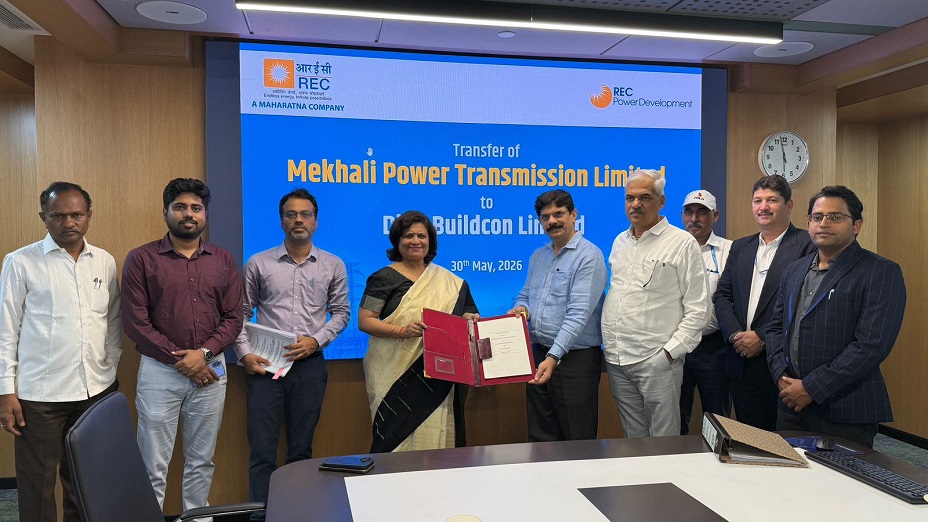
The Ministry of Power’s REC Power Development and Consultancy Limited (RECPDCL), a 100% subsidiary of REC Limited, transferred the InSTS Transmission Project SPV in Karnataka to M/s Resonia Limited on May 30, 2026.
Following Resonia’s successful offer in a Tariff-Based Competitive Bidding (TBCB) procedure overseen by RECPDCL in its role as offer procedure Coordinator, the SPV, Hampapura Power Transmission Limited, was transferred to the business. With a 24-month implementation term, the development will be carried out on a BOOT basis, which stands for Build, Own, Operate & Transfer.
The official handover was performed by Tushar Chhabra, Head (Business Acquisition), Resonia Limited, to Smt. Monisha Barua, GM & HoD, RECPDCL. Notable guests included the KPTCL managing director and several high-ranking officials from both RECPDCL and KPTCL.
A 400 kV double circuit transmission line of about 299 km between Jagalur and Kadakola and a 220 kV double circuit line of about 125 km connecting Hampapura to Nagamangala, Maddur, Tubinakere and Huygonahalli are all part of the plan. The scheme also encompasses the construction of a 400/220/33 kV Gas Insulated Switchgear (GIS) substation at Hampapura. A LILO (line-in-line-out) of the 400 kV DC quad moose line, connecting the Jagalur-Kadakola corridor to the proposed 765/400 kV CN’Halli station, and related civil and electrical works are also part of the project.
The handover, according to RECPDCL, is a major milestone on the road to improved grid reliability and a fortified transmission infrastructure in Karnataka. With the project’s completion scheduled within the 24-month timeline under the BOOT agreement, it will enable power evacuation and system strengthening across the state.
The development and handover of the project-specific SPV were enabled by RECPDCL in its role as Bid Process Coordinator, which involved facilitating competitive bidding and contractual formalities. As per the conditions of the contract, M/s Resonia Limited will now carry out the comprehensive engineering, procurement, construction, commissioning, and operation. Afterwards, the asset will be transferred in accordance with the BOOT model.
During execution, it will be vital for the SPV, the state transmission utility, and regulatory agencies to work closely together to achieve technical, safety, and environmental compliance requirements, according to the officials concerned. In order to quickly extend the transmission network to satisfy increasing demand and integration needs, the central government has been using public-private partnerships, which led to the handover.
Image: T&D india
Disclaimer: All news articles are sourced through valid sources, and Business Unlimited (BU) doesn’t have any exclusive rights on these pieces. If BU features any exclusive story or article, it will be marked as Exclusive Story.