

During his three-day State Visit to the Seychelles, Prime Minister Narendra Modi and President Patrick Herminie paid a visit to the Seychelles National Botanical Garden’s Giant Tortoise Enclosure to commemorate the long-lasting friendship between their countries and the cultural and environmental exchanges that have taken place there.
One of the world’s largest and longest-living terrestrial creatures, the Aldabra Giant Tortoise is native to the Seychelles and represents the country’s abundant biodiversity; Prime Minister Modi emphasised its significance throughout the visit.
The Prime Minister, writing about his encounter on social media, pointed out that Aldabra Giant Tortoises are among the oldest species in the world, having survived for over 200 years.
Also in his memory was the special relationship that existed between the tortoises and India. Two Aldabra Giant Tortoises were donated to Kolkata’s Alipore Zoological Garden in 2014 from the Seychelles. The two nations’ wildlife collaboration was further strengthened after extra tortoises were donated to Hyderabad’s Nehru Zoological Park.
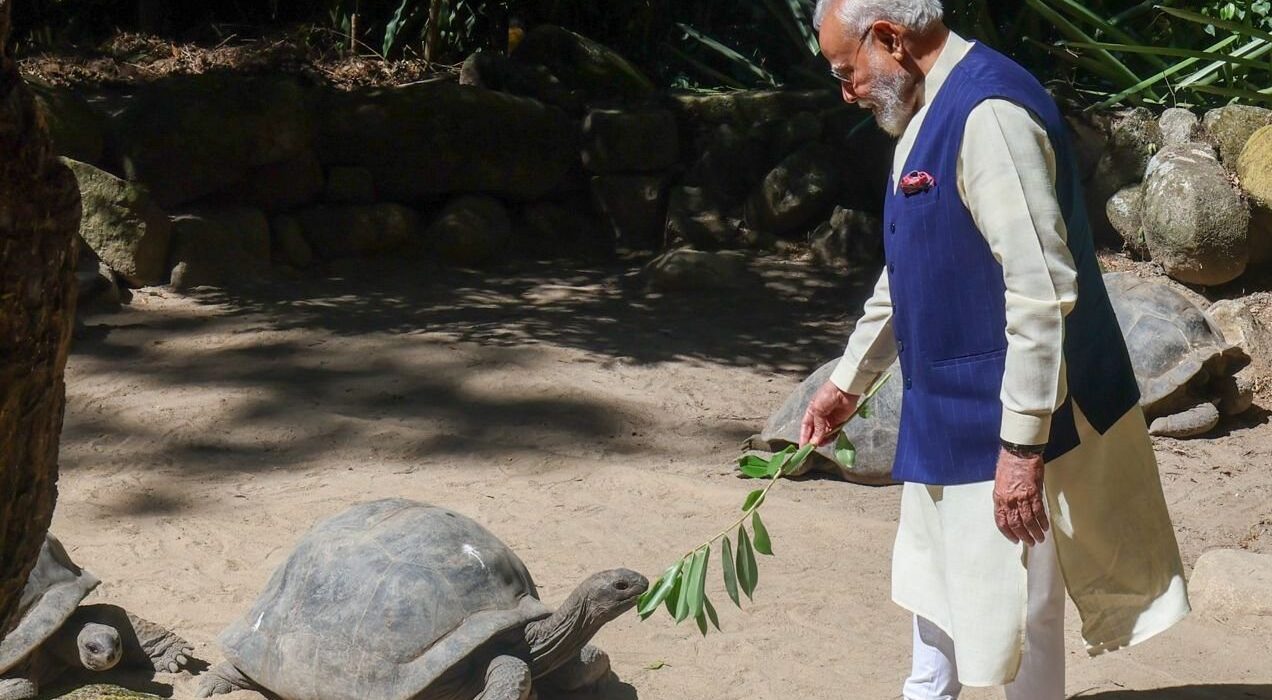
Prime Minister Modi was spotted engaging with and feeding the giant tortoises enthusiastically during his visit to the enclosure. What made the journey even more remarkable was his opportunity to meet Jonathan, a gigantic tortoise believed to be the oldest living land animal at 194 years of age. As part of India’s ‘Ek Ped Maa Ke Naam’ campaign, the two countries planted symbolic trees during the visit to show their solidarity in fighting climate change, protecting the environment, and promoting sustainable development.
The world-renown Coco de Mer palm tree, which Prime Minister Modi and President Herminie planted together, is among the most remarkable and emblematic palm species in the world. Famous for bearing the largest seed and heaviest fruit in the plant kingdom, the Coco de Mer grows naturally only in the Seychelles.
The distinctive palm tree is a powerful emblem of the Seychelles’ natural wealth and cultural identity, and it appears prominently on the national coat of arms.
The plantation, Prime Minister Modi said, stood as a symbol of the two nations’ shared commitment to protecting biodiversity and the environment for the benefit of future generations, and the ceremony was a momentous occasion.
Coco de Mer, he said, is a potent emblem of the Seychelles’ distinctive ecological identity, and the nation’s dedication to protecting its outstanding natural resources is worthy of appreciation. In addition to their extensive collaboration in marine security, climate resilience, sustainable development, and natural resource protection, the plantation ceremony showcased the expanding environmental alliance between Seychelles and India.
In his speech, Prime Minister Modi reiterated the shared goals of his country and India in the fight for environmental protection, biodiversity, and a healthier, more sustainable world.
Along with celebrating the Golden Jubilee of diplomatic relations between India and Seychelles, Prime Minister Modi’s State Visit included a significant cultural and ecological stop at the Botanical Garden.
The meeting further demonstrated India’s unwavering backing for international conservation efforts and reaffirmed the mutual dedication of the two nations to eco-friendly growth and preservation.
Image: DD
Disclaimer: All news articles are sourced through valid sources, and Business Unlimited (BU) doesn’t have any exclusive rights on these pieces. If BU features any exclusive story or article, it will be marked as Exclusive Story.