

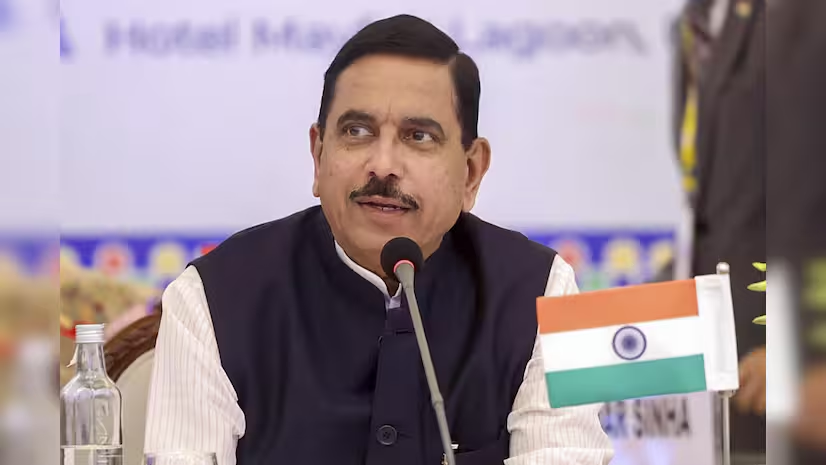
PM-KUSUM 2.0 will enable farmers to generate renewable energy while continuing agricultural activities on the same land, Union Minister for New and Renewable Energy Pralhad Joshi said.
The next phase of the scheme will promote agrivoltaics, which combines solar power generation with crop cultivation. The government is preparing a dedicated agri-PV component to support this model and expand decentralised renewable energy generation in rural areas.
Key Highlights
- PM-KUSUM 2.0 will promote solar power generation alongside farming.
- The next phase will include a dedicated agri-PV component.
- The model will allow farmers to continue cultivation on solarised land.
- Around 29 lakh agricultural pumps have been solarised under PM-KUSUM.
- Decentralised solar contributed 16.3 GW last year.
- The government is seeking more research on crop and climate-specific agrivoltaic models.
PM-KUSUM 2.0 to Promote Agrivoltaics
PM-KUSUM 2.0 will create a new model for decentralised renewable energy generation in rural India, Union Minister Pralhad Joshi said at a curtain-raiser event for the 7th Agrivoltaics World Conference 2026.
The conference is scheduled to take place in New Delhi from October 21 to 23.
Joshi said the next phase of PM-KUSUM will include a dedicated focus on agrivoltaics. The approach will allow farmers to generate electricity while continuing to grow crops on the same land.
The government is also expected to include a dedicated 10 GW agri-PV component in the new phase. The component will promote the co-location of solar panels and crops.
PM-KUSUM 2.0 to Support Farmers and Solar Generation
The agrivoltaic model is aimed at improving land use by combining agricultural production with renewable energy generation.
Joshi said farmers should not have to choose between agriculture and solar power. Solar installations can be designed to allow farming activities to continue below or around the panels.
The approach could provide farmers with an additional source of income while supporting India’s renewable energy goals.
The Minister also highlighted India’s land and farm-size constraints. India accounts for around 18% of the world’s population but only 2.4% of its land area. More than 85% of Indian farmers are small and marginal farmers cultivating less than two hectares.
PM-KUSUM Progress and Solarisation
The government has made significant progress under the existing PM-KUSUM scheme. Joshi said around 29 lakh agricultural pumps have been solarised.
He also said decentralised solar contributed 16.3 GW during the previous year. This included 7.6 GW under PM-KUSUM and 8.7 GW from rooftop solar, largely through the PM Surya Ghar Muft Bijli Yojana.
The PM Surya Ghar scheme has reached around 5.6 million beneficiaries, according to the Minister.
Agrivoltaics Research to Support PM-KUSUM 2.0
The government is also focusing on research to identify the most effective agrivoltaic models for different crops, climates and regions.
Joshi called for greater research into solar structures, panel height, spacing and tracking systems. The objective is to ensure that solar installations do not disrupt farming operations.
He also highlighted the need for structures that allow tractors and harvesters to operate freely. Crop- and region-specific data from institutions such as ICAR, agricultural universities and Krishi Vigyan Kendras will also be important.
Industry Support for Agri-PV Projects
The Indo-German Cooperation on Agrivoltaics (IGCA) has invited proposals from farmers, farmer organisations, renewable energy developers and public institutions.
The proposals will cover technical support, viability gap funding and research instrumentation for existing and planned agrivoltaic projects.
Such support could help develop commercially viable models for combining agriculture with solar generation.
PM-KUSUM to Expand Renewable Energy in Agriculture
The original PM-KUSUM scheme was launched in 2019 to promote renewable energy in agriculture and reduce dependence on conventional energy sources.
The scheme targets the addition of 34,800 MW of solar capacity and aims to support farmers through solar pumps and decentralised solar power generation.
With PM-KUSUM 2.0, the government plans to take the model further by integrating agricultural production with solar power generation.
The new approach could strengthen rural energy security, improve land productivity and create additional opportunities for farmers to participate in India’s renewable energy transition.
Source: Business Standard