

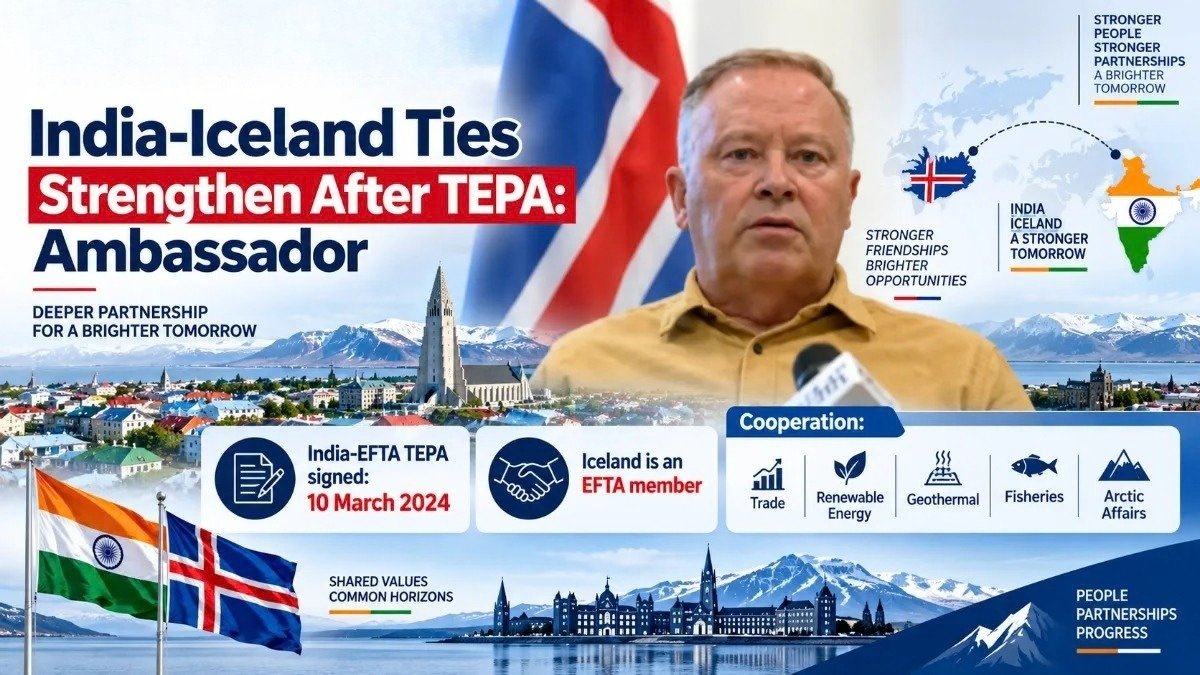
India-Iceland Relations have gained momentum since the India-EFTA Trade and Economic Partnership Agreement (TEPA) came into force in October 2025. Icelandic Ambassador to India Benedikt Höskuldsson said the agreement has created new opportunities for economic cooperation. Tourism, seafood, marine investment and clean technology are among the key areas of interest.
India and EFTA signed TEPA to strengthen trade and economic ties. EFTA comprises Iceland, Switzerland, Norway and Liechtenstein. Höskuldsson said Iceland has been actively promoting the agreement in India.
Iceland has also stepped up its tourism outreach. It has held three tourism workshops in different Indian cities. An event in New Delhi also promoted Icelandic seafood. The Ambassador said these efforts are beginning to generate results. He also pointed to a significant Icelandic investment in India’s marine sector since TEPA took effect.
India-Iceland Relations Expand Into Clean Technology
Iceland sees India as an increasingly important economic partner in Asia. Höskuldsson said India’s growing economy and global role are creating more scope for cooperation. The two countries already work together in areas such as renewable energy, fisheries, science and technology, and Arctic issues.
Climate technology is emerging as another area of interest. Iceland has nearly a century of experience in geothermal energy. Its expertise covers both high-temperature resources used for electricity generation and lower-temperature applications.
Höskuldsson said these technologies could offer opportunities in regions vulnerable to climate change. He specifically pointed to parts of northern India and the Himalayan region.
India-Iceland Relations Focus on Carbon Management
Carbon capture, utilisation and storage (CCUS) is another potential area for cooperation. Iceland has worked on commercial carbon capture technologies for more than two decades. The Ambassador said Icelandic companies and technologies are now being brought to India.
CCUS could help reduce emissions from hard-to-abate industries. These include steel, petrochemicals and cement. Such technologies could support India’s emissions reduction goals while allowing these sectors to continue expanding.
Iceland is also developing technologies that capture carbon and store it underground in basalt rock formations. Another potential application involves combining captured carbon dioxide with hydrogen to produce e-methanol. The fuel could have future applications in aviation.
With TEPA providing a stronger economic framework, India-Iceland Relations are expanding beyond trade. Tourism, marine activities, geothermal energy and carbon management are emerging as areas with potential for deeper bilateral business cooperation.