


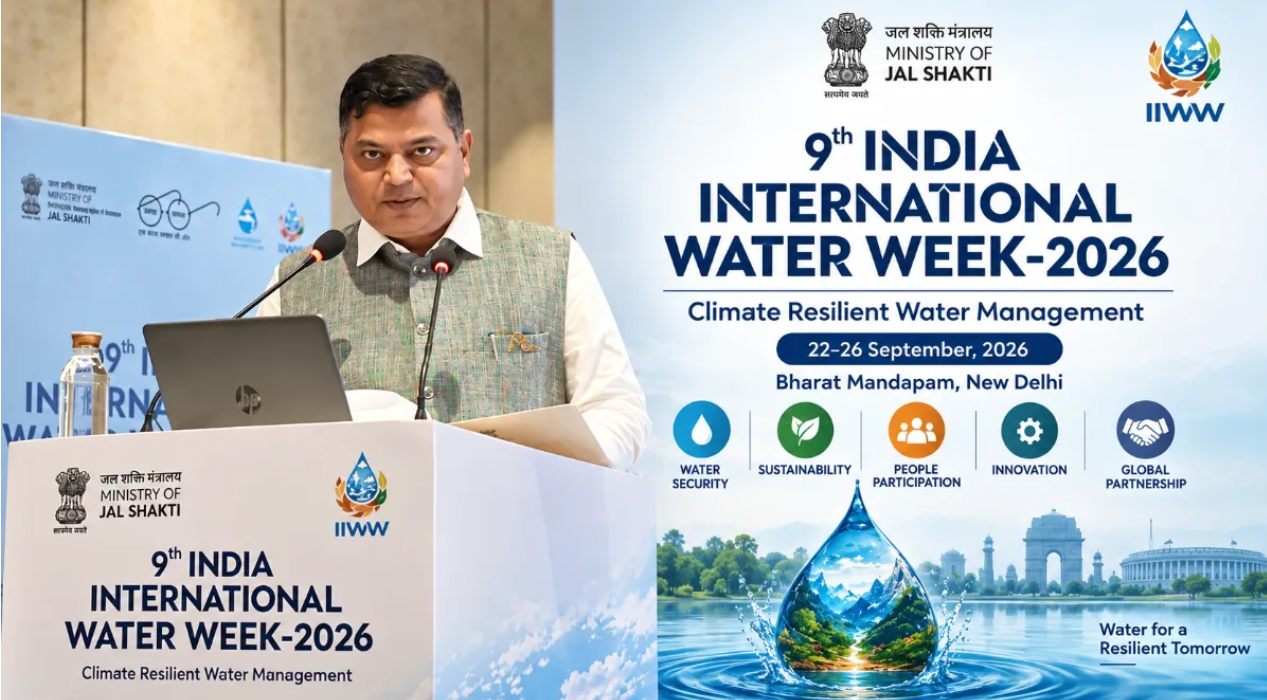
Water Vision 2047 aims to strengthen India’s water security through integrated governance, efficient water use, technology and community participation. Speaking at India International Water Week 2026, Minister of State for Jal Shakti Dr. Raj Bhushan Choudhary outlined the government’s approach to building resilient and inclusive water systems.
The vision forms part of the broader Viksit Bharat @2047 roadmap. It seeks to ensure reliable and sustainable access to water as India moves towards 2047.
Water Vision 2047 Focuses on Integrated Governance
The government has brought surface water, groundwater, drinking water and river health under the Ministry of Jal Shakti. The approach aims to improve coordination across different areas of water management.
India is also using a 5P framework. It covers Political Will, Public Financing, Partnerships, Public Participation and Persuasion for Sustainability. Since water is a state subject, Centre-state cooperation remains important to achieving these goals.
India is also moving towards river-basin-based planning. Dynamic master plans are being prepared for 20 major river basins. The National Water Informatics Centre supports the process through digital hydrological monitoring.
The approach focuses on maintaining both Aviral Dhara, or continuous river flow, and Nirmal Dhara, or clean river flow. The State Water Reform Framework, launched in May 2026, also seeks to promote data-driven water management across states.
Circular Water Use Gains Importance
A circular water economy is a key part of Water Vision 2047. India aims to recycle 50% of urban wastewater by 2030. The target rises to more than 80% by 2047.
Treated wastewater can support thermal power plants and industrial operations. It can also serve non-potable municipal needs and urban green spaces.
Agriculture accounts for more than 80% of India’s freshwater consumption. The government is therefore expanding micro-irrigation through the Pradhan Mantri Krishi Sinchayee Yojana.
Pilot projects under the modified Command Area Development programme are also testing pressurised, piped water systems for farms. The focus is on improving irrigation efficiency and reducing water losses.
Community Participation Supports Conservation
The government is also placing communities at the centre of water conservation. Atal Bhujal Yojana, Mission Amrit Sarovar and Jal Shakti Abhiyan support groundwater management, water-body rejuvenation and conservation.
Under Jal Sanchay Jan Bhagidari, the 3C approach combines Community, CSR and cost-effective execution. The initiative seeks to strengthen groundwater recharge while combining traditional practices with modern infrastructure.
Technology is another focus area. Platforms such as the Bharat Water Innovation Network (Bharat WIN) and the MAHA Water Mission aim to support startups, MSMEs, researchers and technology providers.
These initiatives promote solutions using technologies such as IoT and artificial intelligence. The aim is to develop scalable tools for water management and conservation.
India-Germany Cooperation on Water Security
International partnerships also support India’s water agenda. India-Germany cooperation under the Green and Sustainable Development Partnership includes projects on water security, Ganga rejuvenation and climate adaptation.
Initiatives such as SuWAVi and Support for Ganga Rejuvenation form part of this cooperation. They seek to strengthen technical capacity and support sustainable water management.
Through Water Vision 2047, India is combining policy reform, technology, community participation and international cooperation. The approach aims to build more resilient water systems and strengthen water security by 2047.