

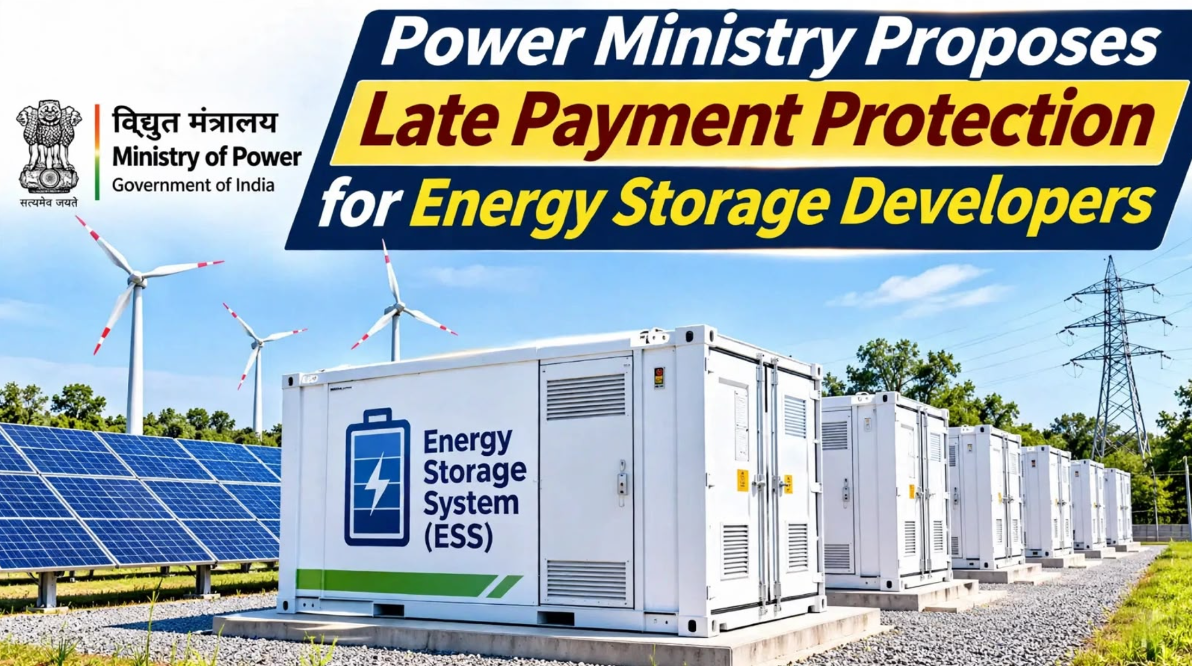
The Ministry of Power has proposed extending late payment protection under the Electricity (Late Payment Surcharge and Related Matters) Rules, 2022, to independent companies operating standalone Energy Storage Systems (ESS). The proposal aims to improve payment security, strengthen investor confidence and encourage investment in India’s expanding energy storage sector.
The ministry has invited stakeholder comments on a draft amendment to the Electricity (Late Payment Surcharge and Related Matters) Rules, 2022, according to a communication issued on Tuesday. The proposed changes seek to provide standalone energy storage service providers with the same protection against delayed payments by electricity distribution companies (DISCOMs) that is currently available to power generation companies, transmission licensees and electricity traders.
According to the explanatory note accompanying the draft, Rule 18 of the Electricity Rules, 2005, permits energy storage systems to be owned by generating companies, transmission companies, DISCOMs, consumers or independent storage companies. Storage facilities owned by generating companies already fall under the existing Late Payment Surcharge (LPS) Rules because they have the legal status of the generator.
However, independent energy storage service providers currently lack equivalent protection when DISCOMs delay payments, leaving them dependent primarily on contractual arrangements.
Draft Amendment to Extend LPS Protection
The proposed amendment seeks to modify Sub-rule (3) of Rule 1 to extend the applicability of the LPS Rules to outstanding dues of generating companies, transmission licensees, electricity trading licensees and energy storage service providers.
It also proposes introducing a definition of an energy storage service provider as an entity providing energy storage as a service or supplying electricity using an Energy Storage System that is not owned by a generating company, transmission licensee, distribution licensee or consumer.
The ministry’s explanatory note states that extending payment protection would provide greater certainty to storage developers and their lenders. This could attract additional investment, reduce financing costs and eventually lower the overall cost of energy storage projects.
The proposed amendment will not impose any new charge on DISCOMs that make payments on time. The late payment surcharge would continue to apply only when electricity bills are paid beyond the prescribed due date.
Existing Late Payment Rules and DISCOM Penalties
Under the existing LPS Rules, payments must be made by the due date specified in the power purchase agreement or within 45 days of presentation of the bill if the agreement does not specify a payment period.
Interest on delayed payments starts at the State Bank of India’s one-year lending rate plus five percentage points. It increases by 0.5 percentage points for every month of delay, subject to a maximum of three percentage points above the initial rate.
DISCOMs are also required to maintain a Letter of Credit (LC) as payment security.
The rules provide additional consequences for continued payment defaults. A DISCOM can be restricted from purchasing electricity in the short-term market and through power exchanges if a bill remains unpaid two-and-a-half months after presentation. Long-term power supply can also be progressively regulated if outstanding dues remain unpaid. Normal access is restored within one day after payment.
Energy Storage Capacity Set for Major Expansion
The proposed amendment comes as India prepares for a substantial expansion of energy storage infrastructure to support its growing renewable energy capacity.
Energy storage systems retain electricity when generation is high, such as during peak solar production hours at midday, and supply it when demand rises, particularly during evening peaks. The explanatory note highlights that storage will become increasingly important for ensuring reliable round-the-clock electricity supply as the share of solar and wind power increases.
India’s Battery Energy Storage System (BESS) capacity is projected to increase from around 15 GWh in October 2026 to 321 GWh by 2035-36. Meanwhile, Pumped Hydro Storage (PSP) capacity is expected to grow from 44 GWh in September 2026 to 630 GWh over the same period.
The ministry has noted that investments on this scale will require an assured and timely payment mechanism for energy storage developers. Extending LPS protection to independent providers is intended to address this requirement and strengthen the investment environment for the sector.
The proposed amendment to the LPS Rules could strengthen payment security for independent energy storage developers and improve confidence among investors and lenders. As India expands battery and pumped hydro storage to support renewable energy integration, a more reliable payment framework could play an important role in attracting investment and strengthening electricity supply reliability.