

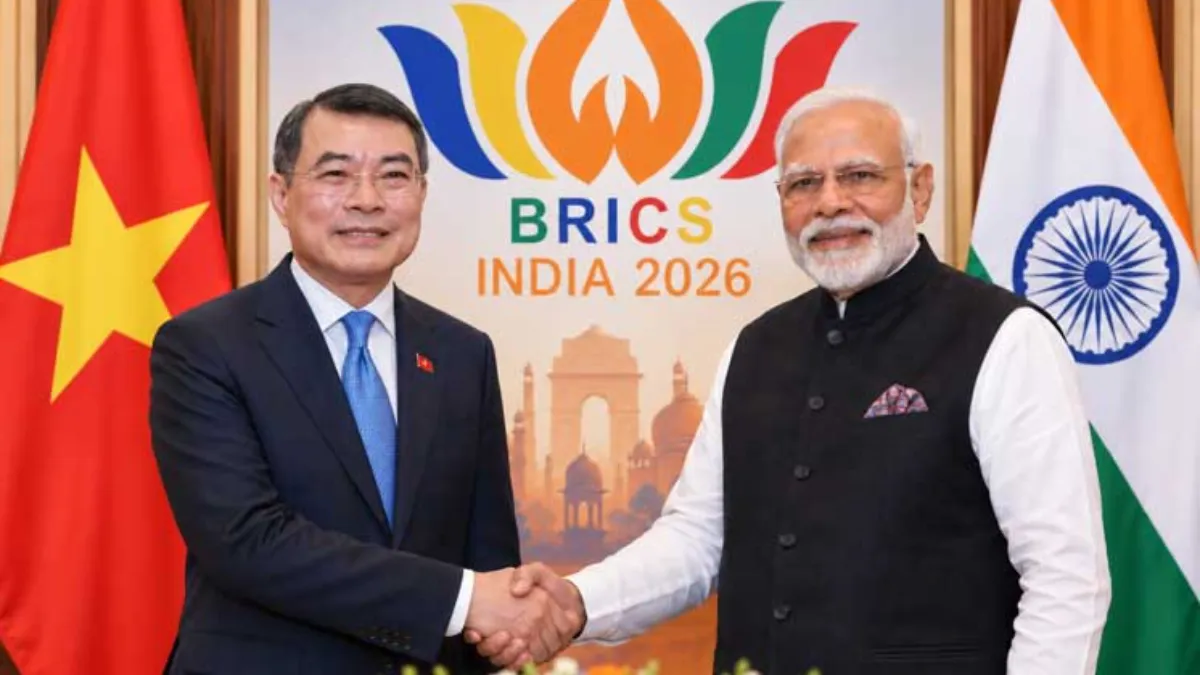
Vietnam–India relations are set to gain fresh momentum as Vietnamese Prime Minister Le Minh Hung is expected to visit India and attend the BRICS Summit in New Delhi on September 12–13, 2026. The visit, at the invitation of India as BRICS Chair for 2026, will be his first visit to India as Prime Minister.
The visit comes as Vietnam and India mark 10 years of their Comprehensive Strategic Partnership, adding significance to an already expanding relationship. It also provides an opportunity for both countries to strengthen cooperation across ASEAN, South Asia, the Indo-Pacific and the wider Global South.
Vietnam India Relations Enter a New Strategic Phase
Vietnam and India established their Comprehensive Strategic Partnership on September 3, 2016, during Prime Minister Narendra Modi’s official visit to Vietnam. The partnership built on decades of friendship between the two countries and their leaders.
A decade later, the strategic importance of the relationship has grown significantly. India views Vietnam as an important partner under its Act East Policy, Indo-Pacific vision and engagement with ASEAN. For Vietnam, India is a major Asian economy, a Comprehensive Strategic Partner and an important gateway to South Asia and the wider Global South.
Fresh momentum came during the State visit of General Secretary and President To Lam to India from May 5–7, 2026. During the visit, the two countries agreed to elevate their relationship to an Enhanced Comprehensive Strategic Partnership, guided by the principles of “Shared Vision, Strategic Convergence and Substantive Cooperation.”
Against this backdrop, BRICS 2026 offers a wider platform for the two countries to translate their growing strategic convergence into multilateral cooperation.
BRICS 2026 Creates New Space for Vietnam
Vietnam’s participation in the BRICS Summit is significant as the country has become a BRICS Partner Country and continues to expand its engagement with multilateral mechanisms.
The BRICS Summit takes place amid geopolitical competition, supply-chain disruptions, energy uncertainty, technological fragmentation and unequal access to finance and development resources. Developing economies are also seeking a greater role in shaping international institutions and global rules.
For Vietnam, engagement with BRICS adds another channel to pursue its longstanding foreign-policy priorities of independence, self-reliance, diversification, multilateralisation and comprehensive international integration.
BRICS does not replace Vietnam’s existing partnerships. Instead, it provides another platform for Hanoi to strengthen relations with emerging economies and participate in discussions on global development and governance.
Vietnam’s position as an active ASEAN member and host of APEC 2027 also gives it an opportunity to strengthen connections between BRICS and the wider Asia-Pacific region. Potential areas include supply chains, energy, logistics, green transition, science and technology, innovation and human-resource development.
Vietnam has consistently supported stronger South-South cooperation and North-South dialogue. These priorities also align closely with India’s efforts to strengthen the representation and voice of developing economies in global affairs.
Vietnam India Relations Gain Economic and Strategic Depth
The last decade has witnessed substantial growth in bilateral economic ties.
Bilateral trade increased from US$5.43 billion in 2016 to US$16.46 billion in 2025. During the first seven months of 2026, bilateral trade reached US$11.78 billion.
India is currently Vietnam’s eighth-largest trading partner, while Vietnam is India’s 21st-largest trading partner and its fourth-largest partner within ASEAN.
Investment ties have also expanded. As of March 2026, India had 503 valid investment projects in Vietnam, with total registered capital of US$1.117 billion. Vietnam had 30 investment projects in India with total capital of nearly US$150.5 million.
Connectivity and people-to-people exchanges have also strengthened. The two countries now have around 80 direct flights a week, while Vietnam welcomed nearly 800,000 Indian visitors in 2025, around four times the 2019 figure.
Defence and security remain important pillars of the partnership, while science and technology, energy and emerging technologies are gaining greater prominence.
Vietnam and India Can Build an ASEAN–South Asia Bridge
The strategic importance of Vietnam India relations extends beyond bilateral trade and investment.
Vietnam occupies a key position in Southeast Asia and is deeply integrated into ASEAN production networks and global supply chains. India, with its large market, technological capabilities and geoeconomic position, offers Vietnam an important gateway to South Asia and other developing economies.
This creates potential for both countries to strengthen connectivity between ASEAN and South Asia, and between the Indian and Pacific Oceans.
The strategic convergence was reaffirmed on August 26, when Prime Minister Le Minh Hung met Indian Minister of State for External Affairs Pabitra Margherita during the latter’s visit to Vietnam.
Le Minh Hung expressed Vietnam’s support for India’s growing international role, including its leadership as BRICS Chair in 2026. Margherita highlighted Vietnam’s importance to India’s Act East Policy, Indo-Pacific vision and ASEAN engagement.
Both countries also share ambitious development goals. Vietnam aims to become a developed country by 2045, while India has set a target of achieving developed-country status by 2047.
The elevation of bilateral ties to an Enhanced Comprehensive Strategic Partnership provides a framework for both countries to support these long-term development objectives.
Trade, Technology and Connectivity to Drive the Next Phase
The two countries have agreed to address market-access challenges, work towards the US$25 billion bilateral trade target and seek to double two-way investment.
Technology, infrastructure, energy and pharmaceuticals are among the areas where Vietnam is encouraging greater Indian investment. Cooperation in science and technology and high-quality human-resource development is also expected to become increasingly important.
The two countries are also exploring stronger air connectivity to support growing demand for tourism, business and people-to-people exchanges.
The next phase of Vietnam India relations will therefore depend on converting political trust into tangible economic, technological and developmental outcomes.
A New Chapter for Vietnam–India Relations
Prime Minister Le Minh Hung’s first visit to India comes at a significant point in the evolution of bilateral relations. It follows the elevation of ties to an Enhanced Comprehensive Strategic Partnership and coincides with the 10th anniversary of the original Comprehensive Strategic Partnership.
His participation in BRICS 2026 adds a broader multilateral dimension to the visit.
For Vietnam, BRICS provides an opportunity to expand its foreign-policy space, strengthen engagement with emerging economies and contribute to discussions affecting developing countries.
For India, Vietnam’s participation can support New Delhi’s efforts to deepen BRICS cooperation and strengthen the voice of the Global South. Vietnam’s ASEAN position, regional supply-chain integration and multilateral experience can also help strengthen India’s engagement with Southeast Asia and the wider Asia-Pacific.
The relationship therefore has the potential to evolve from a strong bilateral partnership into a wider platform for regional cooperation.
Areas such as trade and investment, logistics, air and maritime connectivity, defence and security, energy, critical minerals, artificial intelligence, semiconductors, digital transformation and education could become key drivers of the next phase.
The two countries can also explore stronger cooperation between the Indo-Pacific Oceans Initiative (IPOI) and the ASEAN Outlook on the Indo-Pacific (AOIP), while promoting ASEAN–South Asia connectivity and South-South cooperation.
Ten years after establishing their Comprehensive Strategic Partnership, Vietnam India relations are entering a new phase. BRICS 2026 provides an opportunity for both countries to move from strategic convergence towards joint action and wider regional cooperation.
A stronger Vietnam–India partnership can advance the development priorities of both countries while strengthening links between ASEAN and South Asia, the Indian and Pacific Oceans, and the wider Global South.
Source: Sarkaritel