

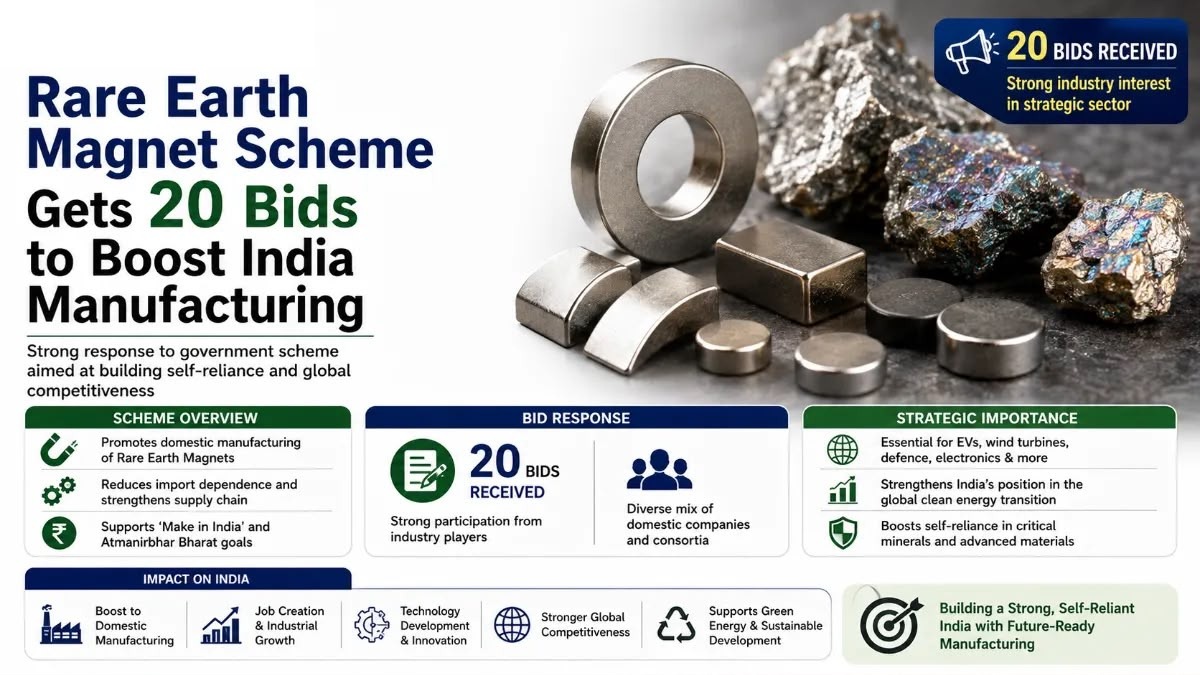
The Centre has received 20 bids in response to a global tender to establish integrated Sintered Rare Earth Permanent Magnet (REPM) manufacturing facilities in India. The scheme targets 6,000 MTPA of domestic capacity through five beneficiaries, with each eligible for up to 1,200 MTPA. Backed by a Rs 7,280 -crore financial outlay, the initiative aims to reduce dependence on imports and strengthen supply chains for electric vehicles, defence, electronics and renewable energy
Rare Earth Magnet Manufacturing Capacity
The Ministry of Heavy Industries (MHI) has received 20 bids to select manufacturers for integrated REPM facilities under the Scheme to Promote Manufacturing of Sintered Rare Earth Permanent Magnets.
The initiative seeks to establish 6,000 Metric Tonnes Per Annum (MTPA) of integrated REPM manufacturing capacity in India. Five beneficiaries will be selected through a global competitive bidding process. Each beneficiary can establish up to 1,200 MTPA of capacity.
The scheme will run for seven years, including a two-year gestation period for setting up facilities and five years of incentive disbursement linked to REPM sales.
Supporting Strategic Manufacturing Sectors
Rare earth permanent magnets are critical components for several high-growth and strategic industries. These include electric vehicles, wind turbines, advanced electronics, aerospace and defence systems.
The government aims to develop an integrated domestic value chain covering NdPr oxide to finished magnets. This is expected to reduce import dependence and improve supply security for industries that rely on rare earth materials.
Rs 7,280 Crore Scheme
The Union Cabinet approved the scheme in November 2025 with a financial outlay of Rs 7,280 crore.
The Request for Proposal (RFP) was floated on the Central Public Procurement Portal on March 20, 2026. The submission deadline was August 12, with technical bids opened on August 13.
The receipt of 20 bids marks a key step in building India’s domestic rare earth magnet manufacturing capacity. The initiative is also expected to strengthen critical mineral supply chains and support the country’s broader manufacturing ecosystem.