

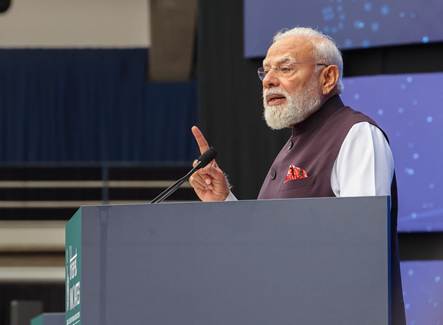
While distributing incentives worth Rs 2,400 crore to support 15 lakh new jobs, Prime Minister Narendra Modi announced on Friday that the Pradhan Mantri Viksit Bharat Rozgar Yojana (PM-VBRY) had so far employed over 70 lakh individuals nationwide.
Last August, the government unveiled its centrepiece employment-linked incentive program, which aims to assist first-time job searchers and broaden social security coverage in all industries. As an incentive to help create 15 lakh jobs, Modi deposited 2,400 crore rupees into the bank accounts of eligible beneficiaries using the direct benefit transfer option during a ceremony here.
As part of his presentation on the program’s successes, Modi mentioned that 70 lakh new jobs have been created and that an equal number of first-time employees are now covered by social security.
In addition, he mentioned that about 20,000 young people have been in their first occupations for six months, and that approximately 10,000 recipients have already earned rewards from the program for reaching this milestone.
Modi claims that the aid goes beyond mere financial backing; it is a symbol of the nation’s admiration for the efforts of its young people and its faith in their potential.When young people, businesses, and the government all pitch in, job creation takes off. “This program exemplifies a new India where chances are provided to young people, industries are supported, and creating jobs is a national priority,” Modi stated. “The Viksit Bharat Rozgar Yojana, which the prime minister launched, is about a lot more than just creating jobs. “It is an initiative that aims to build a strong connection between industry and the workforce and to inspire young people as they start their careers,” Modi said.
While most programs only help businesses or their employees, he noticed that this one did the opposite.
Also, he mentioned that the government is on the side of young people as they start their careers and is supportive of organisations that generate job possibilities.
“The government has worked to strengthen every pathway to employment over the past twelve years,” Modi emphasised.There have been major initiatives in many different fields, including innovation and infrastructure, industry, the internet economy, space technology, and startups. “Make in India,” “Vocal for Local,” “Mission Manufacturing,” and other programs have opened up more opportunities for employment and self-employment,” Modi stated.
According to the prime minister, the government is making great strides in ensuring that workers feel secure, respected, and protected in their jobs. They are also using technology to update the Employees’ Provident Fund Organisation (EPFO), streamline pension systems, and increase the number of workers who have access to affordable health insurance and healthcare. “The same philosophy guides labour reforms undertaken by the government.”
The prime minister also spoke on how women are playing an increasingly important role in India’s progress in economics and society.Modi emphasised that reforms on night-shift employment, work-from-home opportunities, and workplace safety measures are all aimed at increasing women’s job participation.
Furthermore, he stressed that quality, innovation, and talented people are the three most important factors in deciding economic success in the 21st century.
India possesses extraordinary potential in all three of these areas, and he claims that nations with these capabilities will attract the biggest chances.
India had unparalleled capabilities in these three areas, he added, and the prospects of the 21st century would go to nations that cultivate talented individuals, encourage innovation, and maintain the highest quality standards.
Mansukh Mandaviya, the Union Minister for Labour and Employment, brought attention to the fact that, compared to the 2.9 crore employment created in the ten years prior to 2014, approximately 17 crore jobs were created between 2014 and 2024.
According to Mandaviya, the employment elasticity in India was 1.11 from 2017 to 2023, which means that for every 1% growth in GDP, there was a 1.11 percent gain in employment. This is in contrast to the employment elasticity of 0.008 recorded under previous administrations.
Additionally, he brought up the fact that India’s unemployment rate has been falling, and is currently at about 3.1%, which is lower than the world average of 4.8%.
With the goal of encouraging formal employment and providing incentives for job creation, PM-VBRY went into effect on August 1, 2025.
Image: PIB
Disclaimer: All news articles are sourced through valid sources, and Business Unlimited (BU) doesn’t have any exclusive rights on these pieces. If BU features any exclusive story or article, it will be marked as Exclusive Story.