


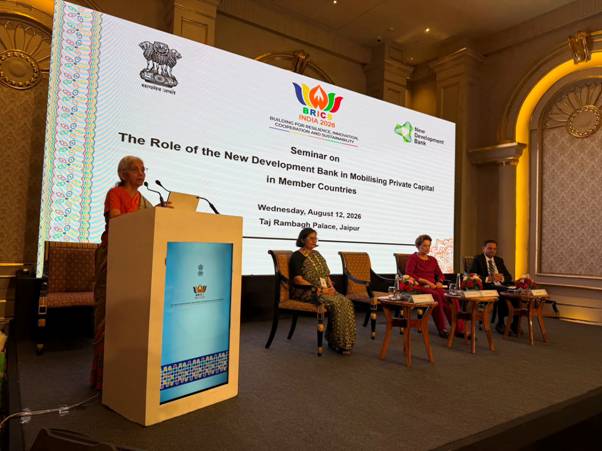
BRICS private capital mobilization needs stronger frameworks, greater investor confidence and deeper public-private partnerships, Union Finance Minister Nirmala Sitharaman said at a seminar in Jaipur. She highlighted the role of multilateral development banks in reducing investment risks and making projects more attractive to private investors.
Sitharaman delivered the keynote address at a seminar on the “Role of the New Development Bank in mobilizing Private Capital in Member Countries”. The event was held on the sidelines of the BRICS Finance Ministers’ and Central Bank Governors’ Meeting in Jaipur.
BRICS Private Capital Needs Stronger Investment Frameworks
The Finance Minister said multilateral development banks can help de-risk investments and improve project bank ability. They can also strengthen investor confidence and support private capital mobilization at scale.
She noted that BRICS economies remain major growth engines of the global economy. However, member countries face common challenges in attracting private capital at scale.
According to Sitharaman, the issue is not only the availability of capital. Investors also need confidence, stability, predictability and credible long-term frameworks. These factors are critical for sustained private-sector participation.
H.E. Dilma Rousseff delivered a special address at the seminar. Economic Affairs Secretary Anuradha Thakur and FICCI Senior Vice President Vijay Sankar also participated.
India Uses Public Capital to Crowd In Private Investment
Sitharaman highlighted India’s experience in using public investment to strengthen infrastructure and create conditions for private-sector participation.
She said the government has increased public capital expenditure significantly over the past decade. The investment has supported infrastructure across highways, railways, ports, logistics, digital networks and energy systems.
The government’s approach is to use public capital as a catalyst rather than a substitute for private investment. Several policy measures have been introduced to support this objective.
These include Viability Gap Funding for financially constrained but socially important projects. The Hybrid Annuity Model has also been used to support balanced risk-sharing in road infrastructure.
The government has further introduced credit enhancement mechanisms to improve project bank ability. Infrastructure Investment Trusts (InvITs) help recycle capital and attract long-term institutional investors.
The National Infrastructure Pipeline provides investors with greater visibility on infrastructure opportunities. PM Gati Shakti, meanwhile, aims to improve coordination and efficiency across multimodal infrastructure projects.
BRICS Private Capital Gets New Infrastructure Opportunities
Sitharaman also highlighted measures announced in the Union Budget 2026-27 to encourage private investment.
These include new Dedicated Freight Corridors and High-Speed Rail Corridors. The government has also announced plans to operationalise new National Waterways and introduce a Coastal Cargo Promotion Scheme.
The measures are aimed at expanding infrastructure capacity and creating additional opportunities for private investors.
For businesses and institutional investors, the focus on long-term infrastructure projects could open opportunities across transport, logistics, energy and related sectors.
Development Finance Needs Public-Private Partnership
Sitharaman said the future of development finance will depend on partnerships between multilateral institutions, governments and the private sector.
Each stakeholder brings a different set of capabilities. Governments can provide policy support and public capital. Multilateral institutions can help reduce risks and strengthen project structures. Private investors can bring capital, technology and operational expertise.
Economic Affairs Secretary Anuradha Thakur said the seminar was timely as development finance enters a phase where scale must be matched with resilience.
She said capital mobilization cannot depend only on favourable market conditions. It needs durable frameworks that can provide stability over the long term. Multilateral cooperation can play an important role in strengthening these frameworks.
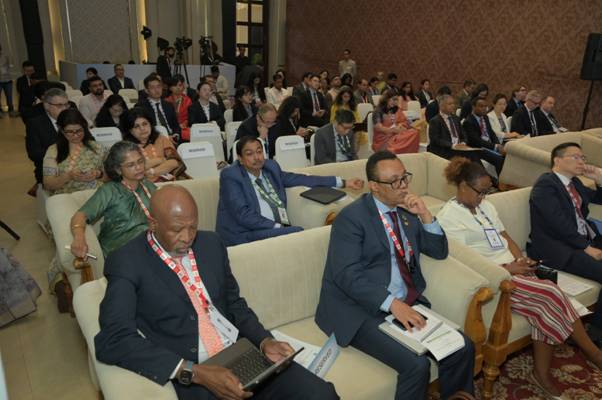
The seminar brought together senior policymakers, multilateral institutions and private-sector leaders. A panel discussion followed the keynote address, with participation from representatives of IRDAI, the New Development Bank, Sertrading, Tencent, Tata Capital Decarbonisation Fund and other BRICS institutions, financial organisations, think tanks and academic bodies.
The discussions focused on ways to improve project bank ability, strengthen investment frameworks and mobilise private capital for development across BRICS economies.