


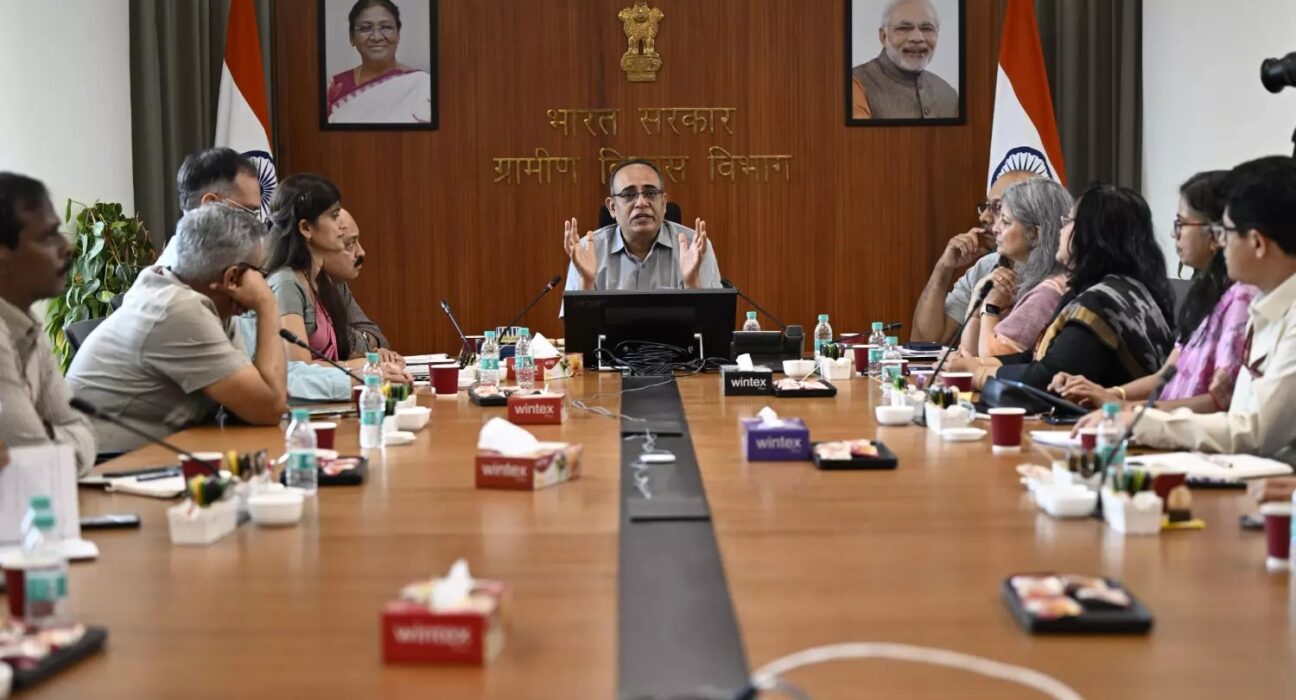
Before the Viksit Bharat-Guarantee for Rozgar and Ajeevika Mission (Gramin) (VB-G RAM G) Act, 2025 goes nationwide on July 1, 2026, the Indian government has announced the deployment of over 100 area officers across the country. This is a major step toward ensuring the Act’s successful implementation.
The Ministry of Rural Development states that throughout the crucial implementation phase, the area officers will act as facilitators and resource persons. To ensure the new framework is effectively operationalised, they will collaborate closely with state governments, union territory administrations, district authorities, and field-level officials.
The officers will assist with resolving operational difficulties that may develop during the transition, bolstering local capacities, promoting knowledge sharing, and supporting implementation efforts, according to the ministry. For the Act’s goals to be effectively implemented at the community level, their role is vital.
Area officers are expected to work closely with district officials and field personnel to determine what is needed for implementation, help share experiences and best practices, back training and capacity-building initiatives, and get rid of operational bottlenecks. The numerous parties participating in the implementation process are anticipated to enhance their coordination through this collaborative approach.
To help states and union territories move more smoothly to the new rural employment and livelihood framework, the government has highlighted the initiative’s goal of providing institutional handholding and continual support.
Positive developments have been noted in the preparations for implementation. A total of twenty-seven states and territories have allocated funds to carry out the Act’s requirements, according to the Ministry of Rural Development. Furthermore, six union territories and states have announced their State Schemes under the VB-G RAM G structure.
There is widespread preparation for the statewide deployment, as the remaining states and union territories are currently finishing their implementation plans and scheme notifications.
By expanding beyond conventional methods of creating jobs, the VB-G RAM G Act, 2025 ushers in a new era of progressive rural development. In addition to promoting livelihoods, bolstering climate resilience, developing rural infrastructure, and instituting technology-driven governance systems, the bill aims to incorporate guaranteed wage employment.
Planning using geographic information systems (GIS), Viksit Gram Panchayat Plans (VGPPs), and the consolidation of several government programs are important aspects of the Act. Rural communities should anticipate more effective planning, better use of resources, and long-term development results as a result of their efforts.
The Act’s goals of inclusive growth, economic empowerment, and sustainable rural transformation are in line with the larger national vision of Viksit Bharat 2047. The framework’s goal is to reinforce local economies and build resilient rural communities by creating jobs, long-term livelihoods, and infrastructure.
During the first phase of the rollout, the Ministry of Transportation considers the deployment of area officers to be critical in providing the states and union territories with the direction, coordination, and implementation support they need. Their presence should lead to better implementation of best practices nationwide, quicker resolution of problems, and less friction during execution.
Image: DC
Disclaimer: All news articles are sourced through valid sources, and Business Unlimited (BU) doesn’t have any exclusive rights on these pieces. If BU features any exclusive story or article, it will be marked as Exclusive Story.