


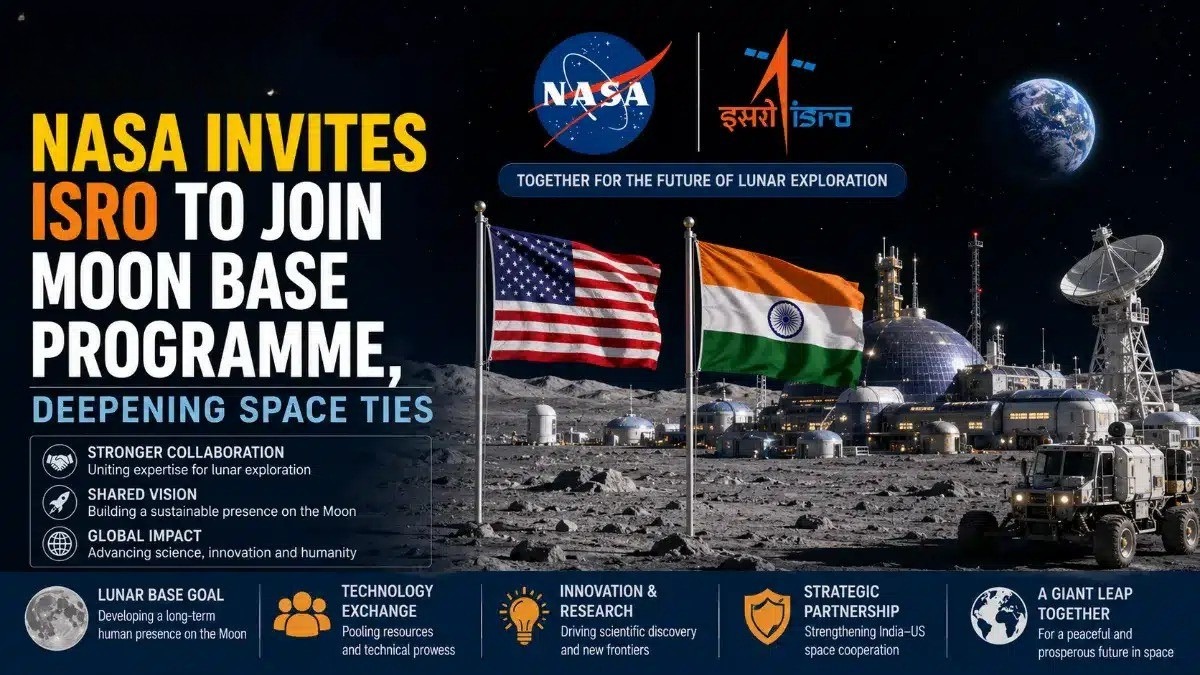
NASA has invited the Indian Space Research Organisation (ISRO) to join its Moon Base programme. This marks a major new phase in India-US space cooperation. The invitation came during the ninth India-US Civil Space Joint Working Group meeting. The meeting took place at ISRO headquarters in Bengaluru on August 5 and 6.
Talks Deepen the Artemis Partnership
US Ambassador to India Sergio Gor said the invitation deepens the two countries’ deep-space partnership. This cooperation builds on the Artemis framework. Discussions also covered sharing open scientific data. Both sides explored future cooperation in space science, advanced technologies, and human spaceflight. NASA describes its Moon Base initiative as a long-term programme. It aims to enable sustained human presence on the lunar surface. The programme focuses particularly on the lunar South Pole region.
ISRO’s Role Builds on Artemis Accords and NISAR Success
These discussions build on the Artemis Accords. This framework supports international cooperation in peaceful lunar and deep-space exploration. India and the US also reviewed opportunities for further joint missions. This follows the successful NASA-ISRO NISAR mission. NISAR monitors changes on Earth’s surface. It supports research into natural hazards, ecosystems, and environmental shifts.
Sustainability and Global Space Guidelines
Both countries also discussed the long-term sustainability of outer-space activities. They reaffirmed commitment to guidelines set by the UN Committee on the Peaceful Uses of Outer Space (COPUOS). This shared commitment reflects a broader push toward responsible space exploration as more nations expand their lunar ambitions.
What This Means for ISRO and India’s Space Programme
Proposed ISRO participation in the Moon Base programme could open new opportunities. Indian scientists and engineers may contribute directly to future lunar exploration efforts. This step also strengthens the broader India-US strategic space partnership. NASA’s invitation marks a significant milestone in India-US lunar cooperation. It potentially opens new avenues for joint science, technology, and human spaceflight activities in the years ahead.