

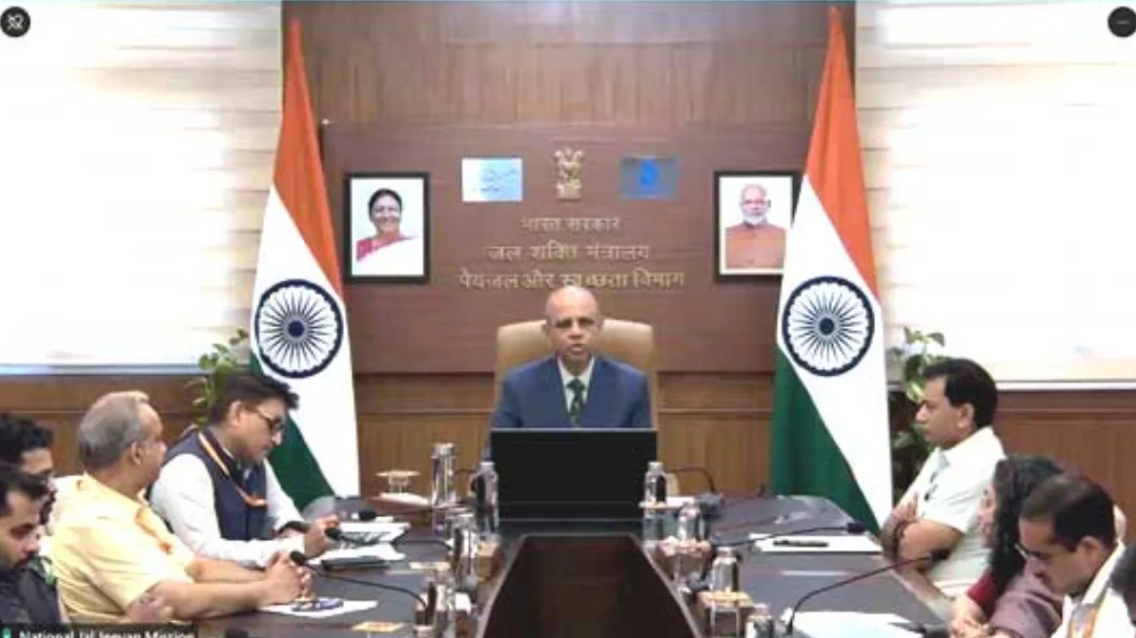
The Department of Drinking Water and Sanitation (DDWS), under the Ministry of Jal Shakti, held a virtual conference with States and Union Territories to strengthen convergence between Jal Jeevan Mission (JJM) 2.0 and 16th Finance Commission grants. The discussions focused on Panchayat-led planning, sustainable financing and the operation and maintenance of rural drinking water infrastructure.
The fourth conference in a series of thematic consultations following the Departmental Summit on Water 2026, held on September 1–2, addressed source sustainability, water security, financial planning and reliable rural water services.
Jal Jeevan Mission 2.0 Emphasises Infrastructure Maintenance
DDWS Secretary Ashok K.K. Meena stressed that the focus under the extended JJM 2.0 must go beyond infrastructure creation to ensure functionality, sustainability and service quality.
He highlighted the role of Gram Panchayats in preparing annual operation and maintenance (O&M) plans, mobilising local resources, managing water supply systems and ensuring accountability. Discussions also covered the use of tied Finance Commission grants for repairs, water quality management, source sustainability, leak prevention, pump maintenance, chlorination, electricity costs and staffing.
₹1.74 Lakh Crore Earmarked for Water Management and Sanitation
According to a presentation by Kritika Kulhari, Deputy Secretary, National Jal Jeevan Mission, more than ₹4.35 lakh crore has been allocated to Rural Local Bodies under the 16th Finance Commission framework. Nearly ₹1.74 lakh crore is earmarked for water management and sanitation over the award period.
Officials emphasised integrating water supply priorities into Gram Panchayat Development Plans (GPDPs), strengthening own-source revenue and user-charge collection, and using digital systems to improve financial accountability.
The Ministry of Panchayati Raj outlined the Requirements, Resources and Responsibilities planning framework. The National Informatics Centre highlighted how the eGramSwaraj portal supports planning, geo-tagging, expenditure reporting, asset management and monitoring, including integration with the Public Financial Management System.
Karnataka, Odisha and Madhya Pradesh Share Best Practices
States presented approaches to improving rural water supply sustainability.
- Karnataka highlighted Jala Sankalana, JalaAasthi and Jeevajala, along with GIS-based asset management, water budgeting and preventive maintenance.
- Odisha presented coordinated departmental planning, bottom-up budgeting, local mechanic training, solarisation, automation and IoT-based monitoring.
- Madhya Pradesh showcased its notified O&M Rules, 2026, simplified procurement procedures, district-level WASH technical committees and digital user-charge collection systems.
National Jal Jeevan Mission Additional Secretary and Mission Director Kamal Kishore Soan urged States to strengthen GPDP-based planning, resolve eGramSwaraj reporting issues, complete pending compliance requirements and improve utilisation of both 15th and 16th Finance Commission grants. Two regional conferences are planned for November 2026 to review preparedness and implementation challenges.
Centre Pushes Sustainable Rural Water Services
The discussions highlighted the importance of maintaining rural water infrastructure beyond its initial construction. Better coordination between JJM 2.0, Finance Commission grants and other rural development programmes could help Gram Panchayats strengthen maintenance, improve local accountability and deliver more reliable drinking water and sanitation services.