

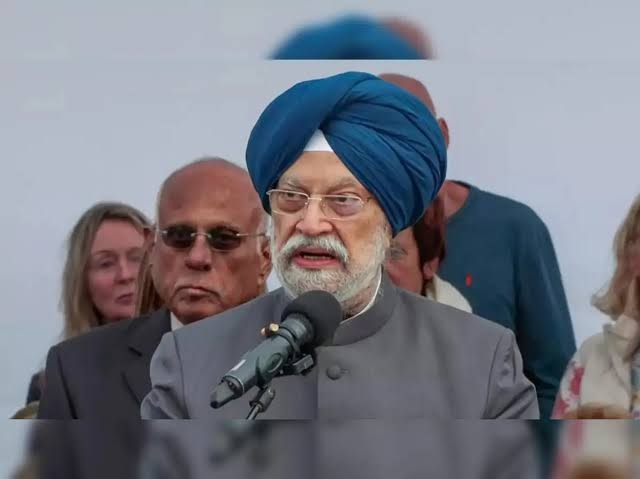
Union Petroleum and Natural Gas Minister Hardeep Singh Puri stated on Wednesday that India is ready to handle any fluctuations in global crude oil markets, regardless of the growing tensions in West Asia.
The minister assured IANS that India’s energy interests will be protected and that the government has done a good job of handling the ups and downs of global oil prices in the past few months.
Fuel supply and price stability in the face of global market uncertainty has been the government’s goal, according to Puri.
Managing the situation in the same way as the last 100 days has been and will continue to be the minister’s constant work, he added, adding that future policy decisions will be based on the evolution of global geopolitical situations.
In response to worries about oil supply in the wake of West Asian tensions, Puri stressed that, because to increased domestic production capacity and varied sourcing tactics, India’s energy security framework is far stronger today.
The critical importance of the Strait of Hormuz as a marine route was highlighted; it is through this passage that almost 20% of India’s crude oil imports and nearly 7% of LPG supplies pass.
The minister did not want to speculate on what the future holds geopolitically, but he did acknowledge that talks about Iran-US relations and regional stability are continuing.
Expanded domestic exploration efforts, higher ethanol blending, and rapid growth in renewable energy output were among of the ways that Puri emphasised India’s progress toward energy self-reliance.
Our solar capacity is expanding, biofuel blending is on the rise, and our exploration and production efforts are ramping up. This, he added, is leading us to become energy independent.
In addition, the minister mentioned the government’s Samudra Manthan program, which has allocated 90,000 crore rupees to finance the construction of new wells and the improvement of existing domestic oil and gas production facilities.
According to Puri, petrol costs in Delhi are still lower than they were four years ago, even if crude oil prices are very volatile on a worldwide scale.
He said this was because the Modi government has slashed central excise levies on petrol and diesel multiple times since 2021 and because many states ruled by the BJP have also reduced their value-added taxes.
In response to questions on the Pradhan Mantri Ujjwala Yojana’s revised criteria for subsidised LPG cylinders, the minister stated that the government had taken measures to prevent the abuse of the program.
Puri states that information were received by authorities suggesting that some recipients were selling or otherwise misusing their subsidised LPG cylinders, which led to a reevaluation of entitlements.
He emphasised that the government’s major goal is still to make sure that everyone has access to inexpensive energy while also making assistance programs more open, efficient, and accountable.
The Indian government asserts that the country’s energy security has been bolstered by its diversification of oil sources, expansion of domestic production, investments in renewable energy, and welfare-focused policies, even if global energy markets are still being affected by geopolitical conflicts. Officials in India are certain that the country can handle any problems that may arise and move closer to its objective of energy independence in the long run.
Image: ET
Disclaimer: All news articles are sourced through valid sources, and Business Unlimited (BU) doesn’t have any exclusive rights on these pieces. If BU features any exclusive story or article, it will be marked as Exclusive Story.