


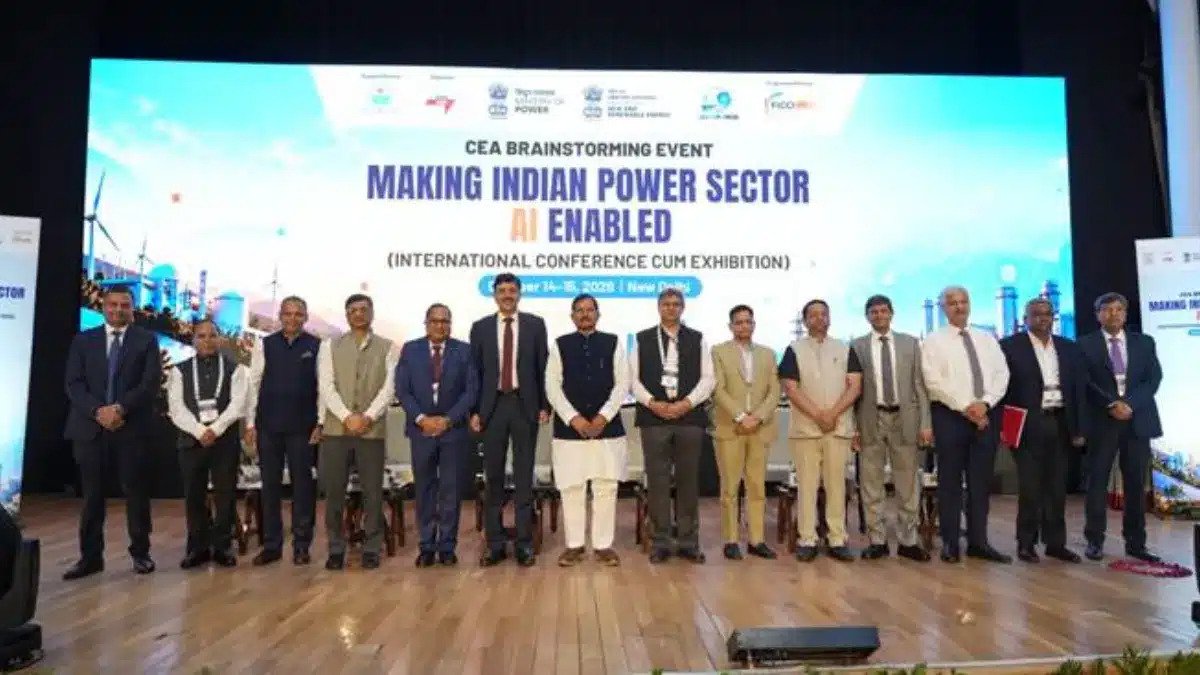
The two-day international conference in New Delhi brings together policymakers, power utilities and technology experts to explore AI-driven solutions for electricity generation, transmission, distribution and renewable energy integration. New Delhi, October 15, 2026: The Central Electricity Authority (CEA), under the Ministry of Power, Government of India, has intensified efforts to integrate artificial intelligence (AI) into the country’s electricity ecosystem, bringing together government representatives, industry leaders and technology experts at a two-day international conference-cum-exhibition titled Making Indian Power Sector AI Enabled.
Held at the Manekshaw Centre in New Delhi on October 14–15, the conference focuses on deploying advanced technologies to improve operational efficiency, grid reliability, energy security and sustainability across India’s rapidly evolving power sector.
The inaugural proceedings on October 14 witnessed the launch of the CEA Vidhyut Dwar Portal and the release of the CEA Manual on Transmission Planning Criteria, 2026, marking important steps towards digital transformation and improved electricity infrastructure planning.
Government Pushes Technology-Led Power Sector Reforms
The conference featured messages from Union Minister for Power and Housing and Urban Affairs Manohar Lal and Union Minister Prahlad Joshi.
Among the senior dignitaries present were Union Minister of State for Power and New and Renewable Energy Shripad Yesso Naik, Union Minister of State Jitin Prasada, Power Secretary Pankaj Agarwal and CEA Chairperson Ghanshyam Prasad.
The deliberations highlighted the growing importance of AI in strengthening electricity infrastructure, improving operational decision-making and preparing India’s power systems for increasing demand and the transition towards cleaner energy sources.
As part of its technology adoption strategy, CEA has constituted a team of 54 AI enthusiasts and brand ambassadors to promote the application of artificial intelligence across the electricity sector. Power utilities have also been encouraged to develop dedicated AI teams to identify and implement practical solutions.
Six Key Areas Identified for AI Integration
The conference’s technical discussions cover six major segments of the electricity ecosystem, including conventional power generation, regulatory processes, renewable energy integration, distribution, transmission and decentralised energy systems.
In conventional power generation, AI-based applications can support predictive maintenance, operational monitoring, and improved plant efficiency.
For renewable energy, advanced forecasting tools can help utilities anticipate fluctuations in solar and wind generation, optimise energy storage and maintain grid stability.
The distribution segment offers opportunities for smart-meter analytics, faster fault detection, improved demand forecasting, and reduced technical and commercial losses.
Similarly, AI-supported transmission planning and grid management can strengthen network reliability, identify potential disruptions and support quicker system restoration.
AI-Driven Regulatory Reforms and Digital Governance
Another major area of discussion was the potential use of AI to modernise regulatory processes and strengthen transparency.
AI-enabled analytics could help electricity regulators examine tariff petitions, validate financial submissions, track compliance, and monitor electricity markets.
However, participants emphasised that technology must complement human expertise rather than replace statutory decision-making or regulatory accountability.
The discussions also highlighted the importance of robust data governance, transparency and institutional safeguards as AI becomes increasingly integrated into electricity-sector operations.
Cybersecurity and Data Infrastructure Remain Critical
As India’s electricity networks become more interconnected and digitally dependent, cybersecurity has emerged as a key consideration.
Experts highlighted the need for reliable datasets, interoperability between digital systems, secure technology infrastructure and stronger institutional capabilities.
The conference stressed that successful AI adoption would require utilities to move beyond isolated pilot projects towards scalable solutions supported by measurable performance indicators.
Such measures would help ensure that AI-driven modernisation delivers tangible improvements in electricity reliability, operational efficiency and consumer services.
Towards a Smarter and More Resilient Electricity Ecosystem
The CEA initiative reflects India’s broader efforts to modernise its power infrastructure while accommodating rising electricity demand and the increasing contribution of renewable energy.
Greater adoption of AI could create opportunities for technology companies, infrastructure developers, equipment manufacturers, digital service providers and power utilities.
The conference also underscored the importance of collaboration among government institutions, industry stakeholders, researchers and technology providers to develop solutions suited to India’s electricity requirements.
By encouraging coordinated AI adoption across the electricity value chain, CEA aims to support a more efficient, reliable, technologically advanced and sustainable power sector.
The initiative marks an important step toward strengthening India’s digital energy infrastructure and building the technological capabilities needed for the country’s long-term energy transition.