


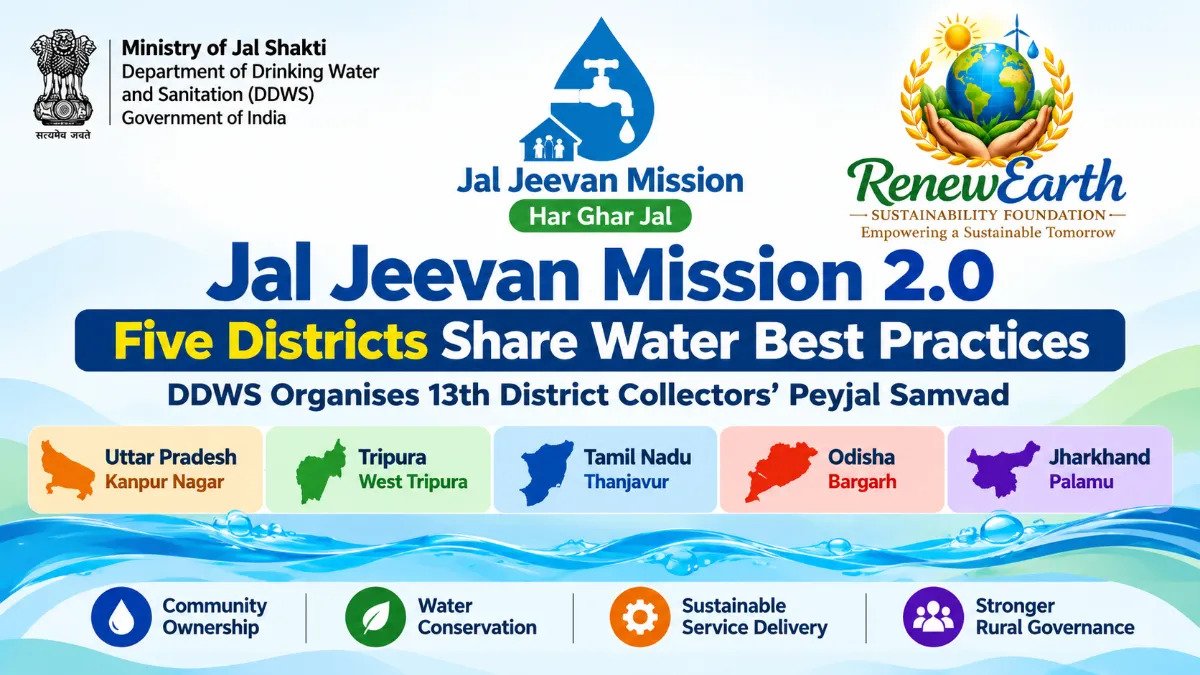
The Ministry of Jal Shakti has reinforced its commitment to sustainable rural drinking water services under Jal Jeevan Mission (JJM) 2.0, highlighting innovative district-level initiatives that combine digital technology, community participation and efficient infrastructure management.
The Department of Drinking Water and Sanitation (DDWS) organised the 13th District Collectors’ Peyjal Samvad through video conferencing, bringing together senior government officials, District Collectors, District Magistrates and State and Union Territory Mission Directors to review implementation strategies and exchange successful practices.
Chaired by Ashok K.K. Meena, Secretary, DDWS, the meeting focused on strengthening institutional accountability, improving drinking water service reliability and ensuring the long-term sustainability of rural water supply systems.
Strengthening Governance and Digital Monitoring
Addressing the participants, Meena emphasised the need for effective district-level monitoring and regular meetings of District Water and Sanitation Missions. He encouraged district administrations to strengthen reporting mechanisms and ensure timely documentation of implementation progress.
Officials were urged to leverage digital platforms, including the Jal Seva Aankalan dashboard and Decision Support System (DSS), to evaluate water supply functionality, identify vulnerable drinking water sources and develop scientifically informed sustainability plans.
The discussions also highlighted the importance of solar-powered rural water supply infrastructure, groundwater recharge and convergence with other government programmes to improve operational efficiency and reduce long-term maintenance challenges.
Kamal Kishore Soan, Additional Secretary and Mission Director, National Jal Jeevan Mission, underscored the need to strengthen grassroots institutions, including Gram Panchayats, Village Water and Sanitation Committees (VWSCs), Panchayat Secretaries, and Sujalam Shakti Groups.
Capacity building, local ownership and financial sustainability were identified as essential components of reliable rural drinking water services.
The meeting also discussed the Jal Arpan module, which facilitates the structured transfer of completed water supply schemes to local institutions for operation and maintenance.
Five Districts Present Innovative Water Management Practices
A key highlight of the interaction was the presentation of successful initiatives by five districts representing different geographical and administrative regions.
Kanpur Nagar, Uttar Pradesh: The district demonstrated community-based water quality testing, Supervisory Control and Data Acquisition (SCADA) systems and digital grievance redressal mechanisms aimed at strengthening transparency and improving service responsiveness.
West Tripura, Tripura: The district highlighted community participation through self-help groups, user-charge collection mechanisms, rainwater harvesting and groundwater recharge initiatives. These measures aim to improve financial sustainability and strengthen local involvement in water resource management.
Thanjavur, Tamil Nadu: The district presented innovative village-level water budgeting practices supported by Internet of Things (IoT)-enabled monitoring systems. Its approach focuses on efficient water utilisation, conservation and technology-assisted oversight.
Bargarh, Odisha: The district showcased improvements in project execution, commissioning and operation and maintenance of water infrastructure. Its presentation also highlighted measures to address implementation bottlenecks and provide round-the-clock piped water supply to IIM Sambalpur.
Palamu, Jharkhand: The district presented its integrated monitoring approach, including a district control room, real-time surveillance, community-led water quality assessment, and the Jalkar Bhugtan Abhiyan to strengthen user-charge collection.
Together, these initiatives demonstrated how locally adapted solutions, supported by digital systems and community engagement, can improve the effectiveness and sustainability of rural drinking water infrastructure.
Community Participation Central to Long-Term Water Security
The discussions reinforced the importance of moving beyond infrastructure development to dependable, accountable, community-managed water services.
District administrations were encouraged to strengthen Village Water Security Plans and adopt measures such as groundwater recharge, rainwater harvesting, afforestation and protection of existing drinking water sources.
Officials also discussed the importance of awareness-building initiatives, including educational visits for school students to water treatment facilities, testing laboratories and multi-village drinking water supply schemes.
Such initiatives can help strengthen public understanding of water conservation, infrastructure management and responsible resource utilisation.
Towards Sustainable Rural Water Infrastructure
Jal Jeevan Mission 2.0 represents an important shift in India’s rural drinking water strategy, with greater emphasis on service quality, operational sustainability and local institutional capacity.
The 13th District Collectors’ Peyjal Samvad highlighted the growing role of digital governance, scientific resource planning and community ownership in addressing rural water management challenges.
By encouraging districts to exchange successful implementation models, the Ministry of Jal Shakti aims to strengthen institutional coordination and support more efficient water service delivery.
The initiatives showcased by the five districts underline the importance of combining technological innovation with grassroots participation to build resilient rural water systems and improve long-term drinking water security across India.