


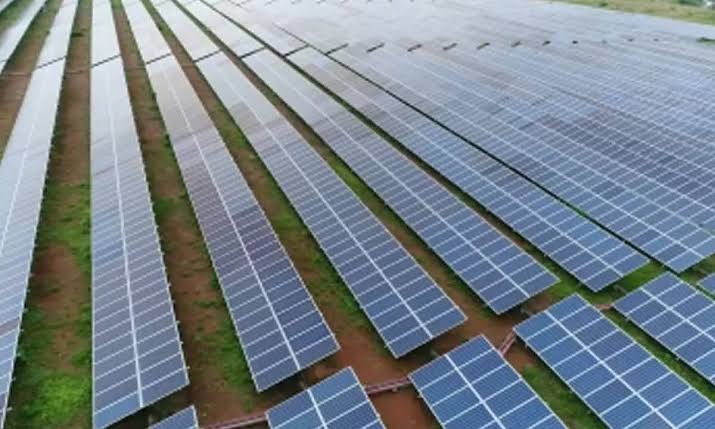
The renewable energy sector in India is set to experience even more rapid growth in the coming years. Equirus Securities predicts that annual solar installations would rise from approximately 50 GW in FY27 to over 85 GW by FY30.
Developers, equipment manufacturers, and infrastructure companies stand to gain substantially from the 15-20 GW of solar demand that could be generated annually beginning in FY29 due to rising demand from data centers, green hydrogen production, and continuous renewable power needs.
The utility-scale solar project pipeline in India is robust, with 145 GW of signed PPAs and an additional 68 GW of pending project awards. This bodes well for the country’s ability to execute these projects in the years to come.
The research states that between FY18 and FY26, the country awarded 215 GW worth of Letters of Award (LOAs), which together form a pipeline for renewable energy utilities. After signing 145 GW of PPAs and commissioning 75 GW of projects, there is a sizable balance pipeline of 70 GW, which includes 58 GW of solar capacity and 12 GW of wind projects.
Nearly 43 GW of the 58 GW of unsigned solar PPAs are for pure solar and hybrid projects, where the signature likelihood is low, according to the research. On the other hand, due to the growing need for renewable power that is available continuously, 15 GW of Round-The-Clock (RTC), Firm and Dispatchable Renewable Energy (FDRE), and Solar+BESS projects are expected to proceed.
The fast development of India’s data centre ecosystem is a key factor propelling the country’s expansion. Worldwide tech giants including Amazon Web Services (AWS), Microsoft (MSFT), and Google (GOOGLE) have all pledged to invest between ₹2 and 3 lakh crore (about $2 million to $3 million) in India’s digital infrastructure, and over 300 data center projects have already received approval. Data centers, driven by the growth of AI and cloud computing, will need consistent, clean energy all day long. One cost-effective option is solar power combined with battery energy storage systems, or BESS.
If every 100 MW data center ran on renewable energy alone, the study estimates that 250 MW of solar power, 150 MW of wind power, and about 450 MWh of battery storage would be needed.
Demand for solar energy is anticipated to be significantly boosted by the National Green Hydrogen Mission. Since it is predicted that one million tonnes of hydrogen generation requires roughly 20 GW of solar power, India’s goal of creating 5 million tonnes of green hydrogen annually by 2030 could necessitate nearly 100 GW of dedicated solar capacity.
Another area that is expected to experience rapid expansion is battery storage. Supported by rising demand for renewable energy, grid stability regulations, government policy incentives, and better project economics, the demand for battery energy storage systems (BESS) in India is expected to rise from 34.7 GWh in 2022–2027 to 236.2 GWh in 2027–2032.
Integrating Independent Power Producers (IPPs) that can generate power during both solar and non-solar hours will be advantageous, according to the report, because of the present trend toward solid renewable power solutions that are backed by storage technology.
Image: The Hans
Disclaimer: All news articles are sourced through valid sources, and Business Unlimited (BU) doesn’t have any exclusive rights on these pieces. If BU features any exclusive story or article, it will be marked as Exclusive Story.