


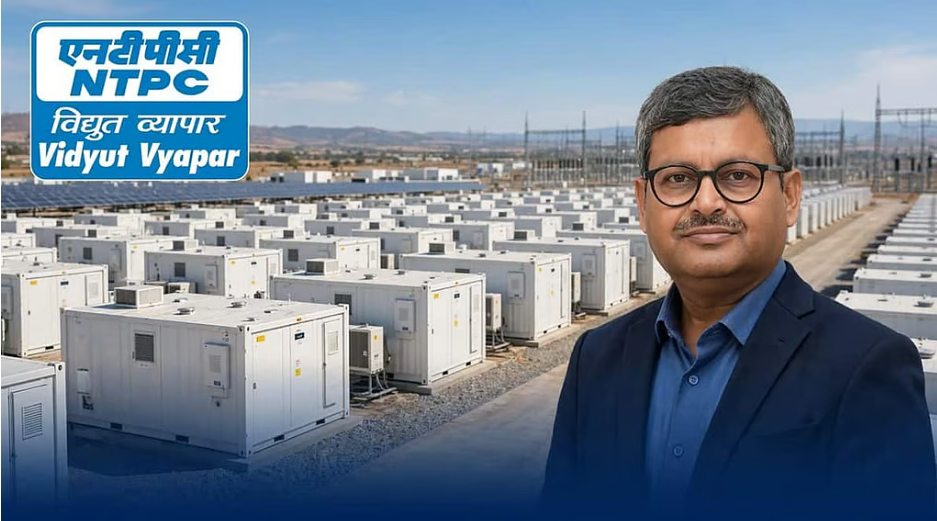
NTPC Vidyut Vyapar Nigam (NVVN), a wholly owned subsidiary of NTPC, is set to synchronise its first Battery Energy Storage System (BESS) project with a capacity of 500 MWh in the coming days. Commercial operations will begin after synchronisation, marking NVVN’s entry into the battery energy storage sector.
NVVN CEO Somes Bandyopadhyay shared the update on Thursday on the sidelines of the 18th India Coal Summit, organised by the Indian Chamber of Commerce. He also indicated that additional battery storage capacity could come up later this year.
NVVN Eyes Further Battery Storage Capacity
Bandyopadhyay said NVVN expects another 1,000 MWh of battery storage capacity to be developed this year, although he described the figure as tentative. He also noted that the government had provided a scheme covering 3,000 MWh of storage capacity.
Explaining the company’s approach, he said NVVN was developing projects through different models, with the company owning the systems while using market-based components.
NVVN Procures Storage Through Competitive Tenders
NVVN has been procuring battery storage capacity through competitive tenders since 2024. Under this model, developers establish standalone BESS facilities and make the capacity available to NVVN for charging and discharging as required.
NVVN signs a Battery Energy Storage Purchase Agreement (BESPA) with each successful developer. Under the terms of its September 2024 tender, the company can use the contracted capacity to sell power through exchanges, supply distribution companies and commercial or industrial consumers through bilateral agreements, or provide ancillary services.
The expansion into storage adds a new dimension to NVVN’s existing power trading business. The company holds a Category I trading licence from the Central Electricity Regulatory Commission (CERC), the highest category of power trading licence.
According to its annual return to CERC for 2023–24, NVVN traded 20,727 million units (MU) through inter-state bilateral transactions and 13,894 MU on power exchanges. It also traded approximately 3.1 lakh renewable energy certificates during the year.
Government Support for Battery Storage
The Centre has supported battery storage development through Viability Gap Funding (VGF). On September 6, 2023, the Union Cabinet approved the first VGF scheme with an outlay of ₹9,400 crore, including budgetary support of ₹3,760 crore. The scheme offered funding of up to 40% of capital costs for 4,000 MWh of BESS capacity to be developed by 2030–31.
As battery costs declined, approvals under the scheme expanded. By June 2025, 13.2 GWh of capacity had been approved, according to the Ministry of Power.
In June 2025, the Ministry of Power announced a second tranche, allocating ₹5,400 crore from the Power System Development Fund (PSDF) to support 30 GWh of BESS capacity at ₹18 lakh per MWh. Of this, 25 GWh was allocated to 15 states and 5 GWh to NTPC.
India’s Battery Storage Capacity Expands
According to estimates by the Central Electricity Authority (CEA), India would require 37 GWh of BESS capacity by 2027 and 236 GWh by 2031–32.
Battery storage installations have also increased sharply. India added 8.2 GWh of battery storage in the first half of 2026, compared with 98.4 MWh during the corresponding period in 2025. This took the country’s cumulative installed battery storage capacity to 9.3 GWh by the end of June 2026.
NVVN’s upcoming 500 MWh project marks its first step into the battery storage segment, as the company looks to build on its power trading operations and participate in the expanding energy storage market.