


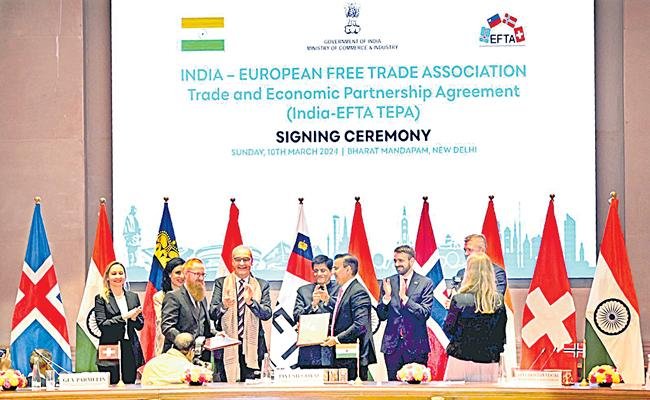
India-EFTA TEPA is opening new opportunities for Indian exporters, businesses and investors as India and the European Free Trade Association (EFTA) mark the first year of their Trade and Economic Partnership Agreement. Commerce Secretary Shri Rajesh Agrawal highlighted the potential of the agreement while addressing Export Promotion Councils, industry associations, exporters and business representatives from the EFTA States at an outreach event in New Delhi.
The event was part of the 2nd India-EFTA Prosperity Summit 2026 and was organised by the Department of Commerce. Leaders from all four EFTA States — Iceland, Liechtenstein, Norway and Switzerland — are in New Delhi to mark the first year of the agreement and discuss the way forward.
India-EFTA TEPA Strengthens Market Access
The India-EFTA TEPA entered into force on 1 October 2025 and has opened markets on both sides. EFTA’s commitments cover 92.2 per cent of its tariff lines, accounting for 99.6 per cent of India’s exports, with full coverage of non-agricultural products. India’s commitments cover 82.7 per cent of tariff lines, accounting for 95.3 per cent of EFTA exports.
Agrawal said the agreement goes beyond tariff reductions, with predictability emerging as one of its most important benefits for businesses. Stable tariffs can give companies greater confidence to make investments, build supply chains and plan for the long term.
He urged Indian companies to partner with businesses in the EFTA States and develop integrated value chains, from inputs to final products. Such partnerships, he said, could improve reliability and create stronger commercial linkages between the two markets.
Quality and Agriculture Offer Export Potential
The Commerce Secretary also highlighted the opportunities available in the high-income EFTA markets, where consumers place a strong emphasis on quality and value. He encouraged Indian exporters to use these markets as a benchmark for developing products that can compete globally.
Agriculture was identified as another area with significant export potential. Agrawal noted that duties on several agricultural products have come down to zero in these markets. He encouraged exporters to identify products with potential and develop long-term supply relationships with EFTA countries.
The combined EFTA market imports goods and services worth more than half a trillion US dollars annually, providing a significant opportunity for Indian businesses looking to expand their international presence.
India-EFTA TEPA Calls for Market-Specific Action
Agrawal called on Export Promotion Councils, industry associations and State Governments to take the opportunities under the agreement to businesses across the country. He stressed the need for companies to understand how a free trade agreement can support their market expansion and export strategies.
He also called for an action plan with each EFTA partner country for the next five years. Such plans should identify how India can grow its presence in individual markets and address the non-tariff issues that could affect trade.
The Commerce Secretary emphasised that the partnership should work both ways, with Indian businesses viewing EFTA markets as an extension of their own market and EFTA companies seeing India as a market for deeper business engagement.
Investment Commitment Adds Another Dimension
A key feature of the India-EFTA TEPA is its investment commitment. Under Article 7.1 of the agreement, the EFTA States have committed to aiming to increase foreign direct investment from EFTA investors into India by US$50 billion within 10 years of the agreement coming into force, followed by an additional US$50 billion over the succeeding five years.
The agreement also includes an aim to facilitate the generation of one million jobs in India within 15 years.
Agrawal said India, as a growing market, offers investment opportunities across sectors. He noted that deeper business partnerships between India and the EFTA States could help take investment beyond the levels envisaged under the agreement.
With market access, predictable tariffs, export opportunities and investment commitments coming together, the first year of India-EFTA TEPA has set the foundation for deeper commercial engagement between India and the four EFTA States.