


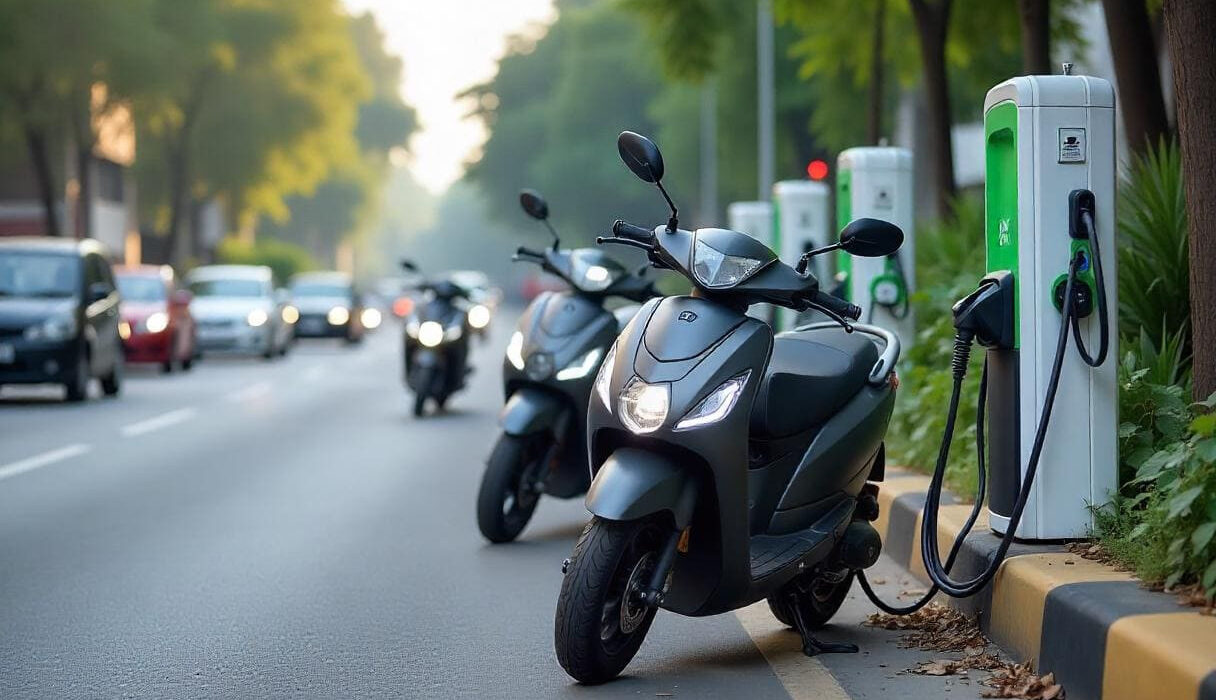
PM E-DRIVE supported the adoption of 88,209 electric vehicles (EVs) in Madhya Pradesh during FY 2025-26. The scheme also recorded 94,277 EVs deployed in the state during the year. The figures underline the growing role of government incentives in expanding clean mobility across Madhya Pradesh.
The Ministry of Heavy Industries said the subsidised vehicles comprised 81,840 electric two-wheelers and 6,369 electric three-wheelers. No electric buses were allocated to Madhya Pradesh under the PM E-DRIVE scheme during the period.
PM E-DRIVE Drives Electric Two-Wheeler Adoption
Electric two-wheelers accounted for the largest share of subsidised vehicles in Madhya Pradesh. The state recorded 81,840 incentivised e-2Ws during FY 2025-26.
Electric three-wheelers accounted for another 6,369 vehicles. The combined figure reached 88,209 vehicles under the scheme.
Indore recorded the highest number of incentivised EVs among districts. It accounted for 12,840 vehicles, including 11,347 e-2Ws and 1,493 e-3Ws.
Gwalior followed with 9,476 vehicles, while Jabalpur recorded 7,913. Bhopal accounted for 6,622 incentivised EVs. Ujjain recorded 3,622 vehicles.
The district-level figures show that EV adoption is extending beyond the state’s largest urban centres. Several districts recorded incentives for both electric two-wheelers and three-wheelers.
PM E-DRIVE Builds on Wider EV Policy Support
The government has implemented multiple schemes to accelerate clean-energy transport across India, including in two-tier and three-tier towns of Madhya Pradesh.
The FAME India Phase-II scheme operated from April 2019 to March 2024 with budgetary support of ₹11,500 crore. It provided demand incentives for electric two-wheelers, three-wheelers and four-wheelers. It also supported e-buses and public EV charging stations.
FAME-II supported the sale of around 16.72 lakh electric vehicles. It also sanctioned 6,862 e-buses for various cities, of which 5,299 had been deployed as of July 31, 2026. The scheme allocated ₹912.50 crore for EV public charging stations.
The government has also introduced the Production Linked Incentive (PLI) scheme for the automobile and auto component industry. The scheme has an outlay of ₹25,938 crore and focuses on strengthening domestic manufacturing of Advanced Automotive Technology products, including EVs.
EV Manufacturing and Battery Ecosystem Get Policy Push
The government’s EV strategy also extends to battery manufacturing. The PLI scheme for the National Programme on Advanced Chemistry Cell Battery Storage has an outlay of ₹18,100 crore.
The programme aims to build a competitive domestic manufacturing ecosystem for 50 GWh of Advanced Chemistry Cell batteries.
The PM E-DRIVE scheme itself has an outlay of ₹10,900 crore. It supports incentives for around 28.30 lakh electric vehicles, including e-2Ws, e-3Ws, e-trucks, e-buses and e-ambulances.
The scheme also provides grants for upgrading testing agencies. It has allocated ₹4,391 crore for the deployment of 14,028 e-buses. Of these, 14,000 e-buses have been allocated. Another ₹2,000 crore has been earmarked for EV public charging infrastructure across India.
Charging Infrastructure and E-Buses Remain Key Focus
The government is also supporting electric public transport through the PM e-Bus Sewa-Payment Security Mechanism Scheme. The programme has an outlay of ₹3,435.33 crore and aims to support the deployment of more than 38,000 electric buses.
The scheme is designed to provide payment security to e-bus operators if public transport authorities default on payments. This is intended to reduce financial risks for operators and support the expansion of electric public transport.
Other policy measures are also aimed at reducing the upfront cost of EV adoption. GST on electric vehicles, chargers and charging stations has been reduced to 5%.
The Ministry of Road Transport and Highways has also provided for green licence plates for battery-operated vehicles and exemption from permit requirements. It has advised states to consider waiving road tax on EVs to further lower initial ownership costs.
The figures from Madhya Pradesh highlight the growing reach of India’s electric mobility policy. With incentives spanning vehicles, manufacturing, batteries, charging infrastructure and public transport, the government is building a broader ecosystem to support the transition towards cleaner mobility.