

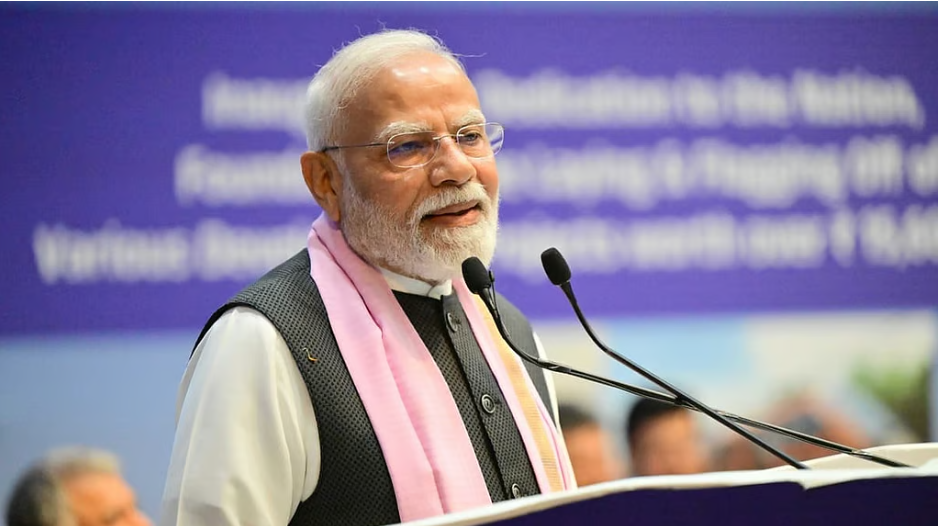
Prime Minister Narendra Modi on Friday launched three energy projects in Karnataka: an LPG storage project in Mangaluru, a petroleum marketing terminal at Devangonthi and a compressed biogas (CBG) plant in Bengaluru. The projects were part of a package of development initiatives worth over Rs 15,600 crore launched by him in Bengaluru.
The Mangaluru project will add to India’s LPG storage capacity. “The LPG project in Mangaluru will increase the country’s LPG storage capacity by 80,000 metric tonnes,” Modi said.
The Devangonthi terminal, he said, “will make the supply of petrol, diesel and aviation fuel more organised and reliable.”
The Bengaluru plant will convert waste into gas. “Meanwhile, the CBG plant in Bengaluru will produce around 13 tonnes of biogas every day. This will improve waste management and also save the money spent on importing natural gas,” the Prime Minister said.
Energy Projects to Strengthen India’s Energy Security
Modi presented the three projects as part of India’s broader energy security strategy. “The three projects whose foundation stones have been laid or which have been inaugurated in Karnataka today will also give new strength to India’s energy security,” he said.
He linked the importance of energy security to the ongoing conflict in West Asia. “The ongoing war around Iran and the Gulf countries has shown how important energy security is. This has also been a challenging time for India,” Modi said. “However, the steps taken over the past decade towards energy security have helped us face this crisis with strength.”
He outlined the measures taken over the past decade, including expanding domestic production and strengthening energy infrastructure. “We have increased our capacity to produce petrol, diesel and LPG; developed arrangements for storing crude oil; expanded solar, hydro and wind energy; achieved almost 100 percent electrification of the Railways; and strengthened public transport such as the metro,” he said.
Renewable Energy Capacity Crosses 300 GW
Modi described electricity generation as a key component of energy security and highlighted its importance for India’s growing technology and industrial sectors.
“An important aspect of energy security is electricity generation,” he said. He also linked the country’s power requirements to its technology ambitions. “Today, India is moving forward with the goal of leadership in new technologies, from chips to ships, and from AI and data centres to quantum computing,” he said.
The government is working to ensure adequate electricity availability to support these ambitions, according to Modi. “Today, India’s renewable energy capacity has crossed 300 gigawatts. To achieve clean energy, India is also increasing the number of its nuclear power plants,” he said.
Rooftop Solar Benefits Over 40,000 Karnataka Families
Modi said central government schemes were enabling households and farmers to become electricity producers alongside consumers.
“Because of the schemes of the Central Government, today the citizens of India are becoming producers of electricity along with being consumers of electricity,” he said.
More than 60 lakh families across the country have installed rooftop solar plants under the PM Surya Ghar Muft Bijli Yojana, Modi said. These include more than 40,000 families in Karnataka. He said the Centre had provided assistance of around Rs 80,000 to each family.
Under the PM-KUSUM scheme, arrangements are being made for irrigation through more than 8 lakh solar pumps for farmers in Karnataka. “This means that the food providers of Karnataka are now also becoming energy providers,” Modi said. “These schemes are reducing electricity expenses, while also creating new opportunities for income and employment.”
Bengaluru Metro and Railway Projects Expand Connectivity
The development projects launched on Friday also included the new Pink Line of the Bengaluru Metro. Modi said it would improve connectivity to IIM Bengaluru, several educational institutions and the city’s major business, technology and commercial centres.
“This means that lakhs of people in Bengaluru will not only have greater convenience in commuting, but will also save both money and time,” he said.
Namma Metro’s network, which was 17 kilometres long in 2014, now exceeds 100 kilometres, according to Modi. He said Bengaluru had become the third city in India, after Delhi-NCR and the Mumbai Metropolitan Region, to have a metro network of over 100 kilometres.
Karnataka also received four Amrit Bharat stations, two doubling and electrification projects, and a Vande Bharat train connecting the state with Goa.
“Through this train, people in Karnataka, including those in Mangaluru and along the entire coastal route, will get a new experience of travelling by a semi-high-speed train,” Modi said.
Karnataka Governor Sudha Yadav and Chief Minister D K Shivakumar attended the event.