


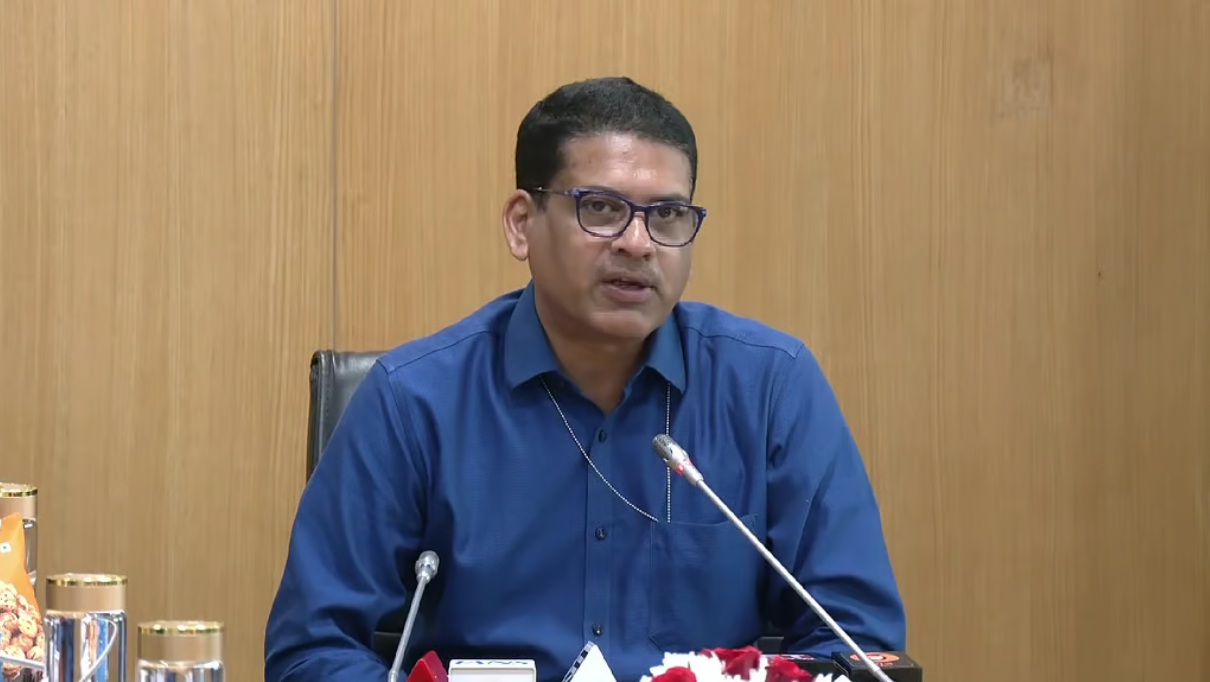
The Ministry of New and Renewable Energy (MNRE) is planning a Central sector scheme to cover the additional cost of agricultural photovoltaic (AgriPV) projects, which are 25–30% more expensive to build than conventional ground-mounted solar plants. MNRE Secretary Santosh Kumar Sarangi outlined the proposal ahead of the AgriVoltaics World Conference 2026, saying the ministry is working with the Ministry of Finance to finalise the support mechanism.
The proposed scheme aims to encourage state governments to adopt AgriPV projects and help the technology become more commercially viable over time. The ministry is yet to decide whether the support will be incorporated into the existing PM-KUSUM scheme or introduced as a standalone initiative.
MNRE Plans Support for AgriPV Cost Gap
Agrivoltaics, also known as agri-photovoltaics or AgriPV, combines solar power generation with agricultural activities on the same land. The model allows farmers to continue cultivating crops while solar panels installed above the fields generate electricity.
Sarangi said the government is considering an initial incentive to encourage states to develop different AgriPV models. The ministry is working out the scheme’s details, including how states could be incentivised to expand adoption.
The additional cost largely comes from the civil infrastructure required to elevate solar panels three to five metres above the ground, leaving sufficient space for agricultural operations. According to Sarangi, this structure makes AgriPV projects 25–30% more expensive than conventional ground-mounted solar installations.
The ministry aims to bridge this cost difference and encourage states to scale up projects so that costs can become more competitive over time.
Agricultural Photovoltaic Power Costs Higher Than Conventional Solar
The cost premium also affects electricity tariffs. Sarangi estimated that power generated by AgriPV plants could cost between ₹3.20 and ₹3.30 per unit, compared with ₹2.80 to ₹3 per unit for decentralised installations under PM-KUSUM.
India’s estimated AgriPV potential ranges from 1 terawatt to 2 terawatts. However, the technology requires around 16% more land, making project design and the choice of suitable crops important considerations.
States Could Drive 5 GW AgriPV Capacity
Sarangi said India could potentially add around 5 GW of AgriPV capacity over the next three to four years. Achieving this target will depend partly on state governments notifying feed-in tariffs for such projects, which could provide greater certainty for farmers and cooperatives considering investments.
Odisha, Madhya Pradesh and Maharashtra are among the states that have shown interest in the technology. Sarangi also identified Madhya Pradesh, Odisha, Chhattisgarh, West Bengal and Uttar Pradesh as regions that could be suited to AgriPV, particularly in moderate solar irradiance zones.
The projects could be developed by individual farmers, farmer-producer organisations (FPOs), cooperatives or groups of farmers. Private developers could also participate by leasing agricultural land on a long-term basis.
Research Identifies Suitable Crops for AgriPV
MNRE has conducted AgriPV pilot projects with the Indian Agricultural Research Institute (IARI) to assess how agricultural production can coexist with solar power generation across different regions.
Sarangi said the pilots have mapped crop metrics across agro-climatic zones and identified crops that respond positively to cultivation under solar panels. Initial findings indicate that fruits, leafy vegetables, horticultural crops and floriculture could be more suitable for AgriPV than staple crops such as rice, wheat and sugarcane.
However, he stressed that these findings remain preliminary and require further research. The ministry is working on crop-specific recommendations to account for India’s diverse agro-climatic conditions and help farmers select appropriate crops for AgriPV installations.
MNRE to Consult Discoms on Power Procurement
Power procurement is another area the ministry is examining. Sarangi said MNRE plans to discuss policy options with electricity distribution companies (discoms) to understand how they can facilitate the purchase of electricity generated by farmers operating AgriPV plants.
The ministry is also preparing a policy document on the technology. In parallel, India is working with Germany, an early adopter of agrivoltaics, to explore the technology’s development. Sarangi said it was too early to comment on a possible joint project with Japan.
The proposed Central sector scheme, state-level tariff support, crop research and procurement mechanisms will be important to the expansion of AgriPV in India. The government’s approach aims to encourage renewable energy generation while allowing agricultural activities to continue on the same land.