


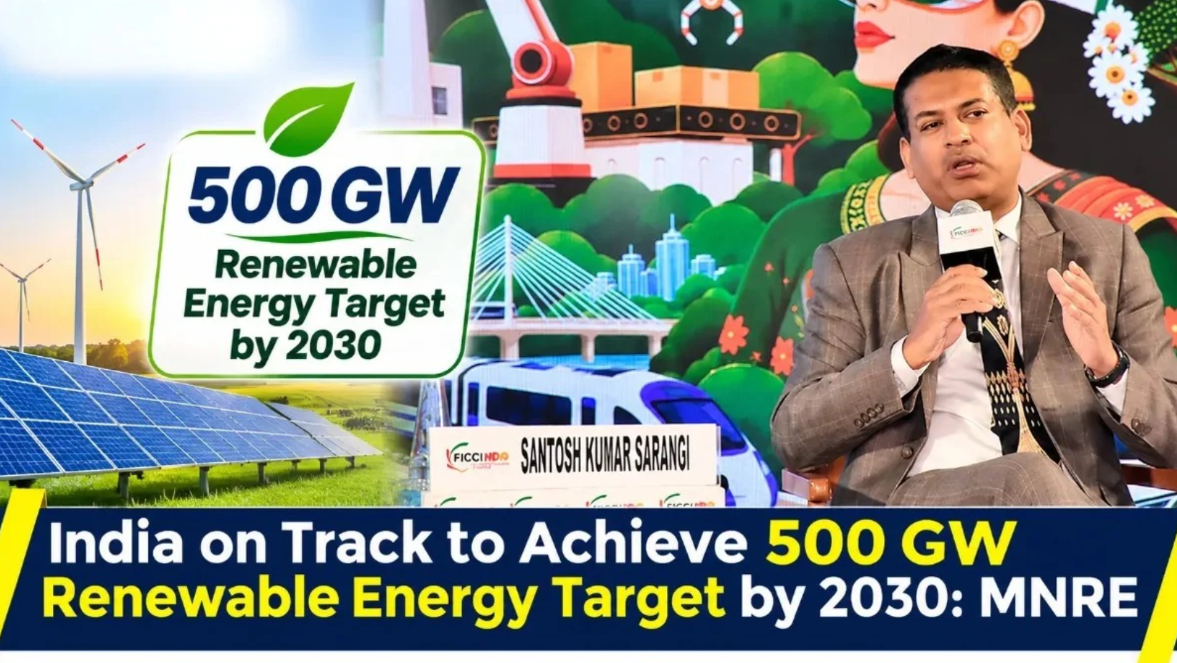
India is on course to achieve its target of installing 500 GW of renewable energy capacity by 2030, supported by favourable government policies, market development initiatives and flagship clean energy programmes, MNRE Secretary Santosh Kumar Sarangi said.
Speaking on the sidelines of FICCI’s Annual General Meeting, Sarangi, Secretary, Ministry of New and Renewable Energy (MNRE), expressed confidence in meeting the ambitious target.
He attributed the country’s progress to the rapid expansion of the sector, policy stability and sustained efforts to create a conducive market environment for clean energy investments. According to him, the combination of government support, market-building initiatives and targeted programmes has strengthened India’s renewable energy growth trajectory.
PM Surya Ghar and PM-KUSUM Boost Distributed Renewable Energy
Sarangi highlighted the contribution of flagship government programmes, particularly the PM Surya Ghar Muft Bijli Yojana and PM-KUSUM, in expanding distributed renewable energy generation.
These initiatives have encouraged renewable energy adoption at both household and agricultural levels, supporting India’s transition towards a cleaner energy system. PM Surya Ghar promotes household-level solar energy adoption, while PM-KUSUM supports renewable energy deployment in the agriculture sector.
The MNRE Secretary said these programmes, alongside broader policy measures, are helping create the conditions required to achieve the 500 GW capacity milestone by the end of the decade.
Government Support for Industry Not Limited to PLI Schemes
Commenting on industrial incentives and Production-Linked Incentive (PLI) schemes, Sarangi said government support for a particular sector does not necessarily have to be channelled through a PLI programme.
He explained that policymakers have several other instruments available to encourage domestic manufacturing, improve industrial competitiveness and promote local production. These include:
- Basic Customs Duty (BCD) adjustments to support domestic industry.
- Approved List of Models and Manufacturers (ALMM) provisions to strengthen domestic manufacturing.
- Regulatory interventions to improve industry competitiveness.
- Other policy measures to encourage investment and local production.
Sarangi did not indicate whether new incentive schemes were being considered for specific sectors.
No Comment on New Budget Incentives or PM Surya Ghar Extension
The MNRE Secretary also declined to comment on matters relating to the forthcoming Union Budget.
On the future of the PM Surya Ghar scheme beyond the current financial year, he did not provide a direct response but indicated that discussions and work on the matter were ongoing.
India’s 500 GW renewable energy capacity target for 2030 remains a major milestone in the country’s clean energy transition. Policy stability, market development and schemes such as PM Surya Ghar and PM-KUSUM are providing momentum, while the government’s wider policy toolkit is expected to support domestic manufacturing and strengthen the renewable energy ecosystem.