

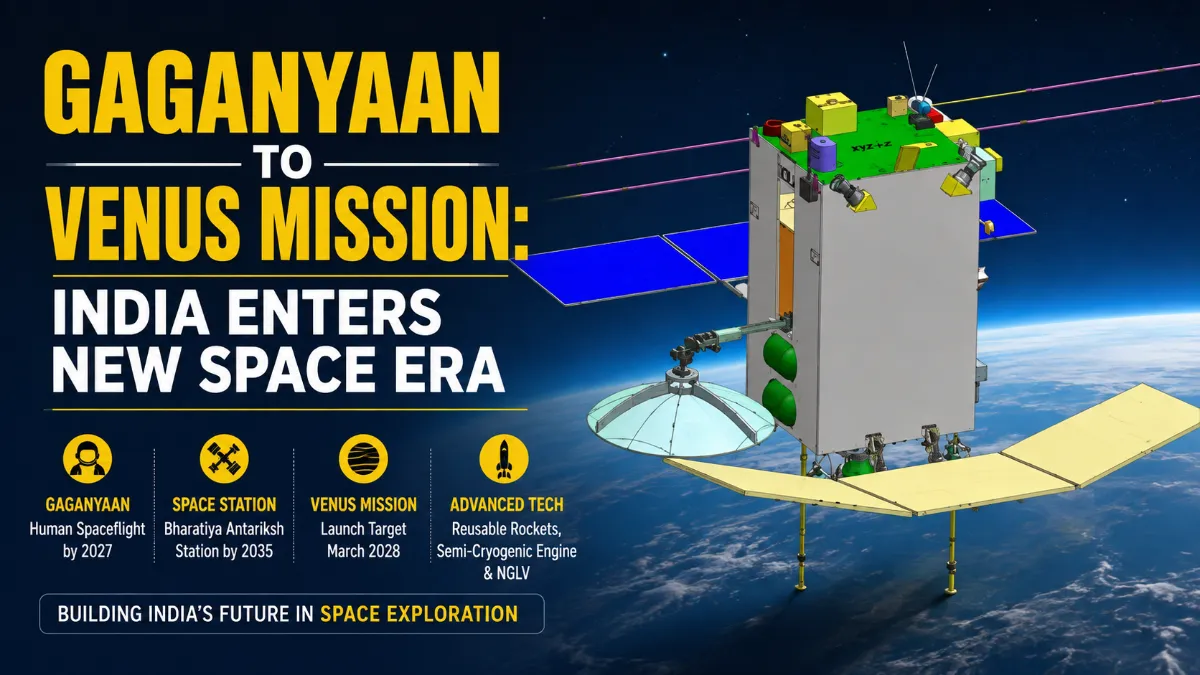
India Space Exploration is entering a new phase as the country advances its human spaceflight, planetary exploration and next-generation launch programmes. Gaganyaan, the Bharatiya Antariksh Station (BAS) and the Venus Orbiter Mission are at the centre of this roadmap.
ISRO is also developing reusable launch systems, semi-cryogenic propulsion, advanced docking technologies and the Next Generation Launch Vehicle (NGLV). These programmes aim to strengthen India’s capabilities in complex space missions and improve long-term access to space.
India Space Exploration: Gaganyaan Targets Human Spaceflight
The Gaganyaan programme aims to send three Indian astronauts to a 400-km orbit for three days. The programme was approved in 2019 and received an expanded outlay of Rs 20,193 crore in 2024.
The programme now covers eight missions. These include precursor missions for the future Bharatiya Antariksh Station.
ISRO is targeting the first uncrewed experimental mission for the fourth quarter of 2026. The mission will validate key technologies, including Vyommitra. The first crewed Gaganyaan mission is targeted for 2027.
Bharatiya Antariksh Station to Build Long-Term Orbital Capability
India is also developing the Bharatiya Antariksh Station (BAS). The planned station will have five modules and is targeted for operationalisation by 2035.
The first module, BAS-01, is planned for 2028. It will support long-duration human spaceflight, microgravity research and advanced orbital operations.
ISRO is also studying SPADEX-2 and SPADEX-3. These missions could support the development of docking, sample transfer, crew transfer and power, fluid and propellant transfer technologies.
Venus Orbiter Mission to Advance Planetary Science
The Venus Orbiter Mission is targeted for launch in March 2028. The mission will study Venus’ geology, atmosphere and ionosphere.
It will also demonstrate technologies such as aerobraking and advanced thermal management. These capabilities can support future planetary missions and complex deep-space operations.
Reusable Launch Systems to Support India Space Exploration
ISRO is working on several technologies to improve launch capacity and mission efficiency.
These include a 200-tonne thrust semi-cryogenic engine and a semi-cryogenic booster for the LVM3. The agency is also developing a VTVL-based booster recovery system.
Another major programme is the partially reusable LOX-methane-powered NGLV. ISRO is also working on a winged orbital re-entry vehicle.
These technologies could increase payload capacity and launch frequency. Reusability could also help reduce launch costs over the long term.
India Builds a Broader Space Technology Ecosystem
The combined roadmap marks a shift from individual space missions towards a broader and more integrated space programme.
Gaganyaan will build human spaceflight capabilities. BAS will support sustained operations in low Earth orbit. The Venus mission will expand India’s planetary science capabilities.
At the same time, reusable launch vehicles, semi-cryogenic propulsion and NGLV technologies can strengthen India’s commercial and strategic access to space.
With these initiatives, India Space Exploration is moving towards more complex missions, sustained human presence in space and advanced launch capabilities. The roadmap positions India for a larger role in the global space economy and next-generation space exploration.