

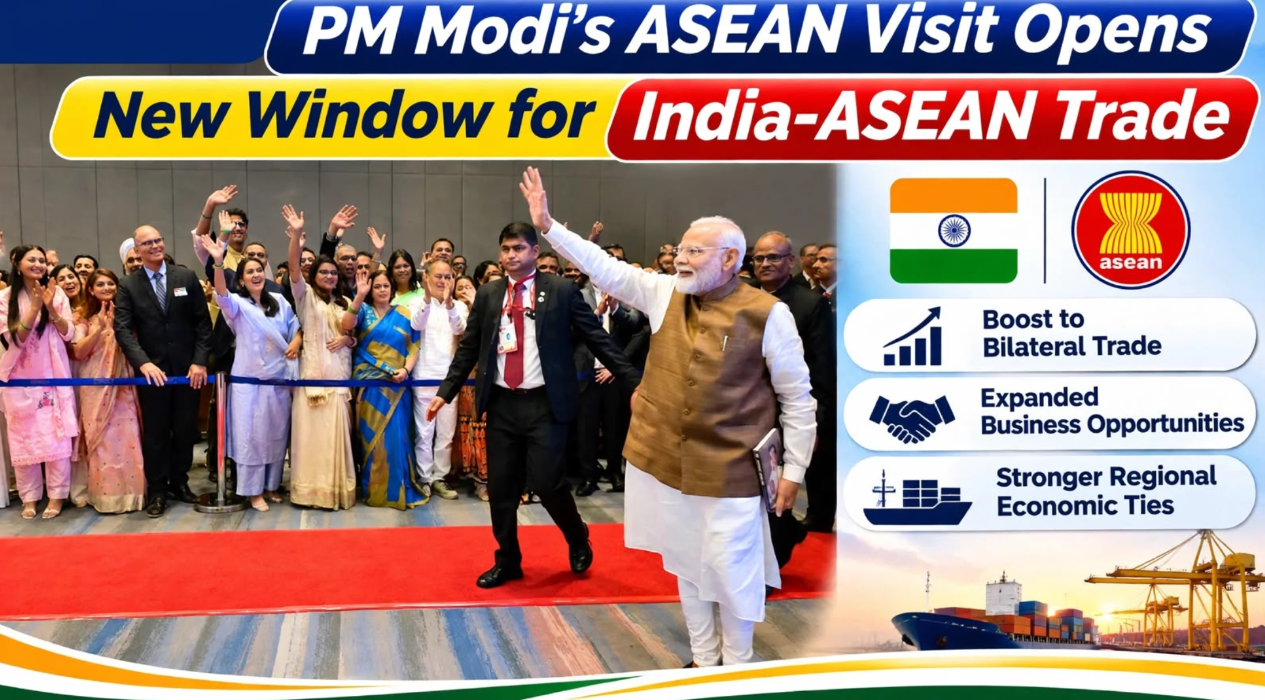
Prime Minister Narendra Modi’s Manila visit for the ASEAN-India Summit has opened an opportunity to strengthen India’s economic engagement with Southeast Asia. With bilateral trade reaching $128.38 billion in 2025-26 and negotiations underway to review the ASEAN-India Trade in Goods Agreement (AITIGA), India is seeking greater export access, balanced trade and deeper regional supply-chain integration.
India-ASEAN trade reached $128.38 billion in 2025-26, with a trade deficit of $51.55 billion. India is seeking a more balanced trade relationship through the AITIGA review and has called for stronger rules of origin to prevent the misuse of preferential tariff arrangements. Connectivity projects such as the India-Myanmar-Thailand Trilateral Highway and the Kaladan project could also strengthen regional trade.
PM Modi’s Manila Visit Puts Economic Partnership in Focus
Prime Minister Narendra Modi’s participation in the 23rd ASEAN-India Summit comes at a time when India is seeking to strengthen its economic engagement with Southeast Asia alongside its expanding maritime and strategic cooperation.
India’s engagement with ASEAN has developed across maritime security, defence cooperation and regional connectivity. The next priority is to deepen commercial relations, expand market access for Indian exporters and strengthen India’s participation in regional value chains.
The issue has gained importance as ASEAN remains one of India’s major trading partners, accounting for 10.55 per cent of India’s total global trade in 2025-26, according to the Ministry of Commerce and Industry.
India-ASEAN Trade Reaches $128.38 Billion, but Deficit Widens
India’s merchandise trade with ASEAN reached $128.38 billion in 2025-26, comprising imports of approximately $89.96 billion and exports of around $38.41 billion. This resulted in a trade deficit of approximately $51.55 billion.
The widening imbalance has become an important consideration in India’s efforts to strengthen the economic partnership.
India’s exports to ASEAN declined from around $42.4 billion in 2021-22 to approximately $38.4 billion in 2025-26, while imports increased. These figures underline the need to improve export competitiveness and secure better market access for Indian businesses.
The growing trade relationship therefore presents both opportunities and challenges for India and ASEAN.
AITIGA Review Key to More Balanced Trade Relations
The proposed review of the ASEAN-India Trade in Goods Agreement (AITIGA) is emerging as an important opportunity to address trade imbalances and improve the functioning of the existing arrangement.
India has sought a more balanced, effective and business-friendly agreement. New Delhi has also raised concerns about the possible misuse of preferential tariff arrangements through the routing of goods from third countries, particularly China, through ASEAN member states.
Stronger rules of origin are among the issues India wants addressed to ensure that preferential trade benefits reach eligible producers and exporters.
The Ministry of Commerce and Industry has reiterated that the AITIGA review should facilitate enhanced trade flows, address existing trade asymmetries and make the agreement more user-friendly for businesses.
India Seeks Greater Access to Regional Supply Chains
India’s withdrawal from the Regional Comprehensive Economic Partnership (RCEP) in 2019 has added importance to its efforts to deepen economic integration with Southeast Asia through other regional arrangements.
A stronger commercial relationship with ASEAN could create opportunities for Indian manufacturers and exporters to participate more actively in regional supply chains.
Ajay Sahai of the Federation of Indian Export Organisations has argued that the success of the AITIGA review should be measured by the export opportunities and business partnerships it creates, rather than simply by the number of tariff concessions.
This approach places emphasis on simpler customs procedures, regulatory transparency, improved market access and stronger business-to-business connections.
Connectivity Projects to Strengthen India-Southeast Asia Trade
Physical connectivity is another important component of India’s engagement with ASEAN.
The proposed India-Myanmar-Thailand Trilateral Highway and the Kaladan Multi-Modal Transit Transport Project are intended to strengthen connectivity between India’s northeastern region and Southeast Asia.
However, progress on these projects has faced delays linked to instability in Myanmar and infrastructure-related challenges. Their completion could improve the movement of goods and people, support cross-border trade and create new economic opportunities for the region.
India has also been expanding maritime and security cooperation with ASEAN countries, providing a foundation for broader regional engagement.
2027 to Mark 35 Years of India-ASEAN Dialogue Relations
India and ASEAN will mark 35 years of Dialogue Relations in 2027, providing an opportunity to strengthen cooperation across trade, investment, maritime security, connectivity and technology.
Prime Minister Modi has described ASEAN as central to India’s MAHASAGAR vision, underlining the importance of Southeast Asia in India’s wider regional and maritime engagement.
The Year of ASEAN-India Maritime Cooperation has also highlighted India’s commitment to maritime partnerships and regional stability.
The next phase of the relationship is expected to place greater emphasis on translating strategic cooperation into stronger economic engagement, with improved trade access and regional connectivity benefiting businesses on both sides.
Prime Minister Modi’s Manila visit comes at an important stage in India-ASEAN relations. While maritime and strategic cooperation have expanded, the widening trade deficit and declining Indian exports underline the need for a more balanced commercial partnership. The AITIGA review, improved connectivity and deeper integration into regional supply chains could help strengthen India’s economic engagement with Southeast Asia.