


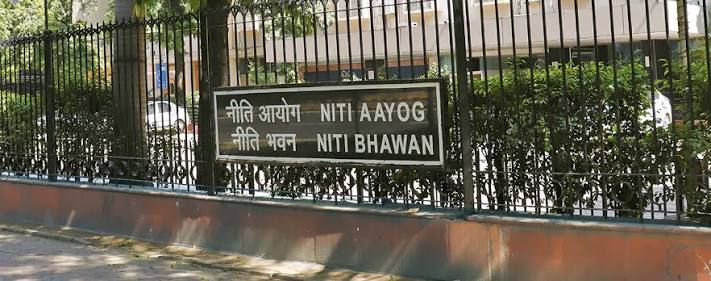
In spite of ongoing global economic uncertainties, India’s external sector proved resilient in FY2025-26, as the country’s overall merchandise and services trade increased by 5.4% year-on-year to reach $1.84 trillion, as reported in the most recent “Trade Watch Quarterly” report by NITI Aayog.
Prominent authorities, including the NITI Aayog CEO, were present in New Delhi as the report was released by Ashok Kumar Lahiri, Vice-Chairman of the NITI Aayog.
The research states that strong increase in services exports was the major factor keeping India’s trade performance steady during the January-March quarter of FY2025-26. The general composition of trade remained balanced, even as merchandise exports moderated and imports soared.
The robust success of India’s service industry is one of the report’s most prominent features. A robust services trade surplus was maintained thanks to a 9.1% increase in exports, which considerably outpaced import growth. In 2025, India was still the world’s eighth-largest exporter of services. The growth rate of services exports from 2015 to 2025 was 10.3%, which was much higher than the global average.
During FY2025-26, India’s overall exports climbed by 4.2% and imports by 6.5%, highlighting the country’s increasing involvement in the global economy.
The pharmaceutical industry in India has grown into a key component of the country’s economy, and this fact is highlighted in the report. The sector is contributing to India’s rising global profile thanks to its robust manufacturing capabilities, worldwide competitiveness in generic medicines, and growing integration into global healthcare supply chains.
The projected worldwide demand for APIs and pharmaceuticals is around $1.3 trillion in the year 2025. As a leading provider of reasonably priced pharmaceuticals globally, India’s $35.8 billion in pharmaceutical and API exports solidified its position during the year.
India has a large international presence in the pharmaceutical formulations market, especially in generic medications and retail medicaments. This is where the majority of India’s pharmaceutical exports are located. India has a lot of space to grow in the high-value segments of the pharmaceutical industry, such as biologics, immunologicals, biosimilars, and advanced medicines, according to NITI Aayog.
Even though India has made strides in producing antibiotics and specialist chemical intermediates, the research stresses that the country is still heavily reliant on Chinese pharmaceutical raw materials and intermediates.
A large portion of India’s pharmaceutical output, exports, and involvement in global value chains are concentrated in the three states of Telangana, Gujarat, and Maharashtra. Powerful industrial ecosystems, cluster-based development, internationally competitive businesses, and enabling government policies have all contributed to their success.
With an eye on the future, NITI Aayog anticipates that India’s pharmaceutical industry will play an increasingly important part in global value chains. The key to increasing value addition is increasing domestic API production, investing in R&D, building innovation ecosystems, making regulations more efficient, and boosting market access in important export destinations.
According to the report, India can cement its role as a world leader in pharmaceutical manufacturing and healthcare innovation by investing in technology, skills, and innovation. This will allow the country to sustainably develop its commerce and exports in the long run.
Disclaimer: All news articles are sourced through valid sources, and Business Unlimited (BU) doesn’t have any exclusive rights on these pieces. If BU features any exclusive story or article, it will be marked as Exclusive Story.