

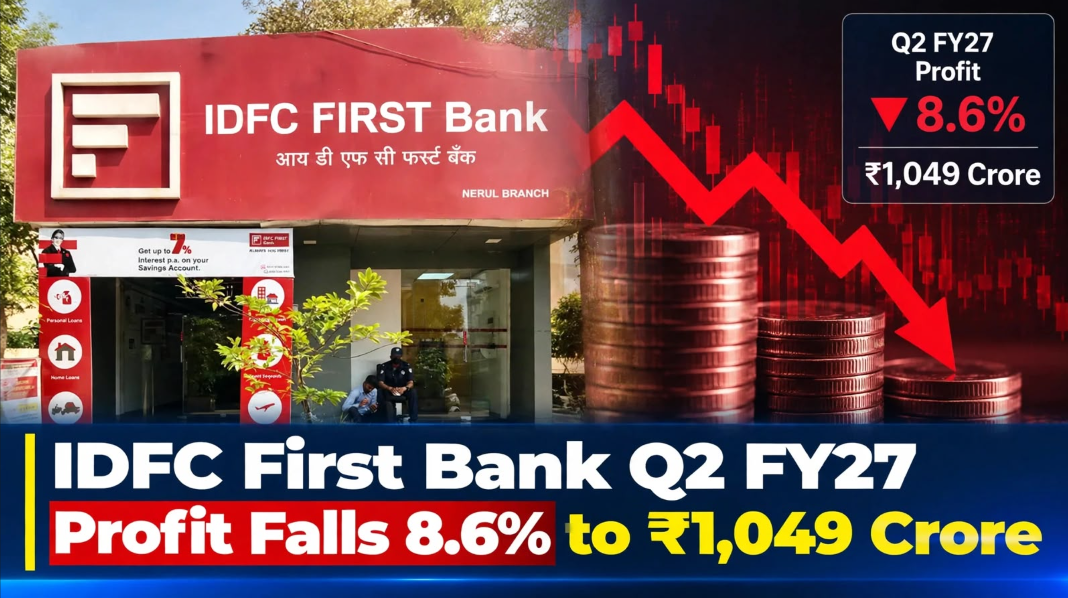
IDFC First Bank reported a consolidated net profit of ₹1,049.17 crore in Q2 FY27, down 8.59% from ₹1,147.82 crore in Q1 FY27. However, net interest income (NII) rose 21.04% year-on-year to ₹6,188 crore. The bank also recorded growth in deposits and advances, alongside an improvement in asset quality.
IDFC First Bank Reports Growth in Net Interest Income
The bank’s NII increased 3.59% quarter-on-quarter from ₹5,974 crore and 21.04% year-on-year from ₹5,112.81 crore in Q2 FY26.
Asset quality improved during the quarter. The gross non-performing asset (NPA) ratio declined to 1.32% from 1.51% in the previous quarter. The net NPA ratio also fell to 0.40% from 0.44%.
Provisions stood at ₹1,137 crore, compared with ₹1,452 crore in Q2 FY26.
Deposits and Advances Record Strong Growth
IDFC First Bank’s total deposits rose 25.9% year-on-year and 11.8% quarter-on-quarter to ₹3,48,583 crore.
The current account and savings account (CASA) ratio stood at 48.4%, compared with 50.1% previously. The bank attributed the decline primarily to the mobilisation of large foreign currency non-resident bank (FCNR(B)) deposits during the quarter.
Loans and advances, including credit substitutes and FCNR(B)-backed loans, grew 30.1% year-on-year to ₹3,46,913 crore.
CEO Highlights Operating Efficiency and Funding Costs
Managing Director and CEO V. Vaidyanathan said operating expense growth had lagged income growth by 500 basis points for two consecutive quarters. He added that the cost-to-income ratio continued to decline, while return on assets was approaching 1%.
Vaidyanathan also said the bank had raised more than ₹34,000 crore through FCNR(B) deposits. According to the supplied report, these deposits provided three-to-five-year liquidity at a cost around one percentage point below domestic deposits.
IDFC First Bank Shares Decline 3.47%
Shares of IDFC First Bank closed at ₹72.35 on the BSE on Friday, down 3.47%. The stock’s reported 52-week high stood at ₹89.58, while its 52-week low was ₹58.08.
The bank’s Q2 FY27 performance reflected strong growth in NII, deposits and advances, along with improved asset quality. However, consolidated net profit declined sequentially. Operating efficiency, funding costs and the sustainability of income growth will remain important indicators in the coming quarters.