

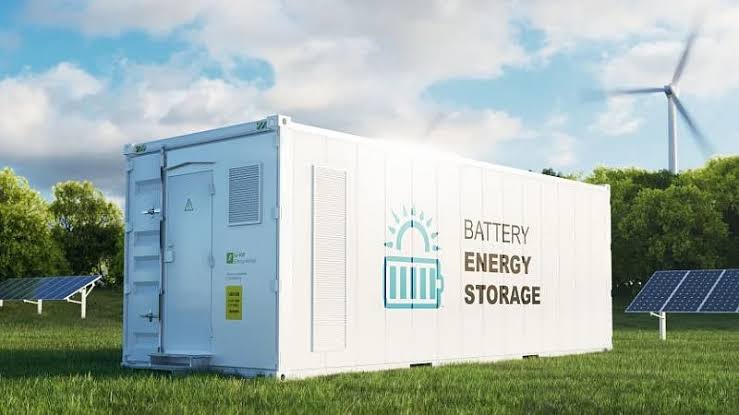
The Indian government would spend ₹3.49 lakh crore by 2031–32 to greatly increase the capacity of the country’s Battery Energy Storage System (BESS), according to Monday’s statement from the Ministry of Power to Parliament. The government’s goal, according to Shripad Naik, Minister of State for Power, in response to a query in the Rajya Sabha, is to reach an installed capacity of 8.68 GW/34 GWh by 2026-27, with an increase to 47.24 GW/236 GWh by 2031-32. In order to facilitate the shift to a low-carbon energy system, speed up the deployment of renewable energy sources, and enhance grid stability, India has made this investment.
The government intends to invest ₹1.29 lakh crore, alongside BESS, towards the development of Pumped Storage Plants (PSPs). In order to achieve India’s ambitious renewable energy ambitions and manage the intermittent nature of solar and wind power, NITI Aayog states that large-scale energy storage systems are crucial. Grid flexibility, the amount of renewable energy curtailed, and overall energy security are all predicted to increase with the construction of storage technology.
Image: Outlook Business
Projects awarded within the specified timeframes, such as hydro pumped storage projects (PSPs) and co-located BESS, have also been granted gearbox charge waivers. The Central Electricity Regulatory Commission (CERC) has also authorised storage-based resources to supply tertiary and secondary reserves, two auxiliary grid services. This means that battery storage projects can now work with conventional power plants to help balance the grid in real-time.
The Ministry of Heavy Industries is putting a Production Linked Incentive (PLI) Scheme worth ₹18,100 crore into action to boost domestic manufacturing. The scheme aims to build a manufacturing capacity for 50 GWh of Advanced Chemistry Cells (ACC), with 10 GWh set aside for grid-scale stationary energy storage. With the help of these programs, India hopes to speed up its transition to a clean energy future that is robust, sustainable, and creates jobs. They also hope to entice substantial private investment.
An important milestone in developing a dependable power system that relies on renewable energy sources is the government’s intention to invest ₹3.49 lakh crore in battery energy storage systems and ₹1.29 lakh crore in pumped storage plants. This move will help India achieve its energy security objectives and long-term clean energy targets.