

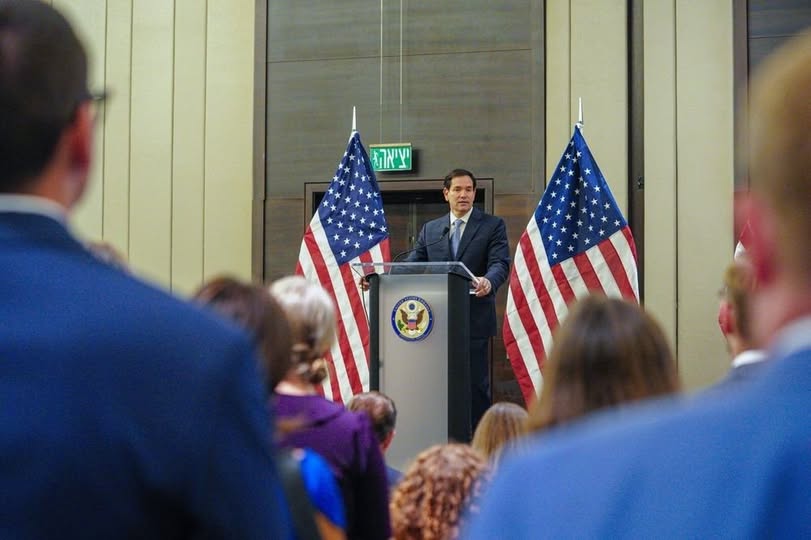
As Washington gets ready for a string of significant global engagements later this year, Secretary of State Marco Rubio announced on Monday that the United States will host the G20 Foreign Ministers’ Meeting in Atlanta, Georgia, on October 30-31.
Foreign ministers from the world’s top economies will gather at the ministerial meeting to further the G20’s goal of fostering global stability and economic prosperity, according to the US State Department.
Open markets and resilient supply chains, as well as bolstering international cooperation in the face of global economic challenges, are likely to be the topics of discussion.
Prior to the G20 Leaders’ Summit in December, which is set to take place under the presidency of US President Donald Trump, this meeting will play a crucial role.
According to the State Department, Atlanta was selected as the site for high-level multilateral engagement due to its status as a hub of diplomacy, commerce, and international connectivity.
Along with the festivities commemorating the United States’ 250th anniversary, the G20 Leaders’ Summit has been officially announced by Washington to take place at Trump National Doral in Miami, Florida, from December 14th to the 15th.
There will likely be a wide range of global priorities discussed at the meeting, though the State Department has not announced the specific ministerial agenda, confirmed the delegations that will be attending, or announced any bilateral engagements.
Global trade, supply chain resilience, and international economic coordination are topics that India, a prominent G20 member and a growing strategic and economic ally of the US, is likely to keep a careful eye on.
Secure supply chains in strategic sectors like semiconductors and critical minerals, as well as reforms in multilateral institutions, have long been priorities for New Delhi.
United States, India, China, Japan, Germany, France, Brazil, Saudi Arabia, South Korea, Australia, and the European Union are all part of the G20 grouping, which includes major economies. Together, these countries account for approximately two-thirds of the world’s population and nearly 85 percent of global GDP.
In addition to providing a forum for discussion of geopolitical tensions and changing global economic dynamics, recent G20 engagements have centred on topics such as energy security, climate finance, diversifying supply chains, and new technology; these issues have also taken center stage in discussions about economic resilience.
Image Credit: AIR
Disclaimer: All news articles are sourced through valid sources, and Business Unlimited (BU) doesn’t have any exclusive rights on these pieces. If BU features any exclusive story or article, it will be marked as Exclusive Story.