


For nearly two years now, Bangladesh’s garment industry — the backbone of its economy and its largest employer — has been caught in a cycle of political instability that shows little sign of fully resolving. What started with the mass protests and change of government in August 2024 has resurfaced repeatedly since, most recently through renewed unrest and factory disruptions into late 2025 and early 2026. For Indian textile manufacturers watching from across the border, this prolonged instability has quietly become one of the more consequential opportunities the industry has seen in years.
The numbers tell their own story. Bangladesh’s ready-made garment (RMG) exports — which account for roughly 85 percent of the country’s total export earnings — declined 2.63 percent year-on-year to $19.37 billion in the first half of FY2025-26, down from $19.88 billion in the same period a year earlier. Exporters there have openly blamed political tensions, security concerns and eroding buyer confidence, layered on top of weak global demand and rising input costs. Exports fell across nearly every major destination, including the EU, the US and several non-traditional markets — a broad-based slowdown, not a one-market blip.
Industry analysts had earlier estimated that India could gain an additional $300-400 million in monthly business if even 10-11 percent of Bangladesh’s garment orders were redirected — and global brands, wary of continued disruption, have indeed been exploring alternatives. Reuters reporting from exporters at India’s Apparel Export Promotion Council described a genuine rush of enquiries from US companies actively seeking alternative suppliers, with domestic manufacturers at times struggling to keep pace with the sudden surge in order volume.
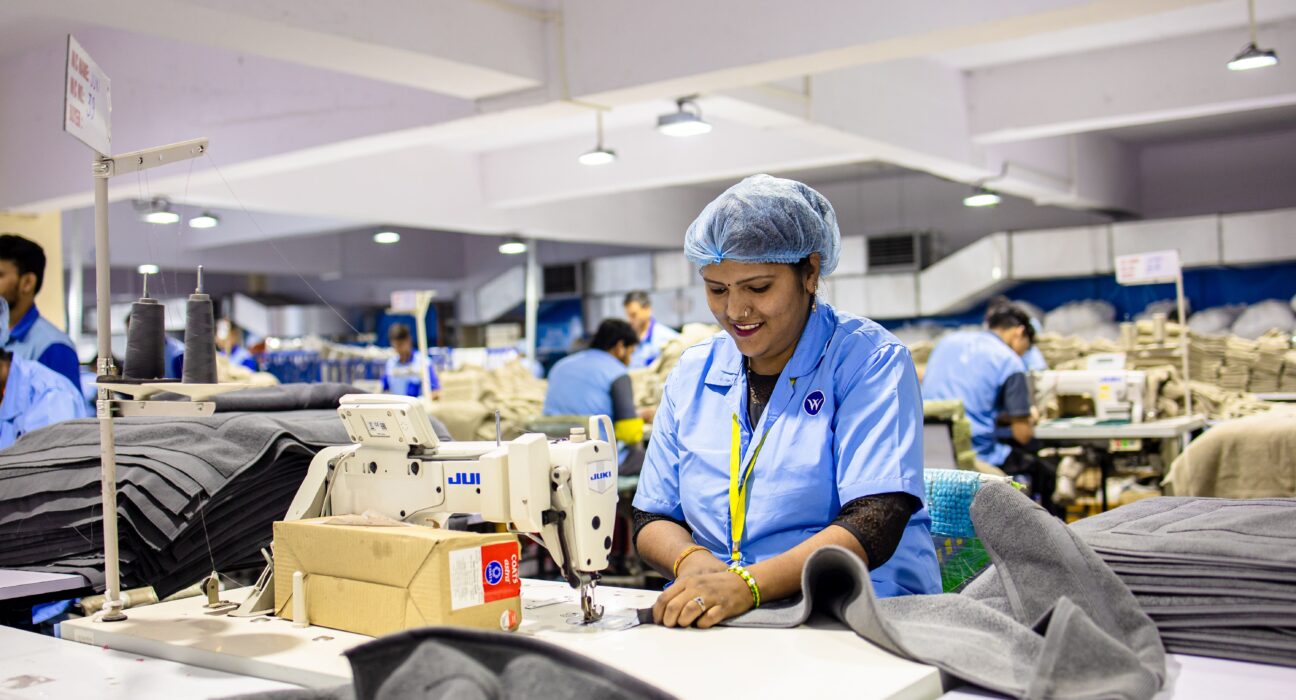
Nowhere has this shift been more visible than in India’s traditional textile hubs, particularly Tirupur in Tamil Nadu — a cluster long known for knitwear and garment manufacturing at scale. As global buyers moved to diversify sourcing away from a single, increasingly unpredictable market, clusters like Tirupur were well positioned to absorb some of that diverted demand, given their existing capacity, established compliance credentials and manufacturing depth.
Ironically, the relationship between the two textile industries runs in both directions. India isn’t just a competitor to Bangladesh’s garment sector — it’s also one of its most important raw material suppliers. Indian cotton and synthetic fibre exports feed directly into Bangladesh’s spinning and weaving operations, and that dependency has only deepened during the crisis. By early 2026, nearly 78 percent of Bangladesh’s cotton yarn imports alone came from India, a dependence that Bangladeshi millers themselves have called a “national crisis” — domestic spinners there were reportedly sitting on unsold yarn worth about 12,500 crore Bangladeshi Taka, beaten down by more competitively priced Indian imports. That’s a striking dynamic: even as Bangladesh’s finished-garment exporters lose ground to Indian rivals, Bangladesh’s own textile supply chain has grown more reliant on Indian inputs to function at all.
Bangladesh’s challenges aren’t purely political, either. The country’s upcoming graduation from Least Developed Country (LDC) status is set to strip away preferential trade privileges that have long made its apparel exports cheaper in key markets like the EU and US. Combined with high gas prices, utility shortages and rising bank interest rates, the structural pressures facing Bangladesh’s garment sector look likely to persist well beyond any near-term political resolution — which suggests the current window of opportunity for Indian exporters may prove more durable than a temporary blip.
The Indian government hasn’t been a passive observer of this shift. Reports have pointed to plans for expanded budgetary support for the textile and garment sector, tariff cuts on key raw materials such as polyester and viscose staple fibre, and enhanced production-linked incentive allocations — all aimed at helping domestic manufacturers scale up quickly enough to capture the demand now looking for a new home. With India’s textile sector already employing an estimated 4.5 crore people and contributing meaningfully to national GDP, exports and industrial output, policymakers appear keen to convert a neighbour’s misfortune into a lasting structural gain rather than a short-lived windfall.
The message is pretty clear for B2B buyers, sourcing managers and manufacturing partners watching the South Asian textile landscape. Bangladesh’s instability has created a real and measurable window and Indian manufacturers – particularly in established hubs like Tirupur – could gain a meaningful share of it. Whether that translates into a permanent shift in global sourcing patterns will depend on how quickly Indian capacity, compliance standards and policy support can scale to match the moment. But for now, the currents of political disruption next door are flowing directly into India’s textile export numbers — and manufacturers who move decisively stand to benefit the most.