

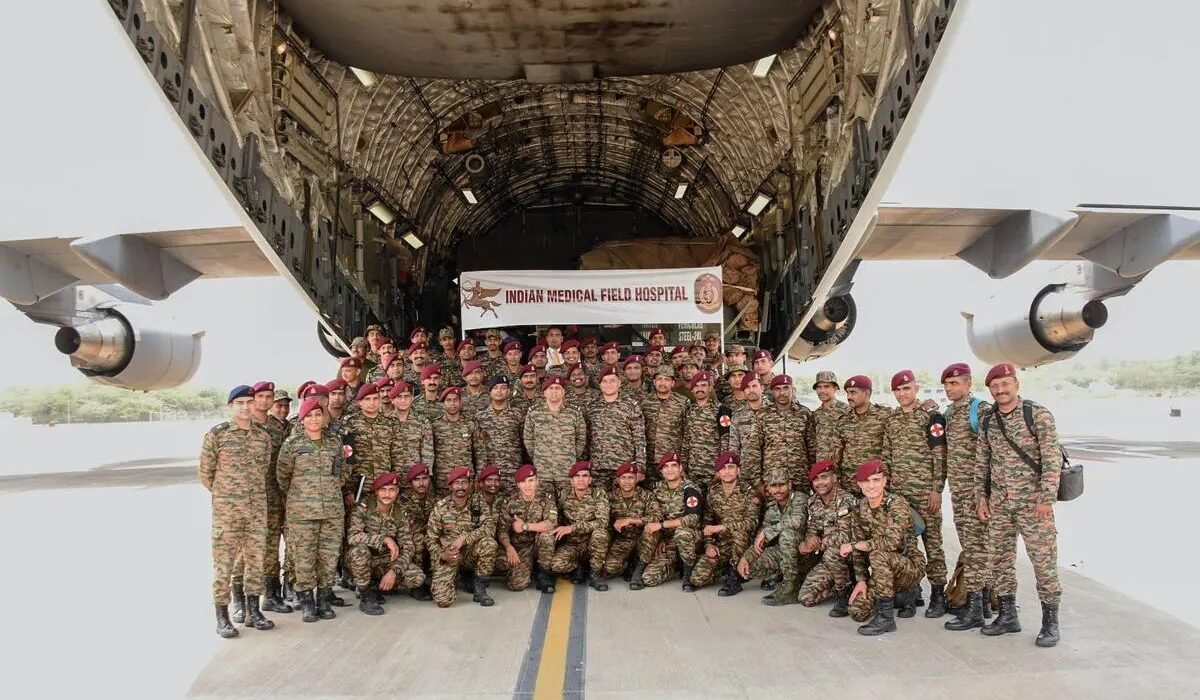
Operation Amistad is a relief expedition that India has launched to aid earthquake-hit Venezuela. This shows India’s dedication to global humanitarian assistance. With the number of natural disasters on the rise, India’s effort is a crucial demonstration of international cooperation in action. As a result of the catastrophic earthquake, the Indian Army has sent a medical detachment consisting of 41 personnel from the 60 Para Field Hospital to offer emergency treatment to individuals in need. To address the complicated medical concerns that arise as a result of these calamities, this contingent is made up of specialists who provide a wealth of knowledge and specialised abilities.
A demonstration of India’s dedication to humanitarian aid is the fact that Operation Amistad was carried out successfully. The capability of the Indian Armed Forces in disaster relief and the importance of global unity are both highlighted by this. The lessons learnt from this operation will surely shape future responses, improving readiness and coordination in global disaster management, as the nation continues to play a crucial role in worldwide humanitarian operations.
The medical crew boarded two C-17 Globemaster planes from the Indian Air Force and took off from Hindon Air Force Station. Nine highly-qualified medical officers with backgrounds in trauma care, emergency surgery, emergency medicine, and disaster response make up the team. They will be ready to handle the difficulties of delivering medical care in hazardous areas thanks to this extensive training. As local healthcare services are already struggling to cope with the disaster, their aim is to help treat injured survivors and create fast medical support in the impacted areas.
In addition to the medical staff, the Ministry of External Affairs is delivering roughly six metric tonnes of medical supplies and humanitarian aid to Venezuela. Included in this assistance are not only life-sustaining medications, but also the necessary emergency medical gear and supplies for handling catastrophe response. Meeting the urgent health needs of the impacted people was the first concern, and this was reflected in the meticulous supply selection. In order to guarantee that healthcare personnel on the ground are adequately prepared to deal with the surge of patients that usually follows big disasters, such all-inclusive help packages are crucial.
The Aarogya Maitri Project in India is deploying the BHISHM Cube, which stands for “Bharat Health Initiative for Sahyog, Hita & Maitri,” as a major component of Operation Amistad. A completely operational field hospital accommodating up to 200 patients can be quickly created from this indigenous modular medical facility. The BHISHM Cube is a mobile medical facility that can respond quickly and effectively to humanitarian crises by providing oxygen systems, ventilators, diagnostic tools, surgical equipment, and intensive care facilities. In catastrophe situations, where time to deployment is of the essence in determining survival rates and recovery durations, its design becomes even more advantageous.
The plane will stop at friendly nations to refuel on its way to Venezuela from India because the distance is about 14,300 km. Not only do these scheduled pauses guarantee the plane will get there safely, but they also represent the cooperative nature of nations responding to humanitarian disasters. This effort showcases India’s increasing capacity to react swiftly to global catastrophes and solidifies its reputation as a dependable ally in humanitarian relief. It shows how logistical planning and international cooperation are crucial to contemporary disaster assistance.
The increasing involvement of India in international disaster aid is exemplified by Operation Amistad. India is committed to bolstering international partnerships and providing prompt help to nations hit by natural catastrophes through its well-developed medical infrastructure, skilled armed forces, and humanitarian aid. Reaffirming the conviction that nations can overcome disaster problems together, this mission showcases India’s commitment to humanitarian principles and its willingness to help people in need. It also marks a remarkable logistical achievement.
Image: Business Line