

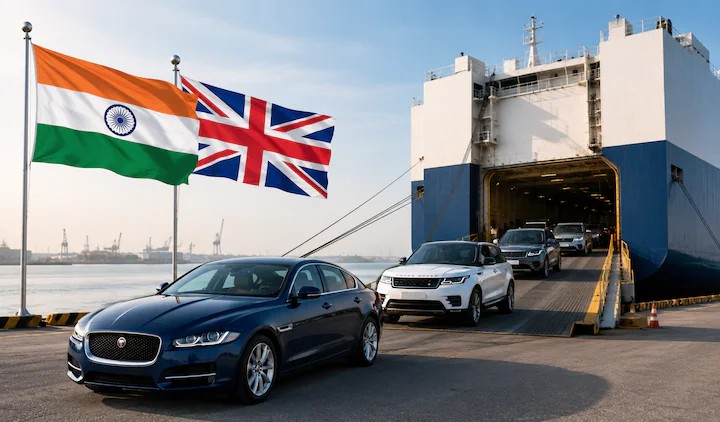
During the first fifteen years of the trade pact’s implementation, India will let the import of 3,78 lakh units of conventional-engine passenger cars, including mass segment models, from the UK at a concessional customs charge.
The agreement calls for quotas on both sides and a reduction in tariffs on imported automobiles from around 110% to 10%. Released on Wednesday, the India-UK CETA document states that beginning in the sixth year, India will be able to export duty-free electric, hybrid, and hydrogen passenger cars to the UK in the price range of GBP 20,000 to GBP 80,000. The total quota will reach a peak of 88,000 units in the fifteenth year and continue thereafter.
Indian automakers including Mahindra & Mahindra, Maruti Suzuki, and Tata Motors Passenger Vehicles would reap the benefits of this.
Commencing on July 15, the two nations will put into effect the Comprehensive Economic and Trade Agreement (CETA).
In the fifth year, across all designated categories of vehicles, the quota for conventional-engine passenger cars imported to India from the UK would exceed 37,000 units, and customs taxes will be reduced by 10 percent. There will be no further reduction in the duties.
There will be a reduction in customs duty to 30% from 11% in the first year, and the quota for passenger cars with engines larger than 3,000 cc (petrol) and 2,500 cc (diesel) is 10,000 units.
The quota is 5,000 units for cars with engine sizes of 1,500 cc (petrol), 2500 cc (diesel), and 3,000 cc (petrol), and the duty has been cut from 66% to 50%.
According to the document, in the first year of the accord, customs tax will be reduced to 50% from 66% in the mass market segment for engines with a displacement of up to 1,500 cc. The quota for approved imports is 5,000 units.
In the first year of the agreement’s implementation, a combined 20,000 units of passenger cars from all three categories will be permitted for import.
During the fifth year, there is a quota of 19,000 units for passenger cars with diesel engines larger than 2,500 cc and more than 3,000 cc. On the other hand, there is a cap of 9,000 units for cars with 1,500 cc, 2,500 cc, and 3,000 cc engines, and a similar quota is fixed for cars with engines smaller than 1,500 cc, subject to a 10% concessional duty.
Beginning in the fifteenth year, the overall quota will be maintained at 15,000 units per annum, with duties set at 10% for all three groups.
Indian automakers Tata Motors, Mahindra & Mahindra, and Maruti Suzuki are vying for worldwide dominance in the mass-market electric car segment, although the country has not yet opened its market to vehicles priced below GBP 40,000 (CIF).
Image: Business To Business
Disclaimer: All news articles are sourced through valid sources, and Business Unlimited (BU) doesn’t have any exclusive rights on these pieces. If BU features any exclusive story or article, it will be marked as Exclusive Story.