


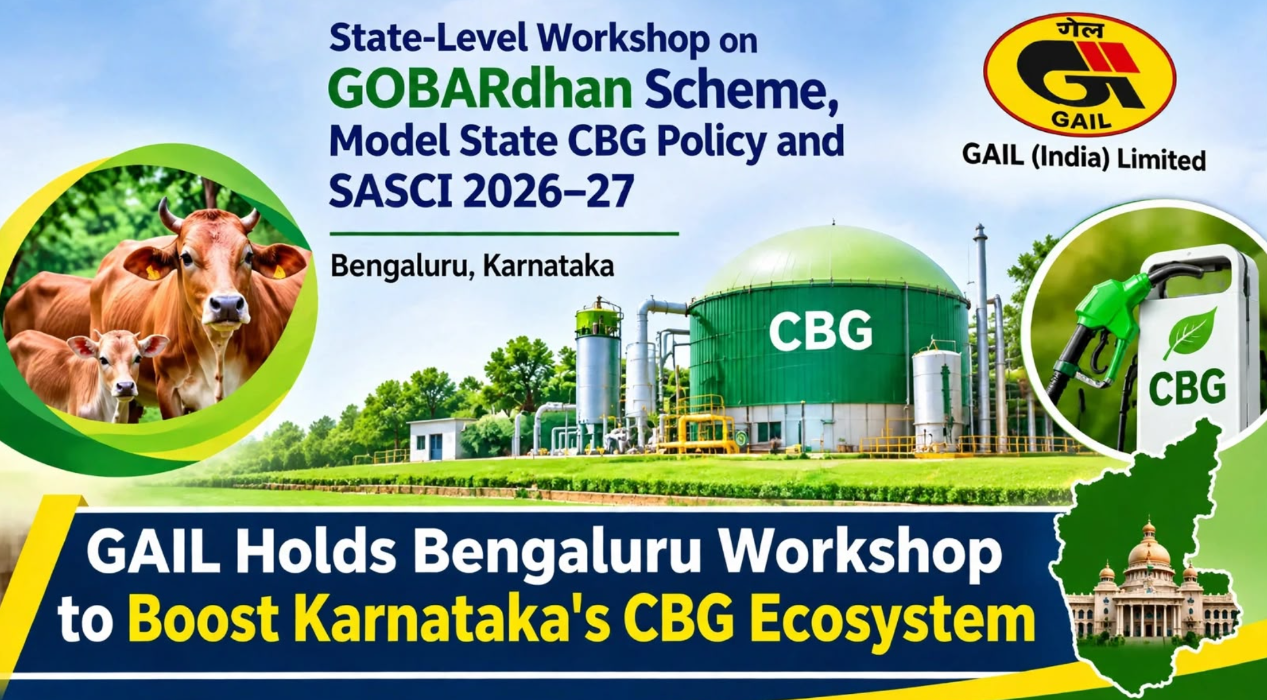
GAIL (India) Limited organised a state-level workshop in Bengaluru, Karnataka, on November 20, 2026, to strengthen the state’s Compressed Biogas (CBG) ecosystem under the GOBARdhan Scheme, Model State CBG Policy and SASCI 2026–27. The workshop focused on policy support, investment opportunities, inter-departmental coordination and accelerating waste-to-energy projects.
Held under the aegis of the Ministry of Petroleum and Natural Gas, Government of India, the workshop was organised on the theme “Waste to Wealth: Scaling GOBARdhan”.
The event brought together government officials, industry representatives, urban local bodies, oil and gas marketing companies, City Gas Distribution (CGD) entities, CBG developers, financial institutions and other stakeholders to discuss ways to strengthen Karnataka’s CBG ecosystem.
Key participants included Dr. Shalini Rajneesh, IAS, Chief Secretary, Government of Karnataka; Maheshwar Rao, IAS, Chief Commissioner, Greater Bengaluru Authority; Dr. S. Selvakumar, IAS, Principal Secretary, Commerce and Industry Department, Government of Karnataka; Manoj Kumar Sharma, Director (Projects), GAIL; and Vikas Singh, Director (GP & Vig.), Ministry of Petroleum and Natural Gas.
Karnataka Plans New Bio-energy Policy Aligned with Centre’s Model CBG Policy
Addressing the workshop, Karnataka Chief Secretary Dr. Shalini Rajneesh highlighted the importance of coordinated action and effective implementation of state-level initiatives to promote sustainable waste management and clean energy solutions.
She said the Government of Karnataka plans to introduce a new State Bio-energy Policy covering Compressed Biogas, aligned with the Government of India’s Model CBG Policy. The proposed policy aims to address challenges faced by upcoming CBG projects and create an enabling environment for investment and implementation.
Vikas Singh, Director (GP & Vig.), Ministry of Petroleum and Natural Gas, highlighted government initiatives, including the GOBARdhan Scheme and SASCI 2026–27, aimed at accelerating the development of the CBG ecosystem. He emphasised the importance of state government support, institutional coordination and active stakeholder participation in expanding the sector.
The discussions also highlighted CBG’s contribution to India’s energy transition, energy security, reduced dependence on imported fuels and rural economic development.
Stakeholders Discuss Project Challenges and Investment Opportunities
A dedicated session on Karnataka’s State CBG Policy allowed stakeholders to discuss implementation challenges, regulatory requirements and the support needed from different government departments.
Industry representatives shared their experiences in developing CBG projects and highlighted issues related to feedstock aggregation and availability, statutory clearances, project financing, investment, market development and offtake arrangements.
A separate session on India Energy Week 2027 showcased opportunities for investment, innovation, technology exchange and collaboration across the energy value chain.
The discussions underlined the importance of bringing together government departments, project developers, financial institutions and industry stakeholders to accelerate CBG investments in Karnataka.
GAIL Plans CBG Plants at 13 Locations in Karnataka
The workshop also highlighted GAIL’s growing commitment to the CBG sector in Karnataka. On November 13, 2026, the Prime Minister virtually laid the foundation stone for GAIL’s 300 tonnes per day (TPD) municipal solid waste-based CBG plant at Haralakunte, Bengaluru.
The project is being developed at an estimated investment of approximately ₹123 crore. Once operational, it is designed to process 300 tonnes of segregated organic municipal waste daily and produce:
- 12.6 tonnes of Compressed Biogas (CBG) per day.
- 21.6 tonnes of Fermented Organic Manure (FOM) per day.
The CBG produced at the facility will be supplied to GAIL Gas Limited.
GAIL is also pursuing plans to establish CBG plants at 13 locations across Karnataka, using different feedstock sources. At the national level, the company plans to develop at least 26 CBG plants across India.
Karnataka Seeks to Strengthen Its Bio-energy Sector
The workshop concluded with a consensus on strengthening collaboration among the Ministry of Petroleum and Natural Gas, the Government of Karnataka, industry stakeholders and financial institutions to address implementation challenges and expedite CBG projects.
Participants emphasised the need to tap Karnataka’s biomass resources, including agricultural biomass, sugar industry press mud and organic municipal waste, to support the development of the state’s bioenergy sector.
Reaffirming its commitment to the Government of India’s clean energy vision, GAIL said it would continue promoting the conversion of organic waste into renewable energy and valuable agricultural inputs.
The initiative supports the national objective of “Waste to Wealth” and the development of a sustainable and circular economy. With a proposed state bio-energy policy, 13 potential CBG project locations being pursued by GAIL and the Haralakunte waste-to-energy project, Karnataka is seeking to strengthen its role in India’s growing bioenergy sector.