

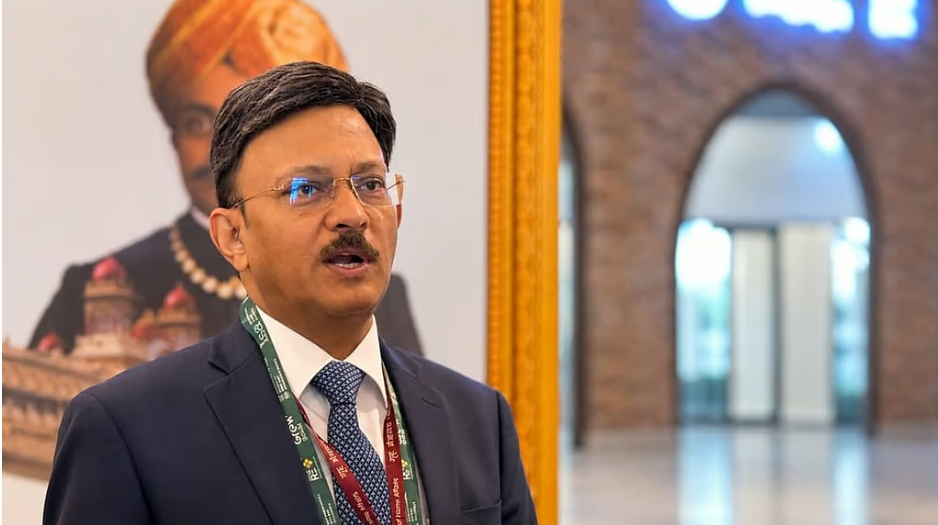
Karnataka expects electricity demand from data centres to increase by another 1,000 MW over the next four to five years, taking the sector’s growth requirements into account. Gaurav Gupta, Additional Chief Secretary of the state’s Energy Department, shared this outlook in an exclusive interview with Energy Watch on the sidelines of the Bharat Renewable Energy (BRE) Summit and Expo 2026. The Ministry of New and Renewable Energy (MNRE) organised the summit at Bharat Mandapam in New Delhi from November 2 to 5.
Gupta estimated the sector’s current electricity demand at 400 to 600 MW. “See, in data centre, we expect that right now the present demand may be of the order of 400 to 600 megawatts, but in the coming few years, maybe 4 or 5 years, we expect another 1,000 megawatts to get added,” he said. He added that demand could continue to increase beyond this period. “And after that, depending on the progress more and more may get added.”
Karnataka Plans Data Centre Capacity Across Three Cities
The state plans to support the expected demand through capacity additions in three cities. “So we expect that we will add about 500 MW capacity in Bangalore, 200 MW around Mysore, another 200 MW near Mangalore, and that capacity being added would be able to suffice for the immediate expansion in the next 4-5 years,” Gupta said.
He said the Energy Department was coordinating with the Industries Department, which would facilitate land availability, and the IT Department, which is in close contact with the IT industry. “And hopefully we will be able to respond to the needs of the industry,” he said.
According to a statement from the state’s Energy, Industries and IT ministers, the three proposed parks would have a combined capacity of 1,000 MW. On September 18, the state Cabinet approved the Karnataka Sustainable Data Centre Policy 2026–2031. The policy targets a cumulative data centre IT load of 1 GW by 2031 and has a budget of Rs 1,300.45 crore.
Targets 48 GW of Renewable Energy in 10 Years
Gupta told Energy Watch that the state had presented investors with a 10-year roadmap at the summit. “In the next 10 years, Karnataka requires almost 48,000 MW of power, renewable energy power,” he said.
The planned capacity addition will include wind, solar, hybrid projects, micro-hydro, pumped storage, battery storage and biomass, along with other initiatives. When asked whether the entire 48,000 MW would come from renewable energy, Gupta confirmed that it would.
However, the state does not plan to replace its thermal power capacity with renewable energy. “See, in India, because we have a fast growth, we are not talking about replacement of one, that is thermal, with renewables. We are talking about developing both but giving more emphasis to renewables.”
Renewable energy already accounts for a significant share of Karnataka’s installed power capacity, and Gupta expects this share to increase further. “So right now, almost 70 percent of our installed capacity is in renewables space. We hope and expect in the next 10 years it may go up to 85 percent,” he said.
He added that almost 90 per cent of the capacity to be added over the next decade would come from renewable energy. This would also increase the share of renewable energy in actual grid consumption. “from 30 percent… to more than 50 percent in the next 10 years,” he said.
In September, at the Bharat Electricity Indian Utility Week 2026 summit in New Delhi, Gupta had said Karnataka planned to increase its installed power capacity from more than 39 GW to 66 GW by 2030.
Focuses on Renewable Energy Near Consumption Centres
When asked whether large-scale renewable energy additions could lead to curtailment and transmission bottlenecks, similar to those reported in Rajasthan, Gupta said Karnataka was distributing new capacity across the state rather than concentrating generation in a single location.
“What has happened is Karnataka is adding renewable power responsibly and in a manner that is distributed across the state. We are not looking at one particular area in which there will be high concentration of power that is generated,” he said.
He contrasted Karnataka’s approach with that of states where renewable energy generation is concentrated in areas with limited local consumption. “Some other states which have seen concentration of renewable energy at a single location and no consumption in that area are facing problems with transmission and curtailment. We are trying to add renewable energy closer to the point of consumption,” he said.
He further explained that concentrating generation far from consumption centres requires substantial investment in transmission infrastructure. “But if you do it in a concentrated manner far away from the points of consumption, in that case you need to invest very heavily on the transmission lines.”
In Rajasthan, commissioned renewable energy capacity stood at about 23 GW in December 2025, while transmission capacity was approximately 18.9 GW, according to Northern Regional Load Despatch Centre (NRLDC) data.
Gupta said Karnataka was not facing similar constraints. “Karnataka, fortunately, we have no such problem of curtailment or transmission inadequacy,” he said. He added that both central and state transmission agencies were expanding the network alongside new generation capacity. “transmission is getting expanded together with addition of the generation capacity.”
The state expects this coordinated development to meet the electricity requirements of its various economic sectors. “We hope and expect that requirements of all the different economic sectors will be met without any kind of constraint,” he said.
Karnataka Plans Up to 6,000 MW of Pumped Storage
Karnataka expects to develop between 4,000 MW and 6,000 MW of pumped storage capacity, along with a similar amount of battery storage. Gupta said several projects had been identified, studied and approved, while work was progressing at three locations.
“Several of them have been identified, several of them have been studied and approved also. Project work is going on at three locations,” he said, naming Sharavathi, Saundatti and Narihalla. A fourth project at Varahi in Udupi district is currently under study. “We are getting the surveys and pre-feasibility established,” he said.
“We expect almost 4,000 to 6,000 MW of pumped storage overall,” Gupta said, “and then an equivalent number of battery storage in the days to come.”
The Central Electricity Authority’s (CEA) July 2026 status report on pumped storage development tracks the three projects. It lists Karnataka Power Corporation Limited’s (KPCL) 2,000 MW Sharavathy project as under construction, with commissioning expected in May 2032. The 1,600 MW Saundatti project in Belagavi district is also under construction, with commissioning expected in December 2027.
The report lists JSW Energy’s 300 MW Narihalla project in Ballari district as being under survey and investigation, with commissioning expected in 2029–30.
Karnataka to Reallocate Small Hydro Project Allocations
On the cancellation of Small Hydro Project (SHP) allocations in the state, Gupta said some developers had received allocations but had not made the required investments.
“Some people have shown intention to invest, they have not invested,” he said. “If they are not invested, we should cancel the earlier allocations made five years back, 10 years back, and reallocate them to the new investors.”
He said future allocations would include execution timelines to ensure that developers complete their projects within a reasonable period. “And with a time limit that, look here, in within 5 years, 10 years, within some reasonable time frame, you must execute the project,” Gupta said. “If you don’t execute, we will again cancel, reallocate to somebody else.”
The state is also preparing to tender additional small hydro capacity. “Another, I think, 150 MW we are going to add shortly. A tender is going to be called for that, but I think there will be a plan for another 600 MW or so,” he said.