


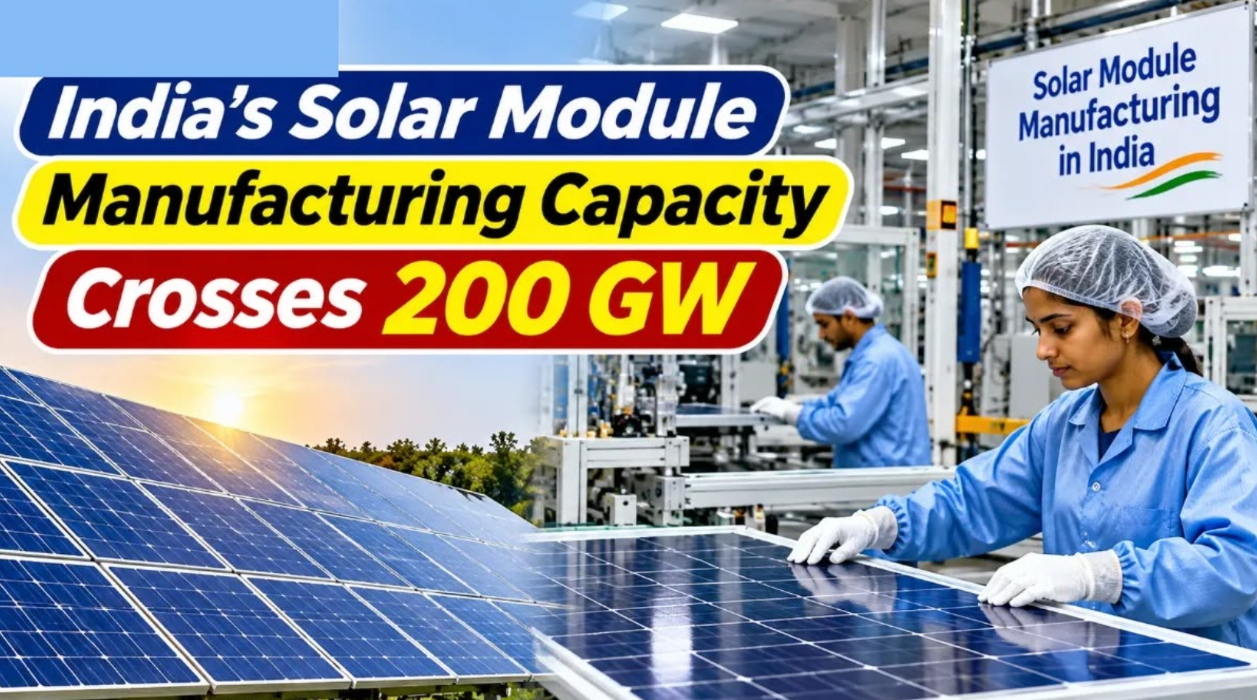
India’s solar module manufacturing capacity has crossed 200 GW, while domestic solar cell manufacturing capacity has reached approximately 45 GW, marking a major expansion of the country’s renewable energy industry. Union Minister Pralhad Joshi highlighted the growth alongside progress in rooftop solar, wind energy, battery storage and green hydrogen.
Solar Manufacturing Capacity Crosses 200 GW
India’s solar module manufacturing capacity has crossed 200 GW, while domestic solar cell manufacturing capacity has reached approximately 45 GW. Solar installations have increased the country’s installed solar capacity from 3 GW in 2014 to approximately 172 GW. The PM Surya Ghar scheme is also enabling nearly one lakh rooftop solar installations every six days, supporting wider adoption of renewable energy among households.
These developments were highlighted at the Bharat Renewable Energy Summit and Expo 2026, where policymakers, industry leaders and international stakeholders discussed opportunities to accelerate India’s clean energy transition.
PM Surya Ghar Drives Rooftop Solar Adoption
Union Minister for New and Renewable Energy Pralhad Joshi said the PM Surya Ghar: Muft Bijli Yojana had evolved into a mass movement, delivering financial savings and welfare benefits to households, states and the country. He highlighted that India is now completing approximately one lakh rooftop solar installations every six days under the initiative.
According to the minister, rooftop solar adoption is helping reduce carbon emissions, strengthen energy security during peak demand and enable households to generate income by selling surplus electricity to the grid. He also highlighted the country’s rapid solar power expansion, with installed solar capacity increasing from just 3 GW in 2014 to approximately 172 GW.
International Cooperation to Strengthen Solar Manufacturing
Minister of State for New and Renewable Energy Shripad Yesso Naik emphasised the importance of international cooperation in achieving the next phase of clean energy growth. He said the next terawatt of clean energy would require collaboration across countries, technologies and institutions.
He also invited diplomats and international representatives to share their perspectives on partnerships, investment, technology development, implementation and capacity building. The discussions highlighted the importance of strengthening international cooperation while expanding India’s domestic renewable energy manufacturing ecosystem.
Green Hydrogen and Emerging Technologies
The summit also hosted the 4th International Conference on Green Hydrogen, which reviewed progress under the National Green Hydrogen Mission. The mission targets an annual green hydrogen production capacity of 5 million tonnes by 2030.
Industry leaders, researchers, manufacturers and knowledge partners explored technology collaborations, research partnerships and opportunities to strengthen domestic supply chains. Other important sessions included discussions on India’s onshore and offshore wind energy potential, domestic giga-scale battery storage manufacturing and the use of Artificial Intelligence in renewable energy forecasting and grid management.
Energy Storage and Transmission Infrastructure
As India’s renewable energy capacity continues to expand, the government has highlighted the growing importance of energy storage and transmission infrastructure for maintaining grid stability and integrating variable renewable electricity.
Battery storage, advanced forecasting technologies and stronger transmission networks will be essential to ensure reliable power supply while accommodating higher contributions from solar and wind energy. The discussions at the summit underlined the need to combine domestic manufacturing, technological innovation and international partnerships to support India’s long-term clean energy ambitions.
Crossing 200 GW of solar module manufacturing capacity marks an important milestone in India’s renewable energy journey. Continued expansion of solar cells, rooftop installations, wind manufacturing, battery storage and green hydrogen will strengthen domestic capabilities and support India’s clean energy and energy security objectives.