

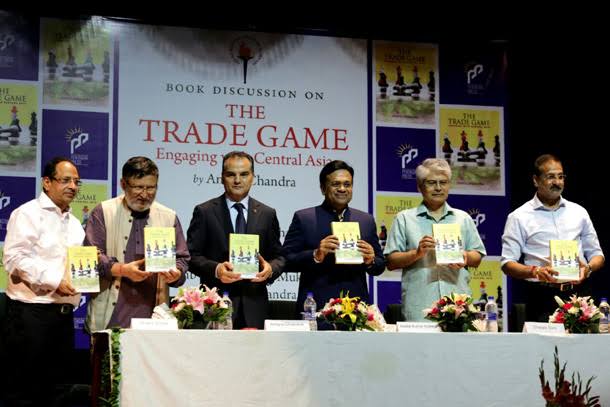
Renewed focus on India’s geopolitical and commercial involvement with Central Asia was brought about by the launch in New Delhi of the book “The Trade Game: Engaging with Central Asia” written by top bureaucrat Dr. Amiya Chandra (ITS). At the occasion, notable academics, diplomats, and politicians debated the region’s increasing geopolitical and commercial importance.
Nehru Memorial Museum and Library Director Shakti Sinha said that Central Asia was “too near yet too far” for India when she unveiled the book. Recalling Prime Minister Narendra Modi’s historic visit to all five Central Asian states, he emphasised the region’s abundant minerals, huge hydrocarbon reserves, and vital position as a gateway to Eurasia.
In his talk, Dr. Amiya Chandra outlined how commerce, infrastructure, and economic influence have transformed the old “Great Game” between world powers into a contemporary contest. He made the interesting observation that Turkey and China have both become major players, with China bolstering its position through massive investments in infrastructure and connectivity projects.
The author pointed out that India’s economic connection with Central Asia is still restricted, even though the country has centuries-old spiritual, cultural, and historical ties to the region. While acknowledging the need for increased policy attention, he highlighted India’s involvement in projects like the TAPI pipeline, the International North-South Transport Corridor (INSTC), the Chabahar Port, and the Shanghai Cooperation Organization (SCO).
To strengthen India’s position in the region, Dr. Chandra suggested putting more focus on connectivity, tourism, pharmaceuticals, IT, hospitality, and manufacturing. In addition to calling for quicker decision-making, more investment, and stronger public-private partnerships, he brought attention to the large disparity between China’s almost $50 billion in commerce with Central Asia and India’s around $1.5 billion in trade.
In his remarks, former Indian ambassador Ashoke Mukherjee emphasised the cultural and spiritual roots of India’s connection to Central Asia, and professor Sharad Soni voiced his hope that the book would serve as an invaluable resource for scholars, practitioners, and politicians engaged in the field.
Image: Diplomacyindia.com
Disclaimer: All news articles are sourced through valid sources, and Business Unlimited (BU) doesn’t have any exclusive rights on these pieces. If BU features any exclusive story or article, it will be marked as Exclusive Story.