


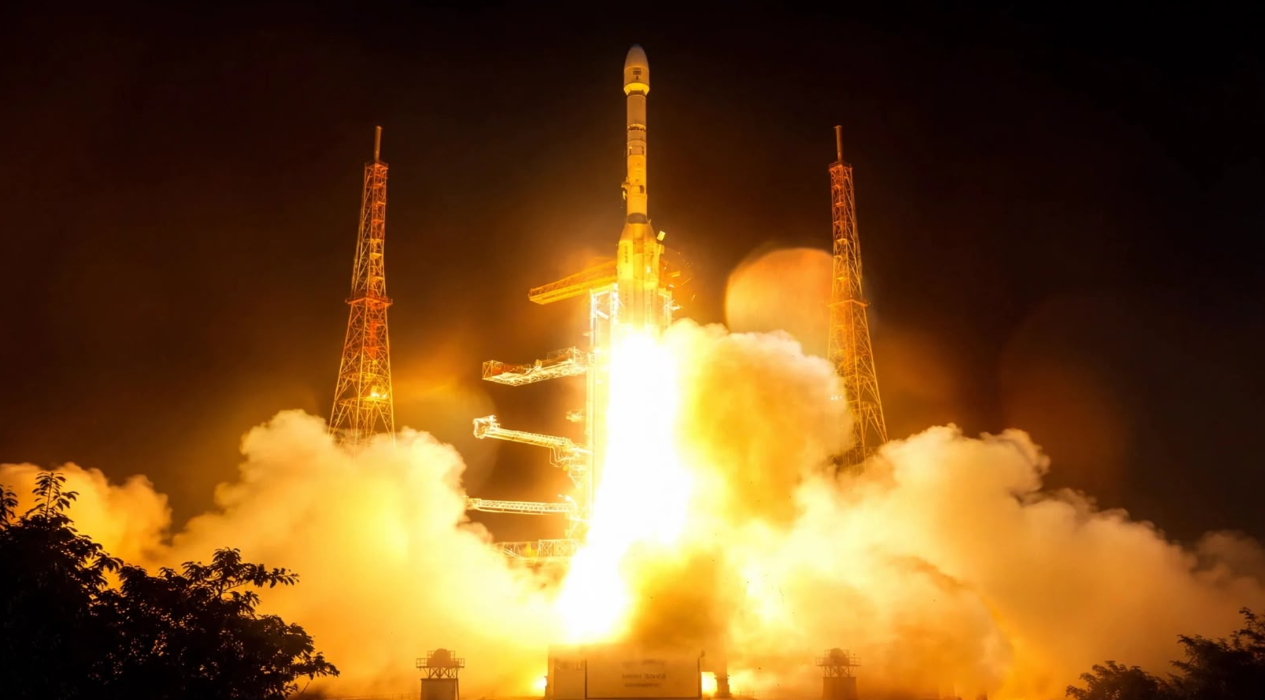
India’s first Polar Satellite Launch Vehicle (PSLV) to be fully manufactured by the domestic industry is expected to undertake its maiden launch in the first quarter of 2027, Indian Space Research Organisation (ISRO) Chairman V. Narayanan said on Tuesday.
Speaking to reporters on the sidelines of the India International Space Conclave in New Delhi, Narayanan said the rocket is being manufactured by a consortium of Hindustan Aeronautics Limited (HAL) and Larsen & Toubro (L&T) under a contract awarded by NewSpace India Limited (NSIL), ISRO’s commercial arm.
He said the consortium had been entrusted with the production of five PSLV rockets and that the first vehicle was getting ready for launch.
“Earlier it was built only by ISRO through the support of the industry, but now the L&T and HAL consortium has been given five PSLVs and the rocket is getting ready. The first launch is expected next year in the first quarter,” Narayanan said.
The five-rocket production contract is valued at ₹860 crore.
HAL-L&T Consortium to Manufacture Five PSLV Rockets
The transfer of PSLV manufacturing to the HAL-L&T consortium is part of the government’s broader strategy to expand private-sector participation in India’s space programme.
Under the arrangement, Indian industry will take on a larger role in manufacturing launch vehicles, enabling ISRO to focus on research, development and advanced space missions while strengthening domestic industrial capabilities.
The initiative also reflects the growing importance of public-private collaboration in meeting India’s expanding launch requirements and strengthening its position in the global space economy.
PSLV: ISRO’s Workhorse Launch Vehicle
The PSLV, often described as ISRO’s workhorse launch vehicle, is an expendable medium-lift rocket weighing approximately 320 tonnes.
Since its first flight in 1993, the launch vehicle has established a strong reliability record and has been extensively used to deploy Indian and international satellites.
Its capabilities include carrying payloads of up to 1,750 kg to sun-synchronous polar orbits at an altitude of 600 km, deploying satellites into geosynchronous and geostationary orbits, and supporting a wide range of Indian and international satellite launch missions.
The industry’s entry into full-scale PSLV manufacturing is expected to expand India’s capacity to produce launch vehicles and support growing demand for satellite deployment.
Gaganyaan Orbital Module Enters Final Stages
ISRO Chairman V. Narayanan also provided an update on India’s ambitious Gaganyaan human spaceflight programme, saying that work on the orbital module is progressing and has entered its final stages.
Describing Gaganyaan as a highly technology-intensive mission, he said efforts are underway to prepare the spacecraft for upcoming mission milestones.
His remarks came a day after ISRO astronaut Prasanth B. Nair said several procedures and operational protocols required for the mission are being developed from scratch.
Nair highlighted the need for a comprehensive ecosystem of safety, operational and recovery procedures to ensure astronauts can be sent into space and brought back safely.
The first uncrewed mission, Gaganyaan-1, is expected to carry an AI-enabled half-humanoid robot as ISRO validates spacecraft systems and mission procedures ahead of a crewed flight.
ISRO Seeks Greater Private-Sector Participation
Narayanan also emphasised that India’s expanding space requirements cannot be met by the government sector alone.
He noted that India currently has 56 space assets and will require many more communication and earth observation satellites in the coming years.
“We need to develop a lot of space assets for communication and earth observation. This cannot be done only by the government sector,” he said.
The ISRO Chairman called for stronger collaboration between the space agency and private companies to expand satellite infrastructure, improve manufacturing capabilities and support India’s growing presence in the global space economy.
The planned Q1 2027 launch of India’s first fully industry-built PSLV marks an important milestone in the country’s space-sector reforms. With HAL and L&T manufacturing five launch vehicles under an ₹860 crore contract, India is moving towards greater industrial participation in launch vehicle production. Alongside progress in Gaganyaan, the initiative reflects ISRO’s broader effort to expand national space capabilities through public-private collaboration.