

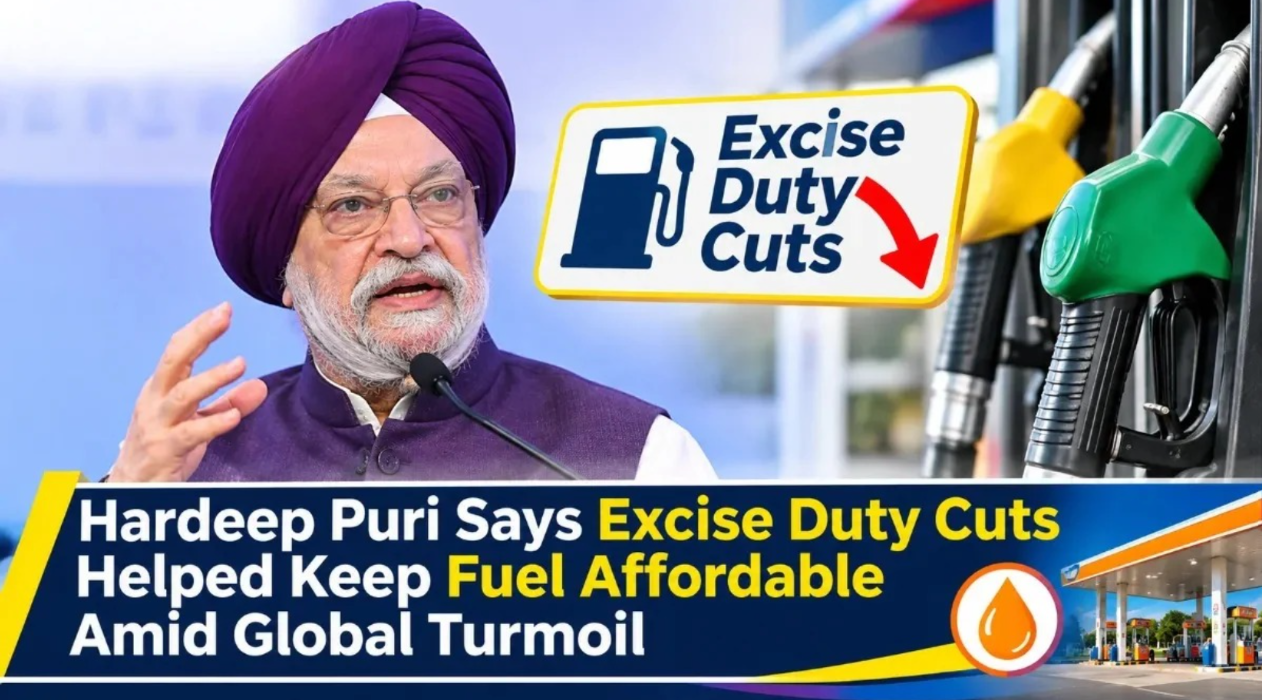
Union Minister for Petroleum and Natural Gas Hardeep Singh Puri said successive excise duty reductions helped keep petrol and diesel affordable despite volatility in global energy markets. Speaking on the sidelines of the FICCI Annual General Meeting and Annual Convention in New Delhi, he highlighted India’s expanded crude oil sourcing network, higher domestic LPG production and refining capacity as key measures supporting energy security during the Strait of Hormuz disruption.
Excise Duty Cuts Help Keep Fuel Affordable
Puri said the Central Government had reduced excise duties on fuel at different intervals over the past four years to protect consumers from sharp increases in international crude oil prices.
He cited three rounds of excise duty reductions in November 2021, May 2022 and March 2026 as measures intended to cushion consumers against fluctuations in global crude oil prices.
The minister also highlighted continuing uncertainty in international energy supplies, particularly disruptions associated with the strategically important Strait of Hormuz.
He said India’s preparedness was supported by advance planning and decisions to diversify energy supplies and strengthen domestic capabilities.
India Expands Crude Oil Sourcing to 41 Countries
Highlighting India’s energy security measures, Puri said the country had expanded its crude oil sourcing network from 27 countries to 41 countries. This diversification has helped strengthen India’s ability to manage disruptions in international energy supply chains.
He also highlighted the increase in domestic LPG production, which rose from approximately 34,000 tonnes per day to 55,000 tonnes per day.
India’s peak refining capacity stands at around 267 million tonnes per annum, providing an important foundation for meeting domestic fuel requirements and managing supply disruptions.
According to Puri, these measures form part of the country’s broader preparedness to address uncertainties in global energy markets.
Strait of Hormuz Disruption Tests Energy Security
Puri referred to the disruption caused by the closure of the Strait of Hormuz on February 28, 2026, describing it as a major challenge for global energy supplies.
He said India managed the situation through coordinated action across government departments, increased domestic production and continuous engagement with energy suppliers.
The minister also said discussions involving the United States, Iran and Gulf nations were underway regarding the reopening and smooth functioning of the strategically important waterway. India welcomed efforts aimed at restoring normal energy flows.
The Strait of Hormuz is a critical route for international energy trade, and disruptions can affect crude oil, natural gas and LPG supplies.
Domestic Production and Refining Capacity Strengthen Preparedness
The minister highlighted the importance of strengthening domestic energy production and refining infrastructure to reduce vulnerability to international supply disruptions.
The measures cited by him include expanding crude oil sourcing from 27 to 41 countries, increasing domestic LPG production from around 34,000 to 55,000 tonnes per day and maintaining peak refining capacity of approximately 267 million tonnes per annum. He also highlighted improved coordination among government departments and energy suppliers.
Puri said India’s response to the disruption demonstrated the importance of advance preparation, supply diversification and domestic production capabilities.
Make in India Opens Opportunities in the Energy Sector
Addressing the FICCI convention, Puri highlighted the opportunities emerging in India’s energy sector as the country moves towards greater self-sufficiency.
He said the sector’s growth, expanding investment opportunities and collaboration under the Make in India initiative were generating interest among industry stakeholders.
The minister emphasised that India’s energy development is creating opportunities for partnerships and investments while supporting the country’s broader energy security objectives.
India’s approach to managing global energy uncertainty combines fuel tax adjustments, diversified crude sourcing, increased domestic LPG production and expanded refining capacity. Puri’s remarks at the FICCI convention highlighted the importance of strengthening domestic capabilities while maintaining engagement with international energy suppliers.