


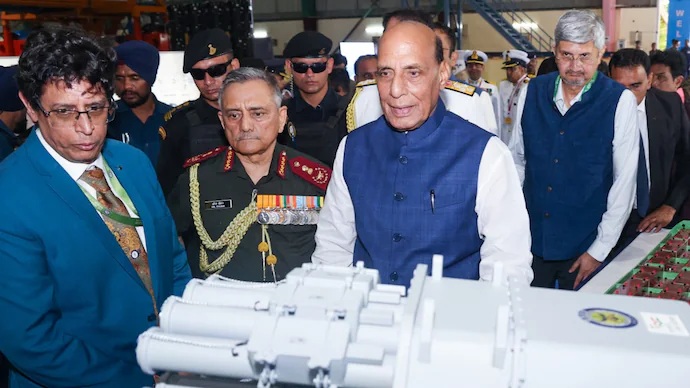
In Visakhapatnam, Andhra Pradesh, at the Naval Science & Technological Laboratory (NSTL), a premier facility of the Defence Research and Development Organization (DRDO), Raksha Mantri Shri Rajnath Singh lay the foundation stone for the new Large Cavitation Tunnel (LCT) on April 3, 2026. A huge stride towards technical independence would be made possible by the facility, which will greatly improve India’s naval research and testing capacities.
Raksha Mantri, speaking to the NSTL’s scientists, researchers, and personnel, claimed that India can position itself as a strong naval power and a leader in defence technology by designing, developing, and testing its equipment, systems, and sub-systems indigenously using its own resources. Until recently, we frequently had to seek important testing from outside, even after developing equipment, systems, and sub-systems. Things are about to shift. We will be able to advance propulsion systems, concentrate on reducing noise, and enhance stealth capabilities thanks to this facility, which is more than just an infrastructure project; it is an enabling system. He went on to say that it will be the backbone of future naval engineering and maritime defence system improvements, as well as the design and development of submarines and ships.
The project, according to Rajnath Singh, is a representation of Prime Minister Shri Narendra Modi’s determination to build Aatmanirbhar Bharat. Despite obstacles, the nation has attained full Aatmanirbharta in different sectors thanks to the combined efforts of domestic industry, academia, MSMEs, youth, and researchers, and he said that the government’s resolve to make India self-sufficient is inextricably bound up with the national security apparatus.
While Raksha Mantri was there, Dr. Samir V. Kamat, chairman of the DRDO and secretary of the Department of Defence Research and Development, informed her on the NSTL’s initiatives and programs. During his visit to the Seakeeping and Manoeuvring Basin, Rajnath Singh was able to see a remarkable exhibition of cutting-edge underwater systems, such as AUVs, decoys, torpedoes, and naval mines.
Showing off its increasing competence in autonomous maritime operations and next-generation undersea warfare technology, India put its emphasis on defence systems that are future-proof with a live demonstration of a swarm of man-portable AUVs. Additionally, Raksha Mantri examined a number of critical items developed as a result of the Naval Systems Materials cluster labs’ spin-off technologies following Operation Sindoor.
As NSTL conducts research and sets standards in several areas such as torpedo systems, underwater mines, decoys, and AUVs, Rajnath Singh commends the organization for helping India become a formidable naval power. In addition, he praised the ongoing research into lithium-ion batteries and the demonstration of swarm technology, stating that these areas will be critical for future military readiness.
In order to strengthen the country’s security infrastructure, Raksha Mantri urged NSTL to keep working diligently towards nation-building. Sailors’ self-assurance and morale are improved by these systems and technologies. “The operational effectiveness of the defence forces is significantly enhanced by reliable and robust technological support,” he stated.
Among the dignitaries in attendance were General Anil Chauhan, Chief of the Defence Staff, Admiral Dinesh K. Tripathi, Vice Admiral Sanjay Bhalla, Flag Officer Commanding-in-Chief, Eastern Naval Command, and others.