


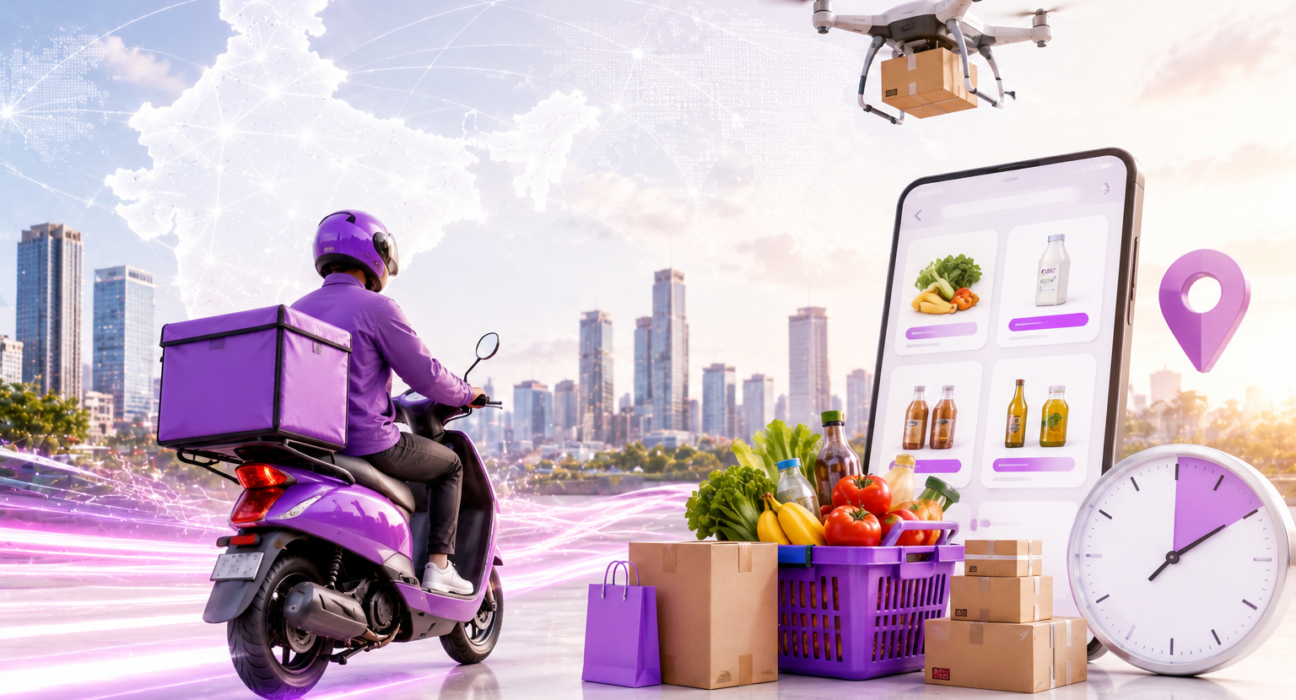
When some people think about retail innovation around the world, they picture Tokyo or Silicon Valley. But Bengaluru’s IT clusters, Delhi’s metro corridors and Mumbai’s bylanes are all being carefully built to become the greatest disruptive force in global business. This is happening more and more . India is currently undergoing a rapid growth in the fast commerce industry, also known as Q-commerce. Developed economies are scrambling to catch up with the competition in rewriting the norms of modern buying.
Q-commerce was introduced during the COVID-19 outbreak. This online marketplace says that it can provide staples like food, medicine, personal care products and other necessities in less than 30 minutes. It started as a way for city dwellers to get out of their houses fast, and blossomed into a revolution in the retail business. The gross order value of India’s e-commerce company saw a staggering twenty-fourfold surge from 2022 to 2025, reaching over $7.4 billion in fiscal year 25. India is set to be one of the fastest growing e-commerce markets in the world with a total estimated at US$ 9.95 billion by 2029 and a growth rate of 17% expected in 2025, the highest in the world.
To put this in perspective, the US market for Q-commerce is predicted to grow at only 8.2% each year despite the fact that it caters to wealthy people. The countries of Germany and France lag far behind. India is much ahead compared to other countries in terms of a much more developed retail infrastructure and a more sophisticated digital maturity.
Why is Q-commerce concept working in India? In order to achieve success, it is vital to have a dense population, affordable logistics expenses and sophisticated operational innovation. The “dark store” concept was originally implemented by Indian e-commerce companies like Blinkit, Zepto and Swiggy Instamart. The plan is to have hyper-local micro-warehouses located within two to three kilometres of dense residential clusters. Through the help of these fulfilment centers and the inventory that they have carefully picked, platforms can reliably offer and deliver the 10-to-30 minute guarantee.
The study forecasts a significant rise in demand for dark retail space in India, from 24 million sq ft in 2023 to 37.6 million sq ft by 2027. It is fairly obvious that this rapid expansion of infrastructure is happening. These platforms have been able to gain profit using AI-powered demand forecasting, dynamic route optimisation and real-time inventory management. This is different from most Western platforms, which have been losing money.
This is a different one unlike the previous markets that have been made. Some Western Q-commerce companies including Getir, Gorillas and GoPuff have either withdrawn from key areas altogether, merged with other companies or scaled down operations substantially due to unsustainable unit economics. The low order frequency, the high personnel costs and the low population density made it seem utterly impossible to reach the goal of profitability. India on the other hand has developed a profitable, scalable model that finds a fair middle ground between front-end and back-end efficiency and value to the consumer.
In 2024, almost ten percent of all online retail spending in India was made via Q-commerce platforms, while more than two-thirds of all online grocery orders were placed through these platforms. Four out of the five most popular food and grocery apps in the world are Indian — Swiggy, Blinkit, Zepto and Zomato — which speaks volumes about the faith people have in these applications and how they are used in India.
Beyond the commercial figures, there’s a big social aspect to the story of India’s Q-commerce. Logistics, warehouse and delivery services businesses are predicted to provide an estimated 2.4 million blue-collar jobs by 2027. This will give workers in these locations a stable source of income. This is where Q-commerce has the double purpose of providing economic growth and employment, something very few tech-driven companies can claim.
The Q-commerce company in India is a case study in retail innovation, but it is more than just a local success story. It is expected to have an annual growth rate that would reach forty percent till the year 2030. Be it through its innovative use of dark shops and AI logistics or its capacity to make large-scale profits in a price-sensitive market, India is a prime example of the power of creation in response to necessity.
The next delivery that reaches the doorstep of an Indian within fifteen minutes may hold the key for developed economies who are still seeking a successful rapid commerce strategy. That might not be the case in Berlin or San Francisco, but it could be in other locations.