

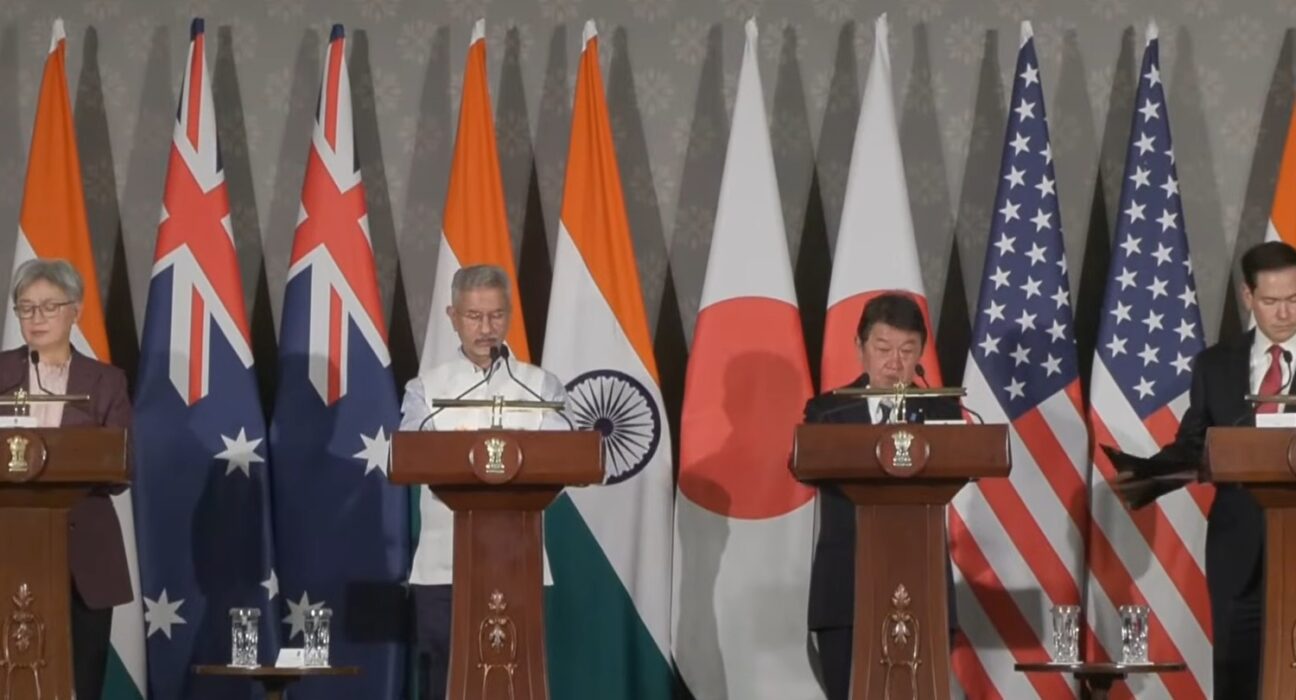
On Tuesday, the four foreign ministers of the Quadrat unveiled a number of measures to improve economic stability and supply chain resilience in the Indo-Pacific region, and they stepped up collaboration on trade, energy security, and maritime connectivity.
Foreign Ministers S. Jaishankar of India, Penny Wong of Australia, Toshimitsu Motegi of Japan, and Secretary Marco Rubio of the United States participated in the negotiations, which were hosted by India, the current Quad chair.
This rising emphasis on operational and economic cooperation is reflected in the five major projects that the four nations have launched, which address maritime surveillance, port infrastructure, vital minerals, energy security, and regional maritime coordination.
In his address to the gathering, Jaishankar predicted that the Indo-Pacific region would have a pivotal role in the future of international trade, finance, and energy.
In addition, he emphasised the importance of working together to combat terrorism, saying that democracies must stand firm in the face of terrorist threats and defend their right to self-defence.
In light of geopolitical unpredictability and worries about global energy flows, the ministers deliberated methods to create more robust supply chains and secure maritime routes.
US Secretary of State Marco Rubio characterised the Quad as a “partnership of action,” highlighting the bloc’s shift from discussing policies to actually putting them into practice.
Concerns about the Strait of Hormuz and regional energy security, as well as the possible effects of tensions in West Asia on energy markets, were brought up by Australian Foreign Minister Penny Wong.
The summit, according to Japanese Foreign Minister Toshimitsu Motegi, demonstrated the Quad’s determination to promote an open and free Indo-Pacific in the face of changing geopolitical dynamics on a global scale.
With the increasing geopolitical and economic importance of the Indo-Pacific region, the Quad grouping—which includes Japan, India, the United States, and infrastructure—has been increasing its collaboration in various areas, including commerce, technology, infrastructure, maritime security, and supply chain networks.
Image Credit: The Hawk
Disclaimer: All news articles are sourced through valid sources, and Business Unlimited (BU) doesn’t have any exclusive rights on these pieces. If BU features any exclusive story or article, it will be marked as Exclusive Story.