


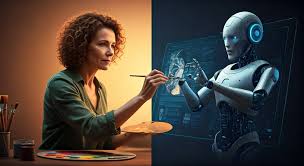
Sam Altman, CEO of OpenAI, stated in 2025 that AI agents would begin operating with their
full potential. Many businesses, companies, and startups welcomed the idea and rushed to
utilize AI chatbots as a replacement for human thinking and creativity. However, Altman
himself made a balanced point of view, saying, “AI won’t replace humans. However, those
who do not use AI will be replaced by humans who are advanced and know how to work with
AI”. The difference is important. Businesses are realizing that reality is much more
sophisticated.
Expensive shifts have often resulted in a hurry to digitize. Klarna fired hundreds of its
workers to save millions of dollars in a year. However, customer service quality also
declined, which resulted in an expensive rehiring. Thousands of jobs were also eliminated by
IBM’s use of modernization of HR processes; further, many jobs were later opened when AI
could not perform tasks requiring judgement. After replacing freelance translators with AI,
Duolingo modified course after users criticised. Business Insider claimed that even advanced
AI agents only complete a small portion of the jobs they are given.
AI at times can learn patterns, but it has no idea of what is like to believe. It can calculate and
analyse, but it can’t care. This is the basic difference: AI can create something that sounds
good logically, but it is unable to awaken the strong to make a meaningful statement.
A shocking result came from Harvard Business School research involving entrepreneurs,
which was that AI was unable to differentiate between good and bad ideas on its own.
Motivated entrepreneurs boosted their working performance through the usage of
recommendations by AI, such as choosing the best breed of chicken or purchasing a
generator for electricity blackouts. Generic recommendations like “Lower prices,” which
failed frequently, were followed through poor judgment.
AI processes data but lacks deep cultural and contextual understanding. As Oakwood
International notes, AI-generated content often misses cultural nuances and fails to connect
with diverse audiences. A machine can compose music that follows harmonic rules, but it
cannot capture the emotional resonance of a human composer drawing from lived experience.
Though AI can understand the data, it may not be socially aware of the understanding. As
Oakwood International notes, AI generated content often misses out cultural differences and
fails to connect the types of audiences. A machine can compose music that will follow all the
harmonic rules, but it may not be able to capture the emotional angle or in simple terms, the
listener might not be able to connect emotionally if AI is composing music.
Emotions, feelings, and experiences are the sources that come through human creativity. In
the case of AI, Innovation Comes through finding patterns that already exist. At times, AI is
capable of creating original combinations of well-known concept, though it cannot give
something out of the box. Creativity, which at times can come from the human mind.
Whereas, on the other hand, human creativity is rich and has variety.
But not everyone gains equally from this partnership. According to the Harvard study, access
to AI improved the performance of high-achieving businesses while negatively affecting
those who performed poorly. Why? While less-talented users followed general, occasionally dangerous recommendations, proficient users used AI’s unique insights. Stronger debaters
used ChatGPT more successfully, whereas lesser debaters benefited little, according to a
debate study conducted by the London School of Economics. AI exacerbates already-existing
judgment disparities rather than democratizing excellence.
The best advice is still Sam Altman’s: AI won’t take the place of people. However, those that
don’t will be replaced by humans who master AI and integrate its analytical capabilities with
human judgment, empathy, and creativity. The best employee is not an algorithm, as
demonstrated by Klarna’s expensive reversal to Harvard’s entrepreneurs. The person who
knows how to use one is a human.
At last, the best advice is still from Sam Altman’s “AI won’t take Place of People. However,
those that don’t will be replaced by humans who master AI and integrate its analytical
Capabilities with human judgment, empathy, and creativity. At times, it cannot be said that
Best employees the algorithm as shown by Klarna’s Expensive reversal to Harvard’s
Entrepreneurs. At last, can be said that the person who knows how to use it effectively to get
the work done is a human.
By Tanish Mahan Gulati