

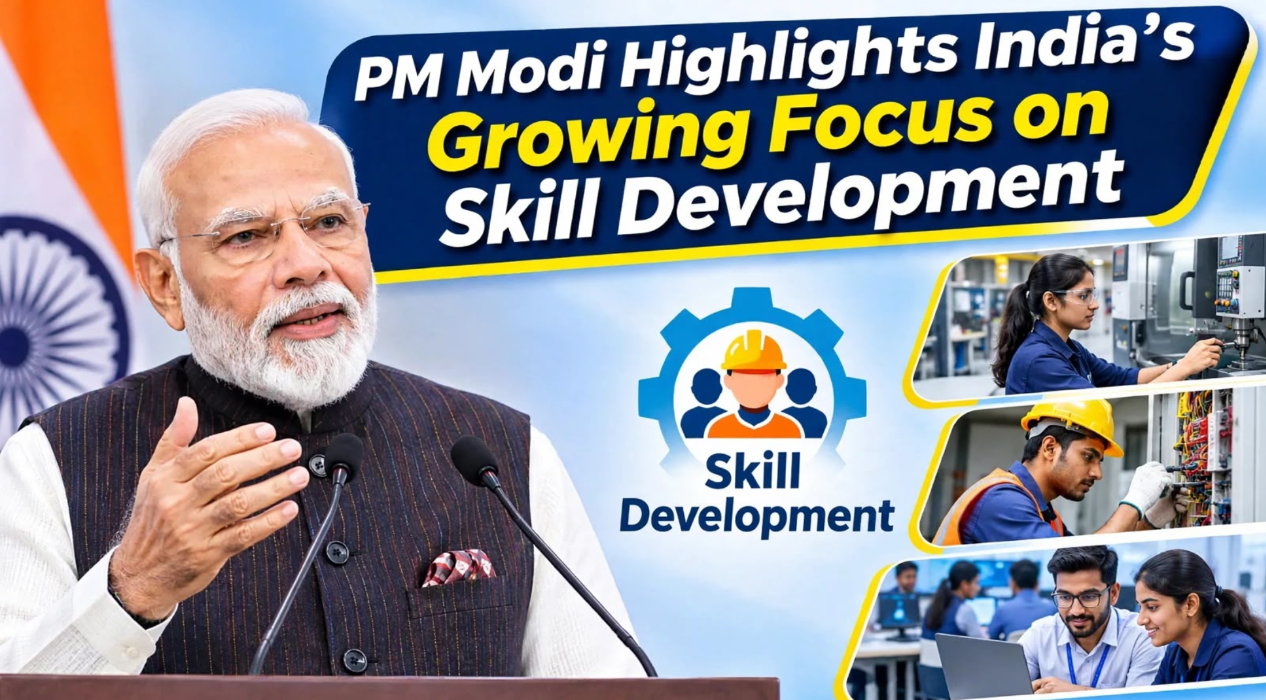
Prime Minister Narendra Modi has highlighted India’s growing emphasis on skill development, industry-linked training and preparing young people for emerging employment opportunities in the age of artificial intelligence (AI).
The Prime Minister’s Office (PMO), in a post on X, said India is taking its skilling journey to the global stage. The post referred to an article by Union Minister of State for Skill Development and Entrepreneurship Jayant Chaudhary, which highlighted WorldSkills Asia 2027, the PM-SETU initiative to upgrade Industrial Training Institutes (ITIs), and efforts to strengthen industry-linked training.
The article also examined how these initiatives are preparing India’s youth for new opportunities in the age of AI and making skill development a preferred career pathway.
WorldSkills Asia 2027 to Put India’s Skilling Ecosystem on Global Stage
Chaudhary highlighted the significance of India hosting WorldSkills Asia 2027 for the first time.
He noted that just a year earlier, India had sent its first-ever contingent to participate in WorldSkills Asia. The country is now preparing to host a WorldSkills event, reflecting the growing international recognition of its skilling ecosystem.
The minister said Indian civilisation has traditionally celebrated craftsmanship and the contribution of skilled workers. However, for many families, vocational education and technical training continue to remain secondary choices compared with conventional academic degrees.
He argued that a good technical qualification can provide a more direct route to employment and professional fulfilment.
Hosting an international skills competition, he said, would demonstrate that the expertise and craftsmanship of India’s youth are valued on the global stage.
AI Is Increasing Demand for Skilled Workers
The article highlighted the changing employment landscape as businesses increasingly adopt artificial intelligence.
While AI is transforming workplaces, demand for highly skilled workers is also increasing. Recent graduates, however, are facing a challenging job market.
According to ADP’s People at Work 2026 study, 80% of employees in India use AI several times a week, while 41% use it nearly every day. The article noted that India’s reported AI usage levels were the highest among the markets surveyed.
It also cited projections from the World Economic Forum, which expects 170 million new jobs to be created globally by 2030, while 92 million existing jobs could be displaced. The report also estimates that 59 out of every 100 workers will require training by 2030.
The article further referred to a study published by The Economist, which estimated that AI had created approximately one million jobs in the United States, compared with around 200,000 layoffs attributed to the technology.
Many emerging employment opportunities are linked to the physical infrastructure supporting AI. These include roles for electricians, technicians and installers involved in building and maintaining data centres.
The article emphasised that AI is creating new requirements for skilled manpower, making technical education and specialised training increasingly important.
PM-SETU to Upgrade 1,000 ITIs with ₹60,000 Crore Outlay
A major component of India’s skilling strategy is the Pradhan Mantri Skilling and Employability Transformation through Upgraded ITIs (PM-SETU) initiative.
Launched by Prime Minister Modi at last year’s convocation, the programme has an outlay of ₹60,000 crore and aims to upgrade 1,000 Industrial Training Institutes across the country.
According to Chaudhary’s article, the initiative is moving from planning towards implementation, with investment plans for 15 clusters approved.
Each cluster will have an anchor industry partner to strengthen alignment between vocational training and industry requirements.
Under the proposed model, ITIs will develop corresponding workshops and laboratories, while employers will gain access to trained talent through industry-linked training facilities.
The approach aims to bridge the gap between vocational education and employment requirements by ensuring that training programmes reflect the skills demanded by industry.
Industry-Linked Training to Prepare Youth for Emerging Jobs
The government’s focus on modernising ITIs and strengthening industry partnerships aims to prepare young people for changing employment requirements.
With the expansion of AI infrastructure, data centres and advanced technologies, demand is expected to grow for technicians, electricians, installers and other skilled professionals.
Initiatives such as PM-SETU and WorldSkills Asia 2027 are intended to raise the profile of vocational education, improve training infrastructure and provide young people with opportunities to compete in emerging sectors.
India’s growing emphasis on skill development reflects the need to align education and training with a rapidly changing employment market. Through WorldSkills Asia 2027, PM-SETU and industry-linked ITI clusters, the government is seeking to strengthen vocational education and prepare the workforce for opportunities emerging from AI and technological transformation.